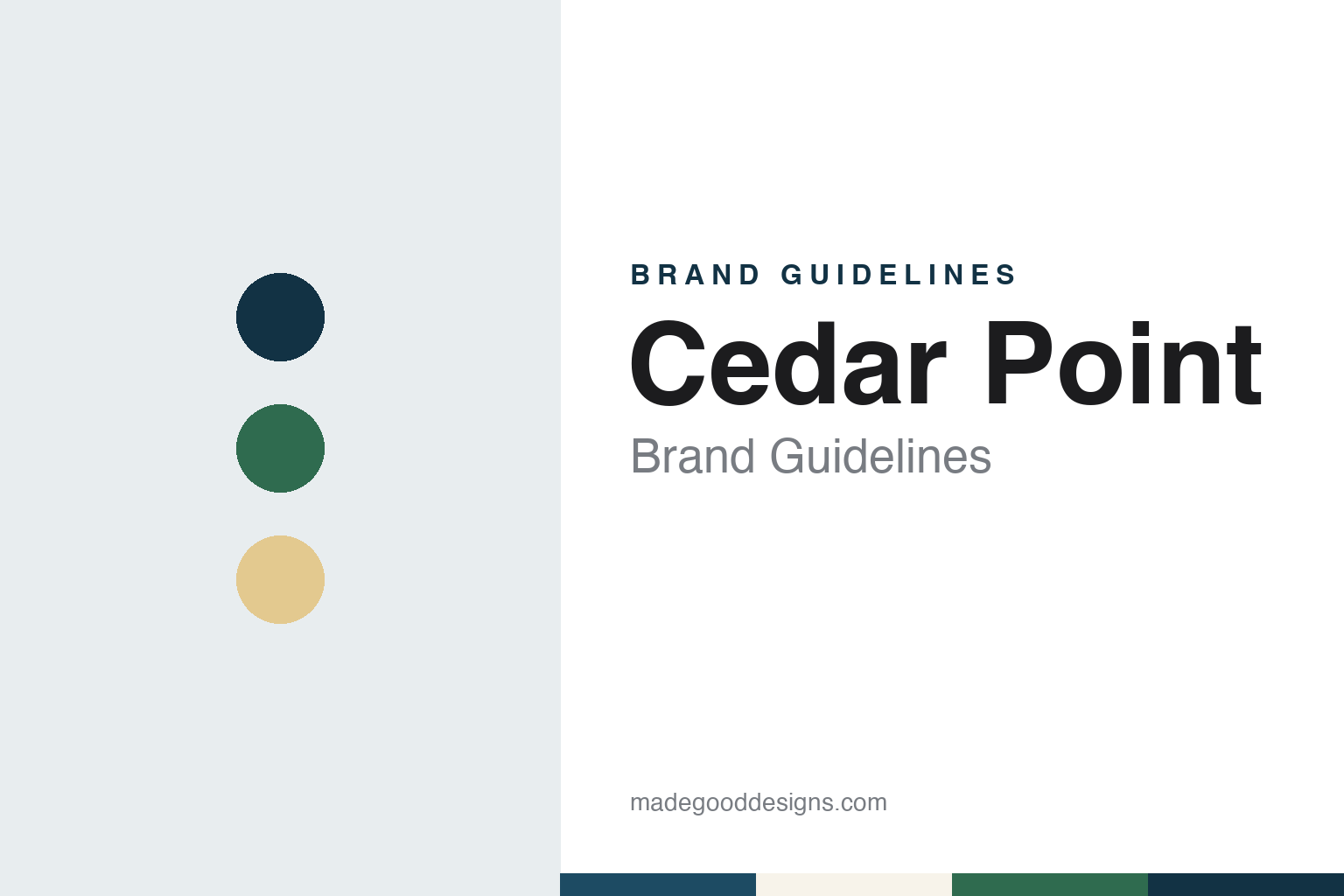
Cedar Point Brand Guidelines
The Lake Erie peninsula park that began with a bathhouse.
Aa
Two constants: a lake blue, cedar green and beach sand palette and a resort-era serif register. Abstract homage — not a Cedar Point mark; no logo, ride or character is reproduced.
A beach on Lake Erie
A bathhouse, a beer garden and a steamboat line.
Cedar Point began as a beach. The Ohio magazine Lake Erie Living, in a history published in its 2020 travel guide for the park’s 150th season, says nineteenth-century editorials in local newspapers had urged someone to build a bathhouse on the peninsula’s Lake Erie shore. In 1870, it says, Louis Zistel — a German immigrant who ran fishing boats and had held a government contract to carry Confederate prisoners of war to nearby Johnson’s Island — built the bathhouse, along with a beer garden with a dance floor. English Wikipedia adds that the peninsula took its name from its cedar trees and that Zistel carried passengers from Sandusky on his boat, the Young Reindeer.
Water shaped the place from the start. The attractions could be reached only by boat, and Lake Erie Living quotes Jim Futrell, historian of the National Amusement Park Historical Association, on the point: “Cedar Point isn’t a trolley park. It’s a steamboat park.” Wikipedia traces the resort’s growth through the 1870s and 1880s: James West opened bathhouses in 1878; Benjamin F. Dwelle and Captain William Slackford leased land in 1882 and added bathhouses, a dance hall and wooden walkways; and in 1888 a partnership led by Dwelle opened the Grand Pavilion, a two-storey theatre and concert hall that Wikipedia says still stands in the park.
Rides followed the resort. Wikipedia dates a water toboggan into the lake to 1890 and electricity to 1891, and both sources date the Switchback Railway roller coaster to 1892. Lake Erie Living says that by the middle of that decade the park faced financial trouble, and that the Indiana businessman George Boeckling bought it and set it right: he built a carousel, bought new bathing suits for swimmers to hire and in 1905 opened the Hotel Breakers. The magazine says the Depression and the Second World War hit the park hard; the park leaned on its coliseum, a hall with a bar, concerts and dancing, to keep going into the post-war years.
Colour
New owners, a partnership named after two parks, and a merger.
By the late 1950s, Lake Erie Living says, the park was so run-down that plans were being made to close and redevelop it, until public outcry kept it open; the magazine notes that Ohio governor Frank Lausche said the state would buy it if it had to. New owners Emile Legros and George Roose then renovated the park, taking cues from Disneyland, which had opened in 1955, and from Six Flags Over Texas, which opened in 1961. The park hired Truman Woodworth, who had helped design Disneyland, added rides such as Cadillac cars and a monorail, and put its staff in uniforms; Lake Erie Living dates the park’s tradition of hiring Ohio college students to the same period.
The company around the park grew from there. Wikipedia says Cedar Point, which had operated independently, bought the Valleyfair amusement park in Shakopee, Minnesota, in 1978, and that the parent partnership formed in 1983 was named Cedar Fair — “Cedar” for Cedar Point and “Fair” for Valleyfair. Cedar Fair went on to acquire other parks; Wikipedia says its purchase of Knott’s Berry Farm in 1997 brought the licence to use the Peanuts characters, and Cedar Point later opened children’s areas called Camp Snoopy, in 1999, and Planet Snoopy, in 2008.
Cedar Fair remained based in Sandusky until the merger with Six Flags. The Associated Press, in a report carried by FOX 4 Dallas–Fort Worth on 2 July 2024, said the merger of Cedar Fair and Six Flags had been completed that week, that the combined Six Flags Entertainment Corporation is headquartered in Charlotte, North Carolina, and that it keeps significant finance and administrative operations in Sandusky, where Cedar Fair was based. The AP quoted the announcement as saying each park would retain its legacy branding, with no changes to park names planned. Cedar Point has been owned by Six Flags Entertainment Corporation since then, and Wikipedia describes it as having been the flagship park of the Cedar Fair chain before the merger.
Typography
Design and documentation.
A theme-park identity is read on the move. Visitors meet it first on a highway sign or a car-park pole, then at the entrance gate, and the same name has to work at the size of a building and the size of a ticket stub. That is why park marks tend to be built from bold, simple shapes that survive distance, glare and a quick glance from a moving car.
Inside the gates, the park map becomes the identity’s busiest document. It has to sort themed areas, paths, food stops and facilities into something a family can follow with one hand, so colour coding, numbered keys and a small set of pictograms usually carry more weight than the logo itself.
Characters and mascots add a second layer. A costumed figure, a cartoon on a cup or a face on a plush toy gives the brand a personality that a wordmark alone cannot, and it travels well onto merchandise.
Ride and area signage then borrows the theme of each zone, from rough timber lettering to bright fairground type, while souvenir packaging, bags and photo folders carry the main mark home. For designers, the lesson is a system that flexes by zone but still reads as one place.
Aa
A resort-era serif — the register of a lakeside hotel sign and an old bathing-beach poster. (Specimen set in Playfair Display, a serif STAND-IN; NOT the Cedar Point logo.)
Cedar Point
A place name, a beach and a hotel that outlasted its owners.
Above all, the Cedar Point identity is a place name. It describes a peninsula of cedar trees on Lake Erie, and it was in use long before there was a park; the business took its name from the land, and Cedar Fair later took half its own name from the park. That chain of naming runs in one direction — from geography to resort to company — and it explains why the park’s name has outlasted several owners, including the company that borrowed it.
The setting is the other constant. Lake Erie Living quotes the park’s general manager Jason McClure, in the post since 2014, saying the park exists because of its location and calling the mile-long beach a natural resource that cannot be manufactured. The resort buildings carry the same continuity: Wikipedia says the Grand Pavilion of 1888 still stands and that the Hotel Breakers, opened in 1905, remains the closest of the park’s resorts to the gates. Wikipedia also notes the park’s nickname, “America’s Roller Coast”, and an autumn event called HalloWeekends, introduced in 1997.
Ride names add local colour. Lake Erie Living says the Blue Streak roller coaster, opened in 1964, took its name from the Sandusky High School football team. The Peanuts characters, licensed through Cedar Fair, give the children’s areas their identity, and the 2024 merger placed the park under a corporate name, Six Flags, while leaving its own name on the gate. For a designer, the park’s history shows a lakeside resort vocabulary — a beach, a pavilion, a grand hotel — sitting alongside the steel and paint of a modern ride park.
For a design guide, Cedar Point shows how a place name and a resort setting can carry a park through more than a century of new owners, new rides and a merger that put a different company name above it. Compare it with Six Flags, the company that has owned it since 2024, and Knott’s Berry Farm, the park whose 1997 purchase by Cedar Fair brought the Peanuts licence. For this guide we use lake blue, cedar green and beach sand with a serif, an unofficial interpretation; no product or logo is reproduced.
Explore & save
Keep Cedar Point’s identity on hand — save it to a board in the Made Good inspiration library.
Cedar Point identity set
Pin the Cedar Point lake blue, cedar green and beach sand palette and the resort-era serif register to your own board.