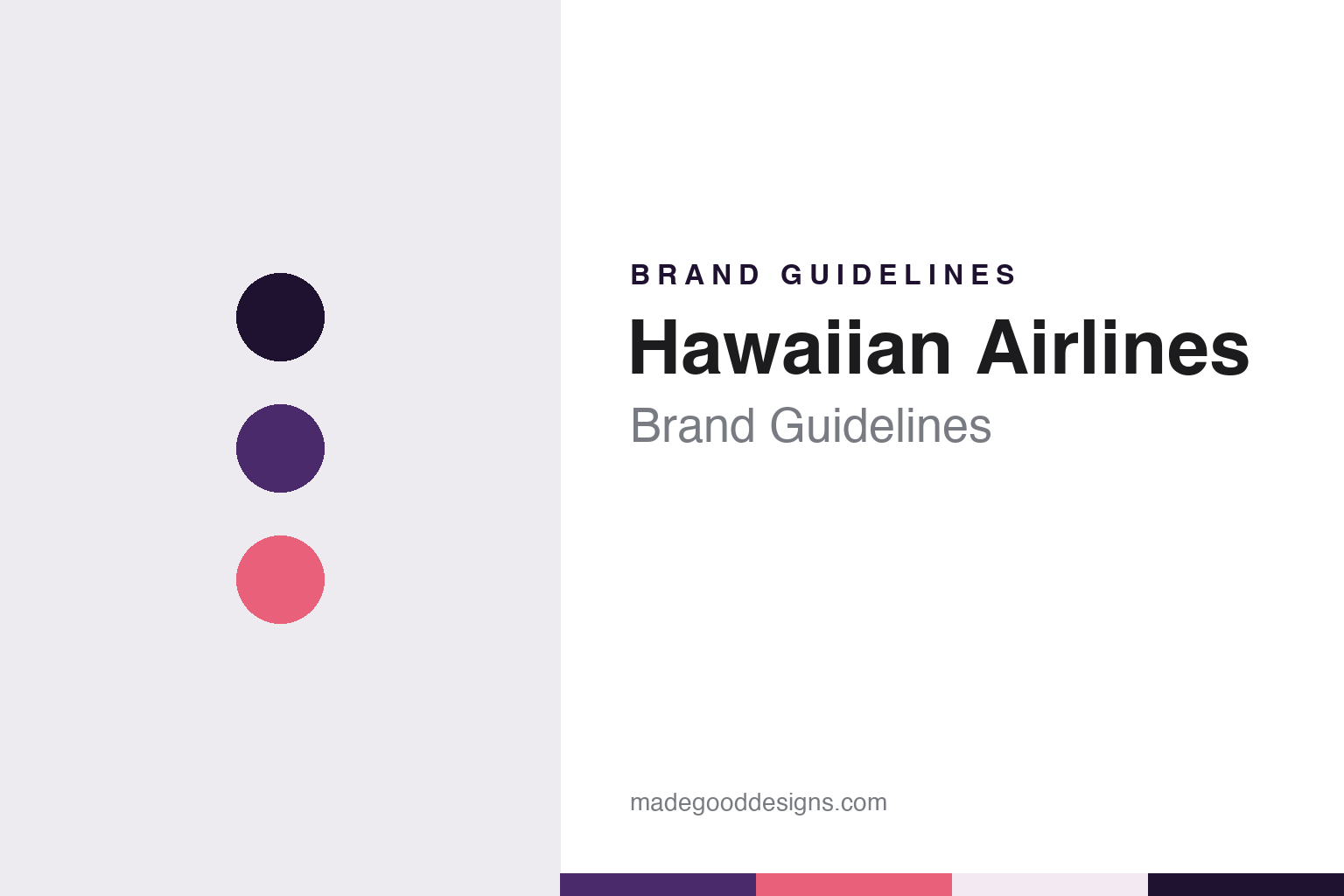
Hawaiian Airlines Brand Guidelines
Pualani, the maile lei and the Inter-Island Airways story.
Aa
Two constants: a Hawaiian purple and pink palette and a Warm serif register. Abstract homage — not a Hawaiian Airlines asset or mark; no aircraft, logo or livery is reproduced.
Inter-Island Airways
A steamship company takes to the air.
Hawaiian Airlines began as Inter-Island Airways. English Wikipedia says the company was incorporated on 30 January 1929 as a subsidiary of the Inter-Island Steam Navigation Company, the business that ran ships between the islands, and that it began operating on 6 October 1929 with sightseeing flights over Oʻahu in a single-engined Bellanca CH-300 Pacemaker. Its name in the Hawaiian language today is given as Hui Mokulele o Hawaiʻi.
The Honolulu Star-Bulletin told the story of that first aircraft in July 2009, when the airline announced that the Bellanca was being restored and would come home to Hawaii. The paper reported that the plane was bought by Inter-Island Airways in 1929 and took residents on aerial tours over Oʻahu, and it quoted Keoni Wagner, then the airline’s vice president of public affairs, saying that the founders “started with this plane because they wanted to get people used to the concept of flying.”
Scheduled service followed a month after the tours. The Star-Bulletin reported that Sikorsky S-38 amphibious aircraft joined the Bellanca and that Inter-Island Airways began scheduled flights between the islands on 11 November 1929; English Wikipedia describes that first route as Honolulu to Hilo, with stops on Molokaʻi and Maui.
The name changed in October 1941, when Inter-Island Airways became Hawaiian Airlines, according to both the Star-Bulletin and English Wikipedia; Wikipedia gives the date as 1 October 1941 and ties it to the retirement of the Sikorsky flying boats in favour of Douglas DC-3 landplanes.
Colour
The face on the tail.
The airline’s best-known mark is a face. English Wikipedia says that from 1973 the logo featured the face of Leinaʻala Drummond, Miss Hawaii 1964, who had worked for the airline as a flight attendant, and CNN Business reported in September 2023 that the image, known as Pualani — Hawaiian for “flower of the sky” — had been used since 1973 “in a few variations,” most recently refreshed in 2017. In a video about the 2017 refresh, CNN reported, employees described the mark as “not just a picture of a woman with a flower.”
The face has been redrawn as the fleet changed. English Wikipedia says Pualani had appeared on the airline’s Douglas aircraft since the 1970s, and that when Boeing 717s and 767s arrived around the start of the 2000s they carried an updated rendition by the local artist Mauriel Morejon. Beneath her, Wikipedia says, a silver maile lei with woven pakalana flowers was wrapped around the fuselage.
A broader change came on 1 May 2017, when, English Wikipedia says, the airline revealed a new logo and livery. Its own brand-refresh page, archived in 2020, described a “refreshed logo, livery and overall creative look that honors Pualani.” The company said Pualani was now “framed by the rising sun,” that she sat in “an even more prominent position on the tail,” and that purple would feature “more prominently in our color palette.” It described the maile lei, “one we use for important occasions,” as wrapping the body of the aircraft “to symbolize the warm welcome we extend to our guests,” and as a sign of how traditions “bind us together as an ʻohana (family).” We give those as the company’s own descriptions.
The same year brought a food brand. English Wikipedia says that in 2017 main-cabin guests on flights between Hawaii and the western United States began to receive meals under the Pau Hāna Café name — from the Hawaiian phrase for finished work — and that in December 2017 the airline announced a partnership with Mana Up, a Hawaii accelerator for local consumer brands, to bring more locally made products on board.
Typography
Livery, cabin and signage.
An airline’s identity is carried by a wide range of surfaces. The livery is one of them: the paint scheme that runs along the fuselage, the colour of the belly and engines, and the way the name is set along the side. The tail fin is a prominent single mark, seen from the terminal window, on the apron and in the sky, and many carriers use it for a symbol, a portrait or a pattern rather than the name itself.
Inside, the identity continues in the cabin: seat fabrics and headrest covers, bulkhead panels, lighting colours, cups, napkins and the cards in the seat pocket. On the ground it appears in airport signage — check-in desks, gate screens, boarding passes, baggage tags and the uniforms of staff.
Each guide sets out what can be checked about the brand behind those surfaces — who founded the airline, who owns it now, how its name and marks have changed — and marks plainly what rests only on the company’s own word.
Aa
A warm serif — the voice of “flower of the sky.” (Specimen set in Fraunces, a serif STAND-IN; NOT the Hawaiian Airlines logo.)
Hawaiian Airlines
A brand kept after a merger.
The identity also reaches the ground. In March 2011 the Honolulu Star-Advertiser reported that Hawaiian was redesigning its two ticket lobbies at Honolulu’s airport, replacing its traditional check-in counter with circular check-in islands of agent-assisted self-service stations, and sending checked bags along a single conveyor belt that combined agricultural inspection, security screening and loading. The airline said the layout came from two years of research and motion studies.
English Wikipedia records Chapter 11 filings in September 1993 and March 2003, with the airline emerging in September 1994 and June 2005. In May 2021 it ended ʻOhana by Hawaiian, the separate inter-island brand it had used for smaller turboprop flights, Wikipedia says.
Ownership changed in the 2020s. Civil Beat reported on 4 December 2023 that Alaska Airlines’ parent had agreed to buy Hawaiian and that both companies planned to keep the Alaska and Hawaiian brands while running them as a joint operation. English Wikipedia says the deal was completed on 18 September 2024, so Alaska Air Group has owned Hawaiian since September 2024; Wikipedia adds that Alaska had promised Hawaii residents to maintain the Hawaiian Airlines brand.
The old airline code was retired the next year. Hawaii News Now reported that the last flight under Hawaiian’s own HA callsign, HA866 from Pago Pago in American Samoa, landed in Honolulu on 29 October 2025 and was greeted with a hula; the new callsign was already in use on bookings and airport signs, and the airlines said guests would continue to enjoy “distinct Alaska and Hawaiian brand experiences.” English Wikipedia says Hawaiian-branded flights moved from the HA designator to Alaska’s AS code in April 2026 and are marketed as “operated by Alaska as Hawaiian Airlines.”
For a design guide, Hawaiian Airlines shows how a single portrait on a tail fin can carry a brand through a renaming, two redesigns and a change of owner. Compare Alaska Airlines, its sister airline under the same parent, and Pan Am, another American airline guide. For this guide we use a purple, a hibiscus pink and an orchid tint with a serif, an unofficial interpretation; no product or logo is reproduced.
Explore & save
Keep Hawaiian Airlines’s identity on hand — save it to a board in the Made Good inspiration library.
Hawaiian Airlines identity set
Pin the Hawaiian purple and pink palette and the Warm serif register to your own board.