Boost Mobile Brand Guidelines
The prepaid name that travelled from Australia to Nextel, Sprint, Dish and EchoStar.
Aa
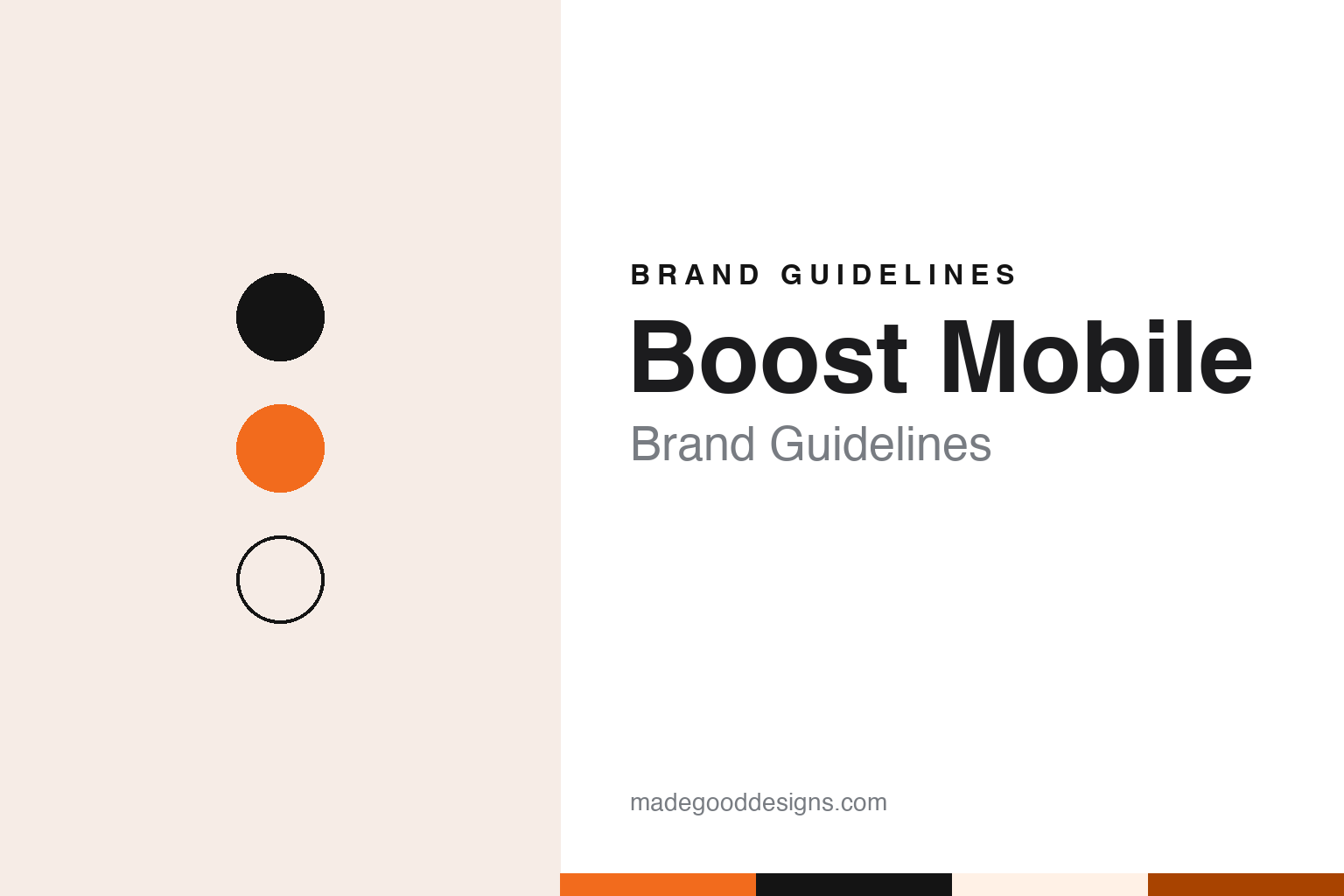
Two constants: an orange and black palette and a heavy grotesque register. Abstract homage — not a Boost Mobile asset; no logo, store sign or SIM pack is reproduced.
From Australia to Irvine
An Australian founder and a joint venture with Nextel.
Boost Mobile began in Australia. Peter Adderton, an Australian telecom entrepreneur later based in Newport Beach, California, founded Boost in Australia in 2000 and expanded it to Irvine, California, in 2001, the Orange County Business Journal reported in April 2023. English Wikipedia adds that Adderton founded Boost Mobile Australia and New Zealand in 2000, and that he, Craig Cooper and Kirt McMaster brought the brand to the United States in 2001 as a joint venture with Nextel Communications.
The American service ran on Nextel’s iDEN network and was built around unlimited push-to-talk, the walkie-talkie feature that let one handset “chirp” another. Wikipedia says the service was initially sold in parts of California and Nevada and that its early advertising was aimed at young urban customers, often using street slang. Boost’s brand marketing director, Peiti Feng, told MediaPost’s Marketing Daily in September 2016 that the brand’s line “Where You At?” had been established by that chirp, and that it also asked customers where they were with their lives, their goals and their passions.
Nextel then took the business over. Wikipedia says Nextel became the sole owner of Boost’s American operations in 2003; the Orange County Business Journal dates Nextel’s acquisition of the US business to 2004. Both sources say Nextel itself was bought by Sprint a year or so later, and Wikipedia records that Boost became a subsidiary of the merged Sprint Nextel Corporation in 2005, as the brand was taken beyond California and Nevada.
Under Sprint, Boost moved gradually onto Sprint’s own network. Wikipedia says an “Unlimited by Boost Mobile” service began on Sprint’s CDMA network in select markets in 2006, and that on January 15, 2009, Boost announced a monthly unlimited plan alongside a refocusing of the brand towards a broader audience than its early urban customers.
Colour
A chirp, a question and a campaign that brought it back.
Boost’s identity has always leaned on its advertising voice more than on any single object. The “Where You At?” line, Feng told Marketing Daily, came from the early 2000s and was tied to the chirp of push-to-talk; by 2016 Sprint, which then owned Boost, wanted to bring a version of it back for the smartphone era.
The September 2016 campaign rewrote the question as a statement, “We are Where You At”, Marketing Daily reported. Its television commercial featured the hip-hop artist Desiigner, the Latin-urban duo Los Rakas, the skateboarder Terry Kennedy, the dancer Monica Douglas and the street artist and DJ Agana, each shown practising their own craft. Feng said the phrase still fitted a culture of texting and social media, and could also refer to how everyday technology goes everywhere with its users.
Sprint also added another prepaid name to Boost. Wikipedia says Sprint acquired Virgin Mobile USA in 2010 and grouped the two brands, with its other no-contract services, in a single prepaid unit. In January 2020 The Verge reported that Sprint was closing Virgin Mobile USA, moving its customers to Boost the following month and returning the rights to the Virgin name to Virgin.
That move came as Sprint prepared to merge with T-Mobile. To win approval for the merger, T-Mobile and Sprint agreed to sell Boost, Engadget reported in July 2020, and Adderton had sought to buy the brand back from Sprint in 2019, the Orange County Business Journal reported. The buyer was the satellite-television company Dish Network, which announced on July 1, 2020 that it had completed the purchase. Engadget reported that Dish would keep the Boost name but had unveiled a new logo for it.
Typography
Store fronts, SIM packs and colour.
The brands in this group are all wireless carriers, and a carrier’s identity reaches people through a handful of familiar places: the shop front on a high street or in a strip mall, the small card that holds a SIM, the screen of a phone during setup, and the advertising that runs on television, billboards and social feeds. Unlike a packaged product, a carrier sells a service that cannot be seen, so the name, the logo and the colour do much of the work of making it recognisable.
Colour is often the first thing a carrier tries to own. A single strong hue can be repeated across signage, uniforms, packaging and digital screens until it reads as the brand on its own. Typography plays a supporting part, setting the tone of headlines and offers in advertising and keeping store signage legible from a distance.
Carrier brands also change hands. A name can pass between owners, be kept as a separate label after a merger or be retired altogether, so each guide sets out who started the brand, who owns it now and how its look has changed along the way.
Aa
A heavy grotesque — the register of loud, plain-spoken carrier advertising. (Specimen set in Archivo Black, a sans STAND-IN; NOT the Boost Mobile logo.)
Boost Mobile
From Dish to EchoStar.
Dish used Boost as the retail face of its move into wireless. Wikipedia says Dish went on to buy other prepaid names, including Ting Mobile in 2020 and Republic Wireless and Gen Mobile in 2021, and in December 2022 launched a postpaid offshoot under the name Boost Infinite. The same source says a ransomware attack on Dish in February 2023 disrupted customer service at its subsidiaries, including Boost, until May 2023.
Dish did not stay independent for long. Wikipedia says EchoStar completed its acquisition of Dish Network, including the wireless business, on December 31, 2023, and Light Reading described EchoStar in February 2025 as the company behind Dish Network and Boost Mobile, with Dish “subsumed” by EchoStar the previous year. EchoStar has owned Boost since that date. On July 17, 2024, Wikipedia says, EchoStar merged Boost Mobile and Boost Infinite into a single rebranded Boost Mobile, and began calling its own network the “Boost Mobile Network” in place of the Dish Wireless name.
The brand narrowed further after that. Sean Lee, Boost’s senior vice-president of product and marketing, told Light Reading in February 2025 that Boost was now bringing a cohesive message to the market after shaving off its other brands, naming Boost Infinite, Republic Wireless, Ting and Project Genesis. Wikipedia says that in August 2025 EchoStar agreed to sell spectrum licences to AT&T and to make AT&T the main host network for Boost customers; that Boost’s own network was shut down on November 15, 2025, after which Boost operated as a virtual operator on AT&T’s network; and that EchoStar closed the spectrum sale to AT&T on July 28, 2026. Wikipedia adds that the June 2026 bankruptcy filing by Dish DBS, the satellite-television business, did not include Boost Mobile.
Adderton went on to start other ventures. The Orange County Business Journal reported in April 2023 that he had launched an app-based service, MobileX, in February of that year.
For a design guide, Boost Mobile shows how a carrier brand can be carried by an advertising line and a strong colour while its owners change around it. Compare AT&T, whose network now hosts Boost customers, and Sprint, which owned Boost from 2005 until 2020. For this guide we use orange, black and cream with a heavy sans, an unofficial interpretation; no product or logo is reproduced.
Explore & save
Keep Boost Mobile’s identity on hand — save it to a board in the Made Good inspiration library.
Boost Mobile identity set
Pin the Boost Mobile orange and black palette and the heavy grotesque register to your own board.