New Jersey Devils Brand Guidelines
Two letters with horns and a tail, kept on red and black.
Aa
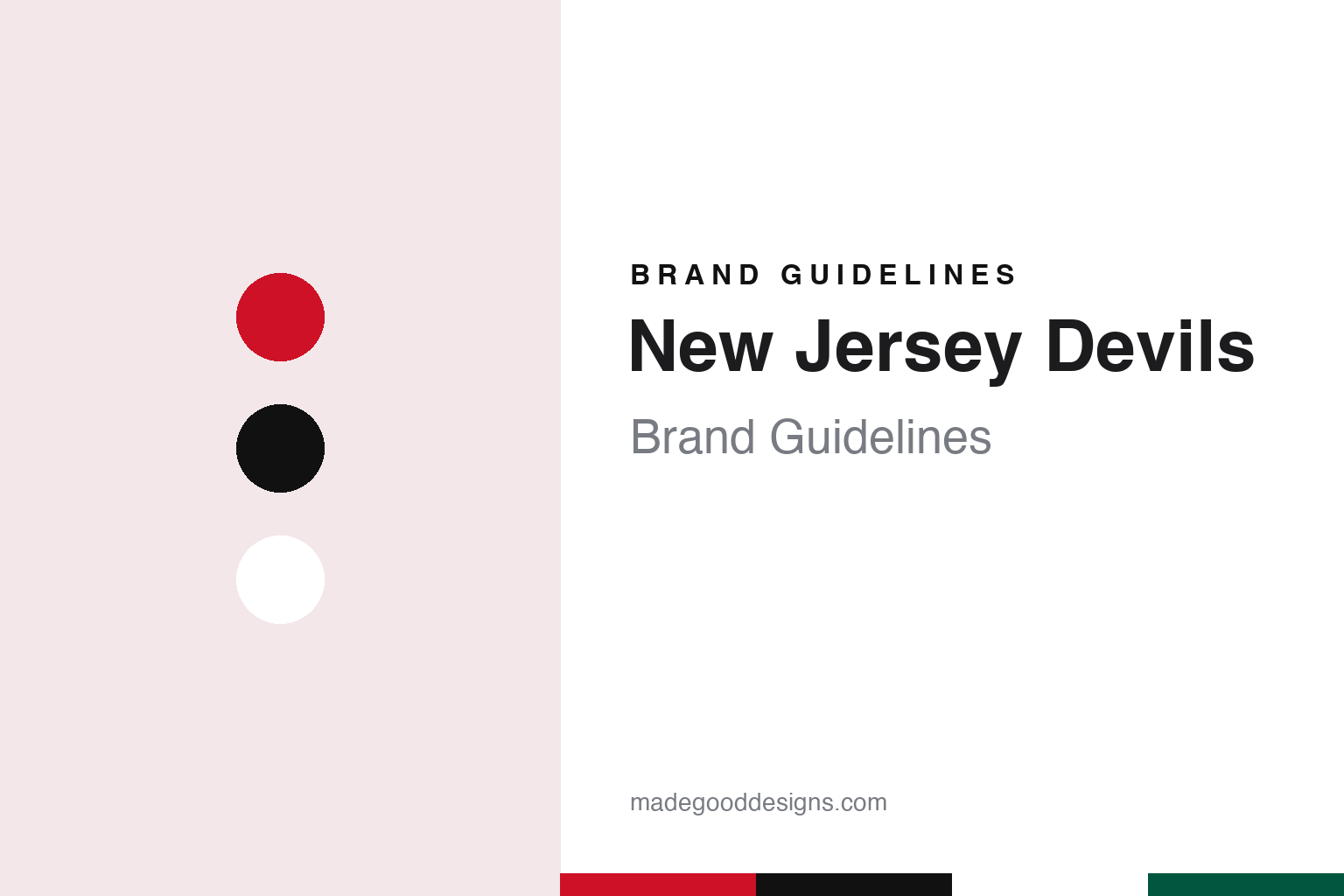
Two constants: a Devil red, shoulder black and Garden green palette and a condensed athletic sans register. Abstract homage — not a New Jersey Devils mark; no NJ monogram, crest or jersey is reproduced.
Scouts, Rockies, Devils
Two cities and a legend from the Pine Barrens.
The club now based in Newark began life in the Midwest. English Wikipedia says the National Hockey League announced plans in 1972 for an expansion team in Kansas City, Missouri, owned by a group headed by Edwin G. Thompson. The team took the ice in the 1974–75 season as the Kansas City Scouts, a name that, according to Wikipedia, referred to The Scout, a statue by the sculptor Cyrus E. Dallin that stands in the city’s Penn Valley Park. Home games were played at Kemper Arena.
The Scouts lasted two seasons. In 1976 the franchise moved to Denver and was renamed the Colorado Rockies, playing at McNichols Sports Arena. Wikipedia records that before the 1978–79 season the team was sold to Arthur Imperatore, a New Jersey trucking executive who wanted to move it to his home state; with the planned arena in the New Jersey Meadowlands still under construction, the club stayed in Denver for the time being.
The move came under the next owner. On 27 May 1982, Wikipedia says, the Rockies were sold to a group headed by John McMullen, a Jersey City native who also owned baseball’s Houston Astros, and the franchise relocated to New Jersey. As part of the deal, the club compensated the three teams already in the region, the New York Islanders, the New York Rangers and the Philadelphia Flyers, for moving into their territory.
A new name followed within weeks. On 30 June 1982, Wikipedia records, the team was renamed the New Jersey Devils after a public contest. The name refers to the legend of the Jersey Devil, a creature said to live in the Pine Barrens of South Jersey.
For 25 seasons the Devils played at the Meadowlands Sports Complex in East Rutherford, in the arena originally called Brendan Byrne Arena and later renamed Continental Airlines Arena and then the Izod Center. Before the 2007–08 season they moved to the Prudential Center in Newark, which opened on 27 October 2007.
Colour
McMullen, Puck Holdings, Vanderbeek and, since 2013, Harris and Blitzer.
McMullen owned the Devils until 2000, when, Wikipedia says, he sold the team to Puck Holdings, an affiliate of YankeeNets, now Yankee Global Enterprises. In March 2004 Jeff Vanderbeek, a Lehman Brothers executive who had been a minority owner since the 2000 sale, bought a controlling interest from Puck Holdings and left Lehman to run the club full time.
The current owners arrived in 2013. Reporting for the Associated Press on 15 August 2013, Tom Canavan wrote that Josh Harris, owner of the Philadelphia 76ers and co-founder of Apollo Global Management, and his business partner David Blitzer had bought the Devils and the lease to the Prudential Center from Vanderbeek, a day after the league’s board of governors approved the deal. The AP said the new owners kept Lou Lamoriello in charge of hockey operations, named Scott O’Neil, already chief executive of the 76ers, to the same role with the Devils, and kept Vanderbeek on as a senior adviser. Harris and Blitzer have owned the Devils since 2013, and Wikipedia says the team is owned and managed through Harris Blitzer Sports & Entertainment.
The uniforms changed less often than the owners. Wikipedia describes a red home sweater and a white road sweater, each with three stripes, one across each arm and, until 2017–18, one across the waist, and with black draped over the shoulders. The red sweater was the road design until the league swapped home and road colours in 2003. Under Lamoriello, who joined as president and general manager in 1987, the club also declined to add a third jersey. Wikipedia quotes him saying, “I strongly believe that you have to have one identity as a team.” When the league moved to Reebok’s Edge template for 2007–08, the Devils kept the same design.
The original colours returned on special nights. On 20 August 2009, Wikipedia says, Lamoriello announced that the team would wear its red, white and green sweaters for a Saint Patrick’s Day game in 2010, and the throwbacks were used around that date over three seasons and at the 2014 Stadium Series against the Rangers. On 20 June 2017 the Devils revealed Adidas uniforms that removed the hem stripes and widened the sleeve stripes into equal bands of white and black. The mascot, Wikipedia notes, is NJ Devil, a costumed seven-foot devil; before 1993 the club used a giant puck called Slapshot.
Typography
Design and documentation.
A hockey sweater carries its identity in a few fixed places. The crest sits large on the chest, where it has to read from the upper rows of an arena and on a television screen at the same time, so club marks are often built from bold, simple shapes with thick outlines that hold up when stitched in twill. Shoulder patches add a secondary mark, and the numbers on the back and sleeves follow their own lettering style, which often echoes the wordmark.
Colour changes are the clearest signal of a new era. A club that swaps one palette for another usually reworks the crest, the striping on the sleeves and hem, the helmets and the arena dressing together, because the colours have to match across every surface fans see. Third jerseys give teams room to test an alternate mark or a throwback palette without retiring the main identity, and several alternates have later been promoted to the primary set.
The ice itself is part of the system. Centre-ice logos are painted under the surface along with the lines, and the boards, banners and scoreboard graphics repeat the same marks, so a redesign reaches far beyond the sweater.
NJ
A condensed athletic sans — the register of sweater numbers, nameplates and arena signage. (Specimen set in Oswald, a condensed sans STAND-IN; NOT the New Jersey Devils logo or wordmark.)
New Jersey Devils
A monogram with horns, recoloured once in 1992.
The Devils’ logo is a ligature of the letters “N” and “J.” Wikipedia describes devil horns at the top of the “J” and a pointed tail at the bottom, with the monogram set inside an open black circle on a field of white in the middle of the chest. It says that before the move from Colorado in 1982, a prototype was designed by the wife of the owner, John McMullen, and then modified by a professional graphic design and marketing firm. The result was the red and green mark the club used for its opening ten years in New Jersey.
Green had a reason to be there. Wikipedia says it was chosen to reflect New Jersey’s nickname, “The Garden State,” and the Pine Barrens, home of the Jersey Devil. Before the 1992–93 season the sweaters were red and green with slightly different striping, a combination some fans called the “Christmas colors.” The change to black came in 1992, and Wikipedia gives a practical cause: the club had difficulty keeping the green consistent between the logo and the jerseys. The red monogram kept its shape and took a black outline.
Alternates later reopened the archive. A 2020–21 “Reverse Retro” design with Adidas used the 1982–1992 template with green as the base colour. Early in 2021–22 the club added a full-time alternate, ending the Lamoriello-era stance, a black sweater with white stripes, laced collar and the word “Jersey” in white script with red drop shadows; Wikipedia says it was designed by the former Devils goaltender Martin Brodeur and drew on the history of hockey in the state. A second Reverse Retro in 2022–23 put the old template on white with red, navy and gold striping, colours chosen to honour the Kansas City Scouts and the Colorado Rockies for the club’s 40th season in New Jersey. For the 2024 Stadium Series the Devils wore red and black without white trim, with an enlarged “NJ” and no circle.
For a design guide, New Jersey Devils shows how a monogram built from local folklore can survive a full colour change when its outline, not its fill, carries the switch. Compare the NHL, the Philadelphia 76ers, which share the Devils’ owners, and the New York Rangers. For this guide we use Devil red, shoulder black and Garden green with a condensed sans, an unofficial interpretation; no product or logo is reproduced.
Explore & save
Keep New Jersey Devils’s identity on hand — save it to a board in the Made Good inspiration library.
New Jersey Devils identity set
Pin the New Jersey Devils Devil red, shoulder black and Garden green palette and the condensed athletic sans register to your own board.