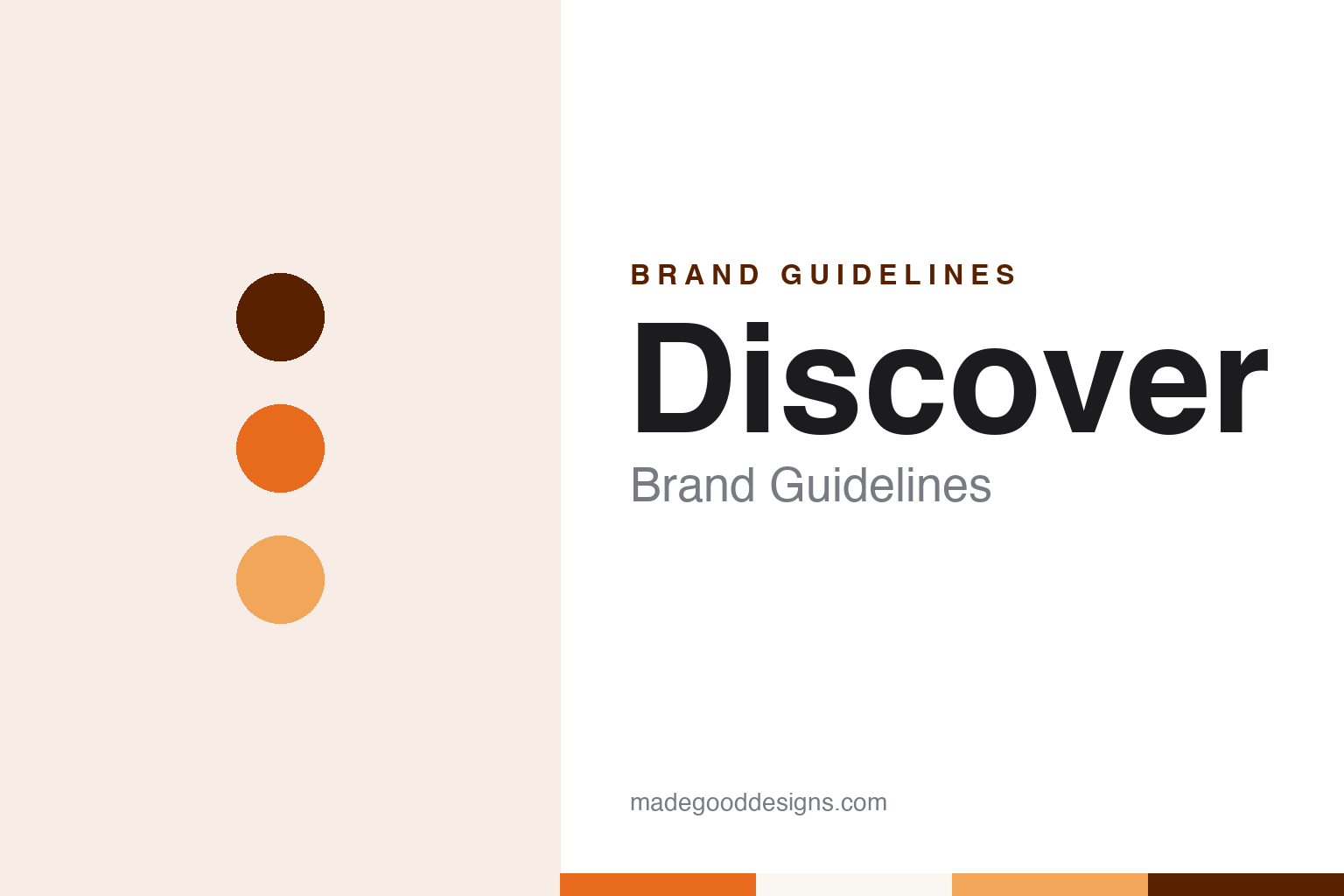
Discover Brand Guidelines
The Sears credit card that became part of Capital One.
Aa
Two constants: a card orange, sunset peach and deep rust palette and a plain card sans register. Abstract homage — not a Discover product or mark; no card, logo or network mark is reproduced.
Sears Financial Network
A retailer’s card, a Delaware bank and a trial in Atlanta.
Discover began inside Sears, Roebuck & Co., the Chicago retailer that had spent the early 1980s adding financial services to its stores. English Wikipedia says Sears bought the Dean Witter Reynolds brokerage and the real-estate firm Coldwell, Banker & Company in 1981, and that the card itself was conceived by Ray Kennedy Sr., then the credit manager for Sears. A trial period followed in 1985, starting with a purchase at a Sears store in Atlanta on 17 September, Wikipedia says, and the wider launch was pushed through by two Sears executives, Philip J. Purcell and Mitchell M. Merin. Wikipedia’s summary dates the card’s public offer to 1986.
The card needed a bank behind it. Sears used the Greenwood Trust Company, a small bank founded in 1911 in Greenwood, Delaware, which Wikipedia says was acquired in 1985 and renamed Discover Bank in 2000. The bank’s original building on East Market Street in Greenwood now houses the town hall and police station. Together, the card, the bank and the Sears brokerage and property businesses were presented as the Sears Financial Network, and Wikipedia notes that early Discover cards carried a small embossed symbol of the Sears Tower, the company’s headquarters at the time.
Inside Sears, the card sat with the brokerage. When The New York Times reported Sears’s first-quarter results on 22 April 1987, it listed the Discover credit card operations alongside Dean Witter within the Dean Witter Financial Services Group, one of the retailer’s business groups next to its stores, the Allstate insurance group and Coldwell Banker. Wikipedia says other retailers resisted the card because they were building their own credit products and did not want to help a competitor, while Sears’s promotion of Discover in its own stores was thought to restrict the card’s reach.
The name and the network developed separately over time. Wikipedia says Novus was once the main processing centre that partnered with the company, and that the Novus logo was later retired and replaced by a Discover Network logo.
Colour
Dean Witter, Morgan Stanley, independence and Capital One.
Sears completed the spin-off of its Dean Witter division in 1993, and Discover moved with it into a new public company called Dean Witter, Discover & Co., Wikipedia says. In 1997 that company merged with Morgan Stanley to form Morgan Stanley Dean Witter, Discover & Co.; The New York Times, writing on 18 June 1998, described Discover Card as “a business unit of Morgan Stanley Dean Witter & Company.” Wikipedia records a 1999 rebranding of the card business as Discover Financial Services.
The Morgan Stanley years were spent largely on visibility. In June 1998 The New York Times reported that Discover Card had contracted to operate one of the large television screens on the facade of 1 Times Square, directly beneath the pole from which the New Year’s ball descends, and had become the presenting sponsor of the Times Square celebration for 1 January 2000. Wikipedia says the company held that billboard from 1998 to 2007 and sponsored the annual ball drop. In February 2000 the same paper reported that the Mills Corporation had sold the naming rights to a planned shopping centre in Gwinnett County, north of Atlanta, to Discover Financial Services; Wikipedia says the mall in Lawrenceville, Georgia, was called Discover Mills from its opening in 2001 until 2012.
Morgan Stanley weighed letting the business go more than once. In a statement dated 17 August 2005, the bank said its board had analysed a possible spin-off of Discover and decided to keep it. Wikipedia says Discover remained part of Morgan Stanley until 2007, when Discover Financial Services became an independent company. A sponsorship programme continued under independence: the Associated Press reported on 26 August 2010 that Discover would sponsor college football’s Orange Bowl from 2011, taking over from FedEx, and Wikipedia records a partnership with the National Hockey League from 2010.
On 19 February 2024, Capital One Financial Corporation announced an agreement to acquire Discover Financial Services. In a release dated 18 May 2025, Capital One said it had completed the acquisition after approval by the Federal Reserve Board and other regulators. Capital One has owned Discover since 2025.
Typography
Design and documentation.
A payment brand lives on very small surfaces. Its app icon sits in a grid of rounded squares on a phone screen, often no larger than a fingertip, so the mark has to survive at a few millimetres across and still be recognised next to dozens of others. That pressure tends to reduce money-app identities to a single letter, a symbol or a solid field of colour, and it makes the colour itself do much of the work a wordmark would do on a larger page.
Colour ownership in this category is partly a matter of repetition. A tone that appears on the icon, the in-app buttons, the card, the confirmation screen and the advertising becomes associated with the brand through sheer exposure, even where no official value is published. For a designer studying the category, the useful exercise is to note which surfaces carry the colour and which stay neutral.
Physical signage follows different rules. A payment card has to sit alongside bank and network marks, and an agent-location sign has to read from across a street, in daylight and under shop lighting, on windows already crowded with other notices. The same identity can appear in a simplified form outdoors and a richer form on screen, and studying both versions shows how a system is built to flex.
Aa
A plain card sans — the register of a card front and a checkout sticker. (Specimen set in Archivo, a sans-serif STAND-IN; NOT the Discover logo.)
Discover
A one-word name on a card, a screen and a parade float.
The Discover identity has always been carried by a single word. The card launched as part of a retailer’s financial supermarket, with a Sears Tower symbol embossed on its face, and it outlived that setting: by the late 1990s the same word appeared on a television screen in Times Square, on the name of a Georgia shopping mall and, later, on the processing network that had once traded as Novus. Wikipedia’s account of the Novus logo being retired in favour of a Discover Network logo shows the network itself taking the card’s name.
The Times Square screen and the ball-drop sponsorship put the name on New Year’s Eve broadcasts from the late 1990s, and the Orange Bowl agreement put it on college football from 2011. The brand also entered the Rose Parade in Pasadena: CBS Los Angeles reported on 2 January 2012 that the Discover Card float “The Dream Believers” received the parade’s Grand Marshal’s Award, and Wikipedia says the company’s float won the same award in 2011. Wikipedia also records Discover as presenting sponsor of the Big Ten Football Championship Game from 2017 and a 2024 television campaign starring the actress Jennifer Coolidge.
The card has passed from Sears to Dean Witter, then to Morgan Stanley, then to an independent Discover Financial Services and, in 2025, to Capital One, and the Discover name has stayed on the card throughout.
For a design guide, Discover shows how a short, ordinary English word chosen by a department store can become the name of a card, a bank and a payments network, and survive a series of owners intact. Compare it with American Express, another card brand that runs its own network, and Visa, another card network brand. For this guide we use card orange, sunset peach and deep rust with a sans, an unofficial interpretation; no product or logo is reproduced.
Explore & save
Keep Discover’s identity on hand — save it to a board in the Made Good inspiration library.
Discover identity set
Pin the Discover card orange, sunset peach and deep rust palette and the plain card sans register to your own board.