Western Union Brand Guidelines
The Rochester telegraph company that became a money-transfer name.
Aa
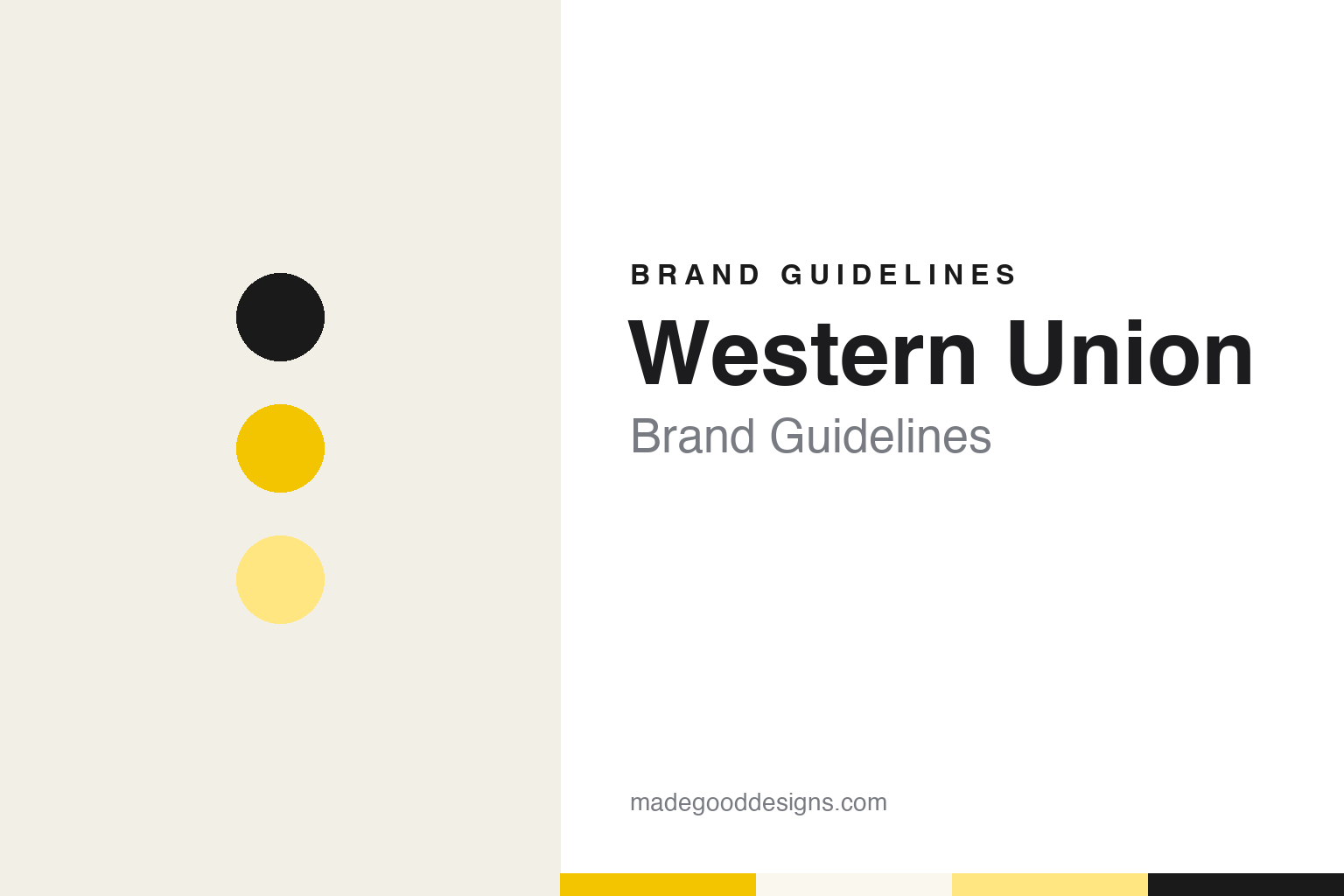
Two constants: a signal yellow, pale yellow and wire black palette and a bold counter sans register. Abstract homage — not a Western Union product or mark; no sign, logo or form is reproduced.
Printing telegraph
A Rochester company, a merger and a new name.
Western Union began in Rochester, New York, in 1851 as the New York and Mississippi Valley Printing Telegraph Company. English Wikipedia names Samuel L. Selden and Hiram Sibley among its founders. In 1856 the company merged with a competitor, the Erie and Michigan Telegraph Company, whose backers included Ezra Cornell, and at Cornell’s insistence the combined business took the name Western Union Telegraph Company.
Through the 1860s the company kept buying other telegraph firms. Wikipedia says Western Union completed a transcontinental telegraph line in 1861, with the opening messages addressed to President Abraham Lincoln, and in 1866 it absorbed the American Telegraph Company and the United States Telegraph Company. It also tried to reach Europe overland, forming the Russian–American Telegraph Company to run a line through Alaska and Siberia; the project was abandoned in 1867 after a transatlantic cable was laid in 1866.
The services that would outlast the telegram arrived in the same period. Wikipedia lists a stock ticker in 1866, a standardised time service in 1870 and wire money transfer in 1871. Western Union briefly tried telephony as well, Wikipedia says, before settling a patent lawsuit with Bell and leaving the telephone business in 1879. In 1881 the financier Jay Gould arranged a merger with the Atlantic and Pacific Telegraph Company that gave him control of the combined firm.
The twentieth century brought new owners and new products under the same name. Wikipedia says AT&T took a stake in Western Union in 1909 and was forced to sell it in 1913 while under antitrust indictment, that the company acquired Postal Telegraph in 1945, and that it began offering telex in New York City in 1958. For Valentine’s Day 1959 it introduced the Candygram, a box of chocolates delivered with a telegram and advertised on television with the radio announcer Don Wilson. In 1963 the international cable business was separated into Western Union International and sold, and that company later stopped using the Western Union name. From 1974, Wikipedia says, the company operated its own fleet of Westar communications satellites, which carried telegram and mailgram traffic between Western Union bureaus and leased capacity to other businesses; the satellites and ground stations were sold to Hughes in 1988.
Colour
Restructuring, bankruptcy auction and First Data.
By the 1980s the telegraph business was in decline, and Western Union began shifting towards money transfer. The New York Times reported on 31 December 1987 that bondholders had approved a debt exchange completing a long restructuring of the Western Union Corporation, under which the company merged with its chief subsidiary, the Western Union Telegraph Company; the paper named the New York financier Bennett S. LeBow as controlling stockholder. Wikipedia says the restructured business later operated within New Valley Corporation.
New Valley sold the money-transfer business in court. The Los Angeles Times, carrying a Reuters report on 20 September 1994, said First Financial Management Corp. of Atlanta had won the bidding for Western Union in an open-court bankruptcy auction in Newark, New Jersey, after the rival bidder Forstmann Little & Co. dropped out. Wikipedia says First Financial merged with First Data Corporation in 1995, which brought Western Union into First Data’s payment-processing group.
A decade later First Data separated it again. The New York Times reported on 27 January 2006 that First Data planned a tax-free spin-off of Western Union, its money-transfer business, into a separate public company, leaving First Data with its back-office processing for merchants and card-issuing banks. Wikipedia says the spin-off took effect on 29 September 2006, and that the next day Western Union said it would stop offering telegram transmission and delivery.
As an independent company, The Western Union Company has kept its headquarters in Colorado. Wikipedia says it moved from Englewood to the Denver Tech Center in 2018, and that it acquired the Canadian payments firm Custom House in 2009, a business that was rebranded as Western Union Business Solutions. The Western Union Company has been an independent public company since 2006.
Typography
Design and documentation.
A payment brand lives on very small surfaces. Its app icon sits in a grid of rounded squares on a phone screen, often no larger than a fingertip, so the mark has to survive at a few millimetres across and still be recognised next to dozens of others. That pressure tends to reduce money-app identities to a single letter, a symbol or a solid field of colour, and it makes the colour itself do much of the work a wordmark would do on a larger page.
Colour ownership in this category is partly a matter of repetition. A tone that appears on the icon, the in-app buttons, the card, the confirmation screen and the advertising becomes associated with the brand through sheer exposure, even where no official value is published. For a designer studying the category, the useful exercise is to note which surfaces carry the colour and which stay neutral.
Physical signage follows different rules. A payment card has to sit alongside bank and network marks, and an agent-location sign has to read from across a street, in daylight and under shop lighting, on windows already crowded with other notices. The same identity can appear in a simplified form outdoors and a richer form on screen, and studying both versions shows how a system is built to flex.
Aa
A bold counter sans — the register of a shop-window sign and a transfer form. (Specimen set in Barlow, a sans-serif STAND-IN; NOT the Western Union logo.)
Western Union
A nineteenth-century name carried into a new business.
The Western Union name was chosen in 1856 for a merger of telegraph lines, and it stayed in place as the company added a ticker, a time service, money transfer, telex and the Candygram, and then as it gave up the telegram in 2006. Wikipedia says the merged company took the name at Ezra Cornell’s insistence, and the same name now appears over money-transfer counters.
The name has also been separated from parts of the company more than once. Western Union International left the group in 1963, and Wikipedia says its later owner renamed it and ended its use of the Western Union branding. The money-transfer business itself passed through New Valley, First Financial Management and First Data before it became The Western Union Company in 2006.
The brand has also appeared in sport. Wikipedia says the Denver Nuggets of the National Basketball Association announced a three-season deal that made Western Union the team’s jersey sponsor from the 2017–18 season.
For a design guide, Western Union shows how a company name written for one technology can be kept and reused for another, so that a nineteenth-century telegraph title now marks a money-transfer counter. Compare it with Mastercard, a payments brand built on a network of member banks, and PayPal, a payments brand of the internet era. For this guide we use signal yellow, pale yellow and wire black with a sans, an unofficial interpretation; no product or logo is reproduced.
Explore & save
Keep Western Union’s identity on hand — save it to a board in the Made Good inspiration library.
Western Union identity set
Pin the Western Union signal yellow, pale yellow and wire black palette and the bold counter sans register to your own board.