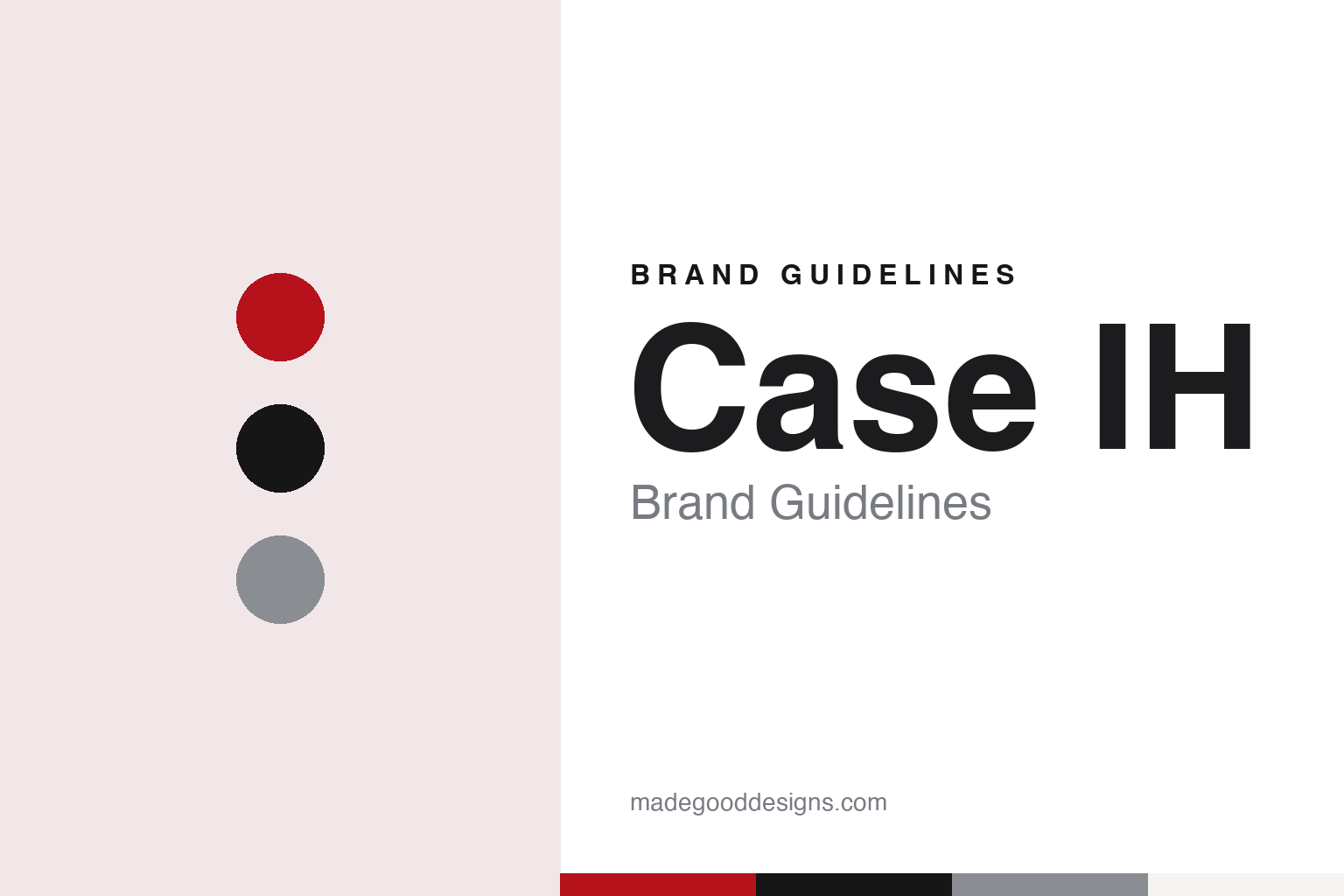
Case IH Brand Guidelines
Two farm-machinery names, one letter pair and a dealer pylon.
Aa
Two constants: a red, black and steel gray palette and a condensed grotesque register. Abstract homage — not a Case IH product or mark; no machine, logo or decal is reproduced.
Racine and the eagle
A threshing business in Wisconsin and a Civil War mascot.
The older half of Case IH begins with Jerome Increase Case. The Wisconsin Historical Society’s Dictionary of Wisconsin History says Case, born in Williamstown, New York, moved to Wisconsin in 1842 and settled at Rochester, where he opened a threshing-machine repair shop and worked as a thresherman. It says that in 1844 he developed a combined grain thresher and separator, moved to Racine and set up a shop to manufacture it. English Wikipedia dates the move to Racine to 1843, citing better access to water power.
Wikipedia dates the company to 1842 as the J. I. Case Threshing Machine Company, a name it says the business kept until 1928, after which it was the J. I. Case Company and was often called simply Case. It records that in 1863 Case took three of his employees into partnership. The Society’s essay adds that Case was a founder of banks in Racine and Burlington, served in the Wisconsin state senate in 1865–1866 and was twice mayor of Racine. After retiring from business, the Society says, he bred race horses and owned the trotting horse Jay-Eye-See. Wikipedia adds that Case built a portable steam engine in 1869 to power threshers, that this engine is held by the Smithsonian in Washington, D.C., and that the company opened a factory in Argentina in 1890.
Case’s eagle emblem came from the Civil War. Farm Collector reported in May 2012 that when Company C of the Eighth Wisconsin Infantry Volunteers was organised, a live eagle was bought as its mascot and nicknamed “Old Abe” after President Abraham Lincoln. The magazine says Jerome Increase Case adopted the eagle as a trademark for J. I. Case in 1865 and that Case used the eagle trademark until 1969. Wikipedia likewise dates the first eagle logo, based on Old Abe, to 1865.
Colour
Tenneco, International Harvester and CNH.
The newer half of the name came through a deal in the farm downturn of the 1980s. Wikipedia says Tenneco bought J. I. Case in 1967 and kept marketing its products under the Case name. On 27 November 1984, The Christian Science Monitor reported that International Harvester had announced the day before that it was selling most of its farm-equipment plants to Tenneco. In a longer piece the next day, the paper’s Laurent Belsie wrote that Harvester’s North American agricultural division would be combined with Tenneco’s J. I. Case subsidiary, and that Harvester officials said they would concentrate on making trucks. Belsie reported that the deal still needed approval from Harvester’s creditors and had to clear federal antitrust review.
Wikipedia says the combined farm brands first went out as Case International and were then shortened to Case IH, with the new corporate identity arriving in 1985, while the corporation itself legally remained the J. I. Case Company. It records that the Harvester business left behind was renamed Navistar. In 1986, Wikipedia says, Case IH bought the North Dakota tractor maker Steiger, and in 1987 it launched the Magnum tractor range, a tractor line developed by the combined Case and International Harvester business.
Ownership changed again in the 1990s. Wikipedia says Tenneco divested the business in 1994 as Case Equipment Corporation, which became Case Corporation. On 18 May 1999, Farmers Weekly reported that New Holland, then majority-owned by the Italian group Fiat, had agreed to acquire Case Corp. Wikipedia says the two joined in November 1999 as CNH, and that Case IH is today owned by CNH Industrial. It lists Axial-Flow combines and the Magnum, Steiger and Farmall tractor names among the brand’s model lines.
Typography
Design and documentation.
On farm and construction machinery, colour does a great deal of the identity work. A paint scheme carried across tractors, loaders and implements lets a machine be recognised across a field or a building site long before any badge can be read, and several equipment makers have treated their paint as a protected part of the brand, defending it as trade dress in the same way other companies defend a wordmark.
The decal is the second layer. Model numbers, wordmarks and stripes are usually applied as vinyl decals rather than cast badges, which is why restorers and collectors pay close attention to reproduction decal sets, and why a change of decal style often marks a new generation of machine as clearly as any change in the metal underneath.
Dealer signage carries the same identity to the roadside. Pole signs, fascia panels and branded service vans repeat the colours and wordmark at a scale meant to be read from a passing vehicle. Operator manuals, parts catalogues and safety labels then carry the typography and colour into the cab and the workshop, where the brand is read most often of all.
Aa
A bold condensed grotesque — the register of a hood decal and a dealer pylon. (Specimen set in Barlow Condensed, a sans-serif STAND-IN; NOT the Case IH logo.)
Case IH
A letter pair by Raymond Loewy.
The IH in Case IH carries a mark with a documented designer. In an article updated in August 2022, Farm Collector writer Sam Moore described how International Harvester invited the industrial designer Raymond Loewy to style a new line of Farmall tractors, introduced as the Farmall H and M at a Farmall Day event in Rock Island, Illinois, on 9 August 1939. Moore wrote that Loewy also designed the company’s logo: block letters made of a lower-case “i” set over an upper-case “H,” which together roughly resembled the front view of a man driving a Farmall tricycle tractor. He dated its adoption to 1946 and wrote that a slanted version of the “man on a tractor” mark could still be seen on Case IH machines. Wikipedia gives the same reading of the letters as a farmer on a tractor seen head-on.
Moore’s article also credits Loewy with the standardised International Harvester dealership buildings, with a red central pylon carrying the IH logo and the dealer’s name. Wikipedia records that in 2006 Case IH brought back the old International Harvester logo as part of a plan to restore an “International” feel to its products and to separate it more clearly from its sister brand.
The brand name joins two older identities: the Case name, with an eagle trademark that Farm Collector dates from 1865 to 1969, and the IH letter pair that Loewy drew in the 1940s. The farm brands were combined in the mid-1980s, and the business has been part of CNH since 1999.
For a design guide, Case IH shows how a merged company can keep a predecessor’s letter mark at the centre of a new name. Compare New Holland, its sister brand under CNH, and Massey Ferguson, another tractor brand in this collection. For this guide we use pylon red, implement black and steel gray with a sans, an unofficial interpretation; no product or logo is reproduced.
Explore & save
Keep Case IH’s identity on hand — save it to a board in the Made Good inspiration library.
Case IH identity set
Pin the Case IH pylon red, implement black and steel gray palette and the condensed grotesque register to your own board.