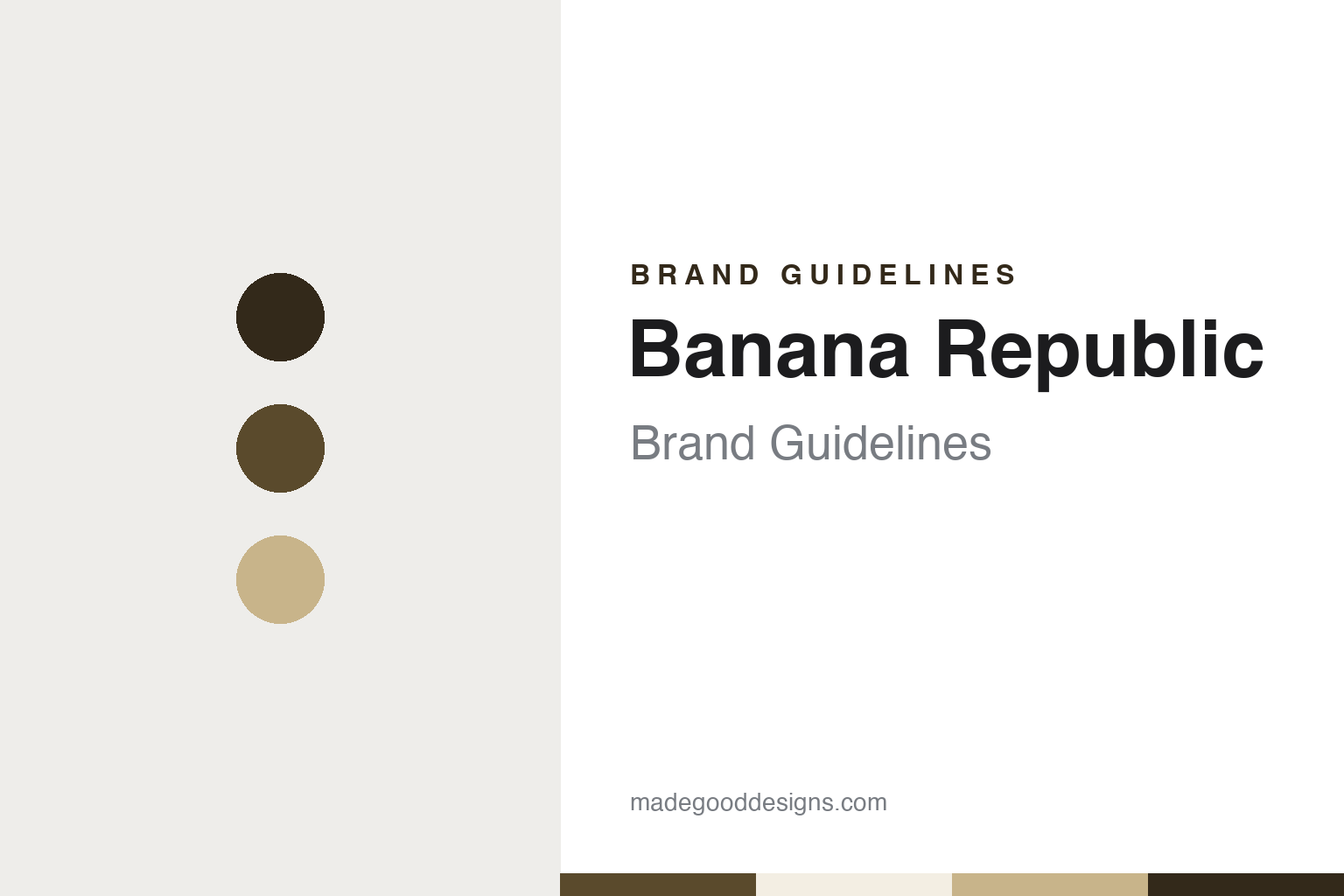
Banana Republic Brand Guidelines
An army-surplus stall in Marin County that became a Gap Inc. brand.
Aa
Two constants: a khaki drill, sand and catalogue paper palette and a catalogue serif register. Abstract homage — not a Banana Republic product or mark; no logo, catalogue page or illustration is reproduced.
Travel & Safari
A reporter, an illustrator and a crate of surplus shirts.
Banana Republic was started in 1978 by Mel Ziegler and Patricia Ziegler, a married couple who had both worked at the San Francisco Chronicle — he as a reporter, she as an illustrator. The New York Times, reporting on the business in March 1988, described Mel Ziegler as a former newspaper reporter and his wife as a former illustrator, and gave the company’s full name as the Banana Republic Travel and Safari Clothing Company. English Wikipedia places the founding in Mill Valley, in Marin County north of San Francisco.
The business began with clothes that already existed. In an interview with the Buddhist magazine Tricycle in 2014, the Zieglers said they started Banana Republic in 1978 selling military surplus exclusively, and that their opening stock was a batch of Spanish paratrooper shirts found at a surplus dealer’s warehouse across the bay in Oakland. They bought every one, they recalled, and only afterwards discovered that the sleeves were too short. The company’s own history page says the idea had grown from a worn bush jacket Mel Ziegler brought back from a trip to Australia, that the couple added touches such as new buttons and elbow patches to the surplus pieces, and that they sold them at a flea market in Marin County before opening a shop in Mill Valley the same year.
The catalogue was where the brand found its voice. The Zieglers told Tricycle that in the early years every garment was designed by Patricia and every catalogue was written and illustrated by the two of them at their kitchen table. The company says the short-sleeved shirts were turned into a success by giving them an invented back story, and that the catalogue combined Mel’s playful copy with Patricia’s hand-drawn illustrations of each piece. Wikipedia describes the result as a hand-drawn catalogue with traveller and explorer stories printed alongside the clothes.
The couple later told their own version of the early years in the memoir Wild Company, published by Simon & Schuster in 2012, according to Wikipedia.
Colour
Gap Inc., a travel magazine and a move into the city.
Gap Inc. bought Banana Republic in 1983. The New York Times reported in 1988 that the Gap had acquired the business, then a small chain of shops with a catalogue operation, from the Zieglers, and that Mel Ziegler had stayed on as president. The company’s history page says Gap’s manufacturing and financial resources allowed the brand to expand, with lavishly themed safari stores opening across the United States and new writers and artists hired to keep the illustrated catalogues going. Gap Inc. has owned Banana Republic since 1983, and Wikipedia says the new owner shortened the name to Banana Republic.
The themed shops became part of the identity. The New York Times described the chain’s decor in 1988 as including imitation elephant-tusk door handles and real jeeps and bush planes, and quoted analysts who linked its success to the “Indiana Jones look”. Wikipedia says the business grew quickly in the wake of the 1981 film Raiders of the Lost Ark. The same 1988 report said Ziegler had spent the previous months bringing out a travel magazine called Trips under the company logotype, while Gap’s chairman Donald G. Fisher said in a statement that the company was re-evaluating the Banana Republic strategy and slowing its expansion.
The founders left soon afterwards. Speaking to Tricycle, they said they departed five years after the sale; Wikipedia dates their resignation to 1988 and says their relationship with Fisher had soured over the magazine. Under Gap, Banana Republic moved away from surplus and safari clothing towards tailored city wear, and Wikipedia says the hand-drawn catalogue and its stories were phased out.
Later moves extended the brand upward and abroad. In April 2008 the business magazine Portfolio, in a report carried by NBC News, described BR Monogram, a more expensive concept whose debut location sat inside Banana Republic’s Greenwich Village store in New York. The Guardian reported on 18 October 2016 that Gap would close all Banana Republic shops in the United Kingdom while keeping a regional website. In August 2023 Hypebeast reported a capsule collection by the New York designer Peter Do for Banana Republic, due that October.
Typography
Design and documentation.
A fashion retailer’s identity is met first on the street. The fascia above the shopfront carries the name at a scale meant to be read from across the road, so the wordmark may need to work in illuminated letters, in flat paint and in vinyl on glass. Inside, the same mark returns at a smaller size on till points, fitting-room doors and wayfinding signs, and the colour that sits behind it can be as recognisable as the letters themselves.
The shopping bag leaves the shop with the customer. Paper, plastic or fabric, with twisted or flat handles, a bag carries the name out of the shop and down the street, and its design can be as plain as one colour field, one mark and generous margins.
Swing tags and woven labels do quieter work. The tag carries size, care and code information, but its card weight, colour and typeface also signal which line or sub-brand a garment belongs to.
Window displays change with the seasons. Seasonal schemes, mannequin styling and printed graphics let a retailer refresh its look without touching the fascia, while the logo on the fascia stays the same.
Aa
A catalogue serif — the register of an illustrated mail-order page and a travel story. (Specimen set in Libre Caslon Text, a serif STAND-IN; NOT the Banana Republic logo.)
Banana Republic
A storyteller’s catalogue, a stage-set shop and a shortened name.
Banana Republic’s early identity was built by two journalists rather than by a design agency. The name, the long-form company title and the catalogue all came from the Zieglers, who said they wrote and drew the pages themselves, pairing a short story with an illustration of each garment. That approach put words and drawings, not photography, at the centre of the brand, and the company’s own history page still describes the founders as a journalist and an illustrator.
The stores carried the same storytelling into three dimensions. The New York Times in 1988 pointed to the imitation tusk door handles, jeeps and bush planes of the safari-era shops, scenery that matched the catalogue’s travel tales. The magazine Trips, published under the company logotype, was an attempt to stretch the identity further into publishing before the founders left.
Gap’s changes after 1988 were largely reductions: the long name was cut to two words, the surplus clothing gave way to city tailoring, and the illustrated catalogue stories were phased out, as Wikipedia records. What remained was the name itself, carried from a Marin County flea market to shopping streets in North America and Asia. Later projects such as BR Monogram and the Peter Do collection show the company continuing to adjust the brand’s position under the same ownership.
For a design guide, Banana Republic shows how a brand’s founding voice — a hand-drawn catalogue written like a travel diary — can define it long after the clothes have changed, and how much of an identity can rest on a name alone. Compare it with its sister chain Old Navy and with its parent Gap, which bought the business in 1983. For this guide we use khaki drill, sand and catalogue paper with a serif, an unofficial interpretation; no product or logo is reproduced.
Explore & save
Keep Banana Republic’s identity on hand — save it to a board in the Made Good inspiration library.
Banana Republic identity set
Pin the Banana Republic khaki drill, sand and catalogue paper palette and the catalogue serif register to your own board.