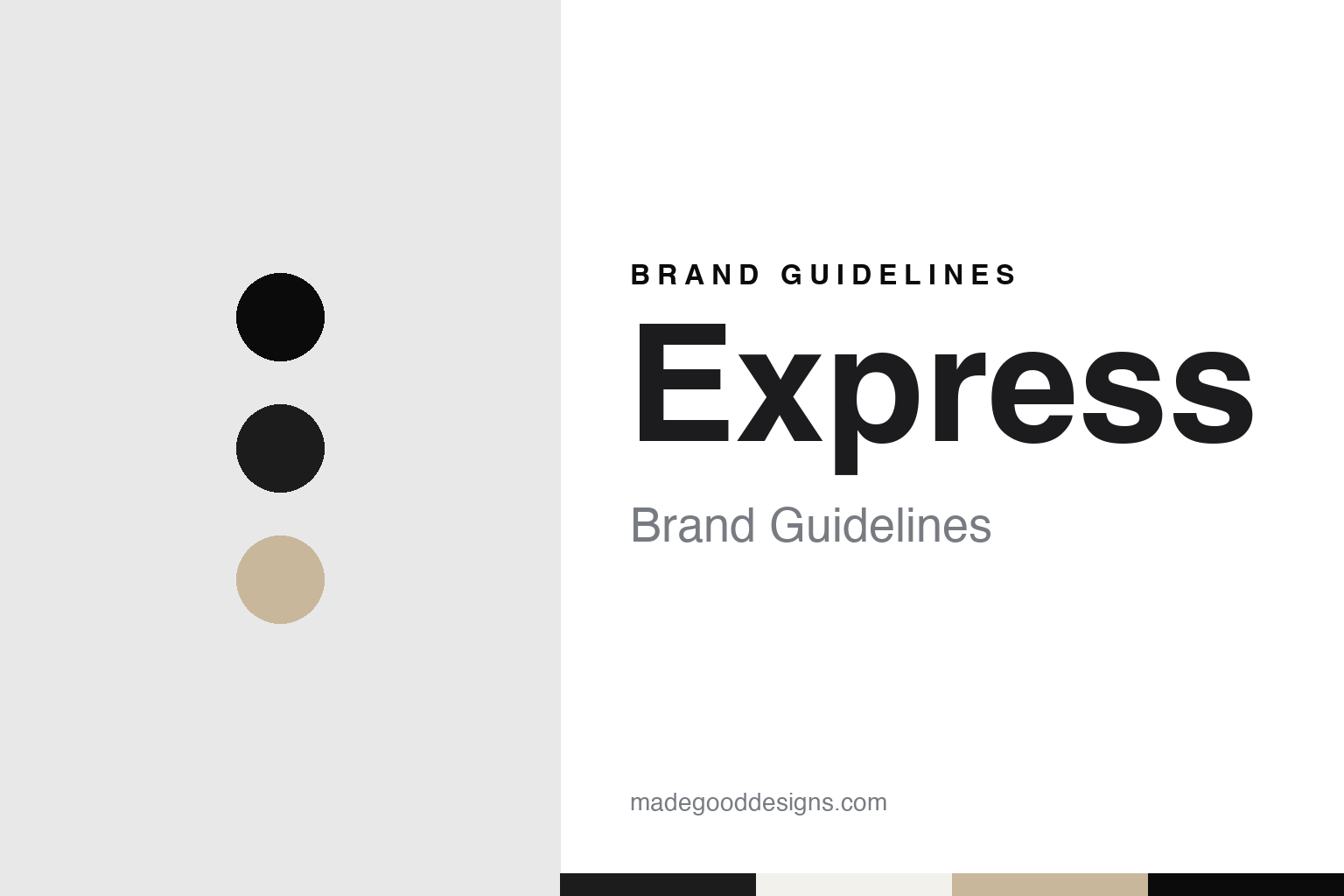
Express Brand Guidelines
From Limited Express in Chicago to the Phoenix joint venture.
Aa
Two constants: a night black, sand and shirt white palette and a fashion serif register. Abstract homage — not an Express product or mark; no logo, label or shopping bag is reproduced.
Limited Express
A test division of The Limited, opened in a Chicago mall.
Express began in 1980 as Limited Express, a women’s clothing store opened by The Limited, the Columbus, Ohio retail group later known as Limited Brands. English Wikipedia places the opening at Water Tower Place, the vertical shopping centre on Chicago’s North Michigan Avenue. The Ohio State University’s Historic Costume & Textiles Collection, in its online exhibit The Columbus Fashion Story, describes Limited Express as the group’s earliest brand extension: an experimental division of women’s specialty apparel and accessories, aimed at a younger customer than the one shopping at The Limited itself.
The look of those early stores was tied to its decade. Wikipedia says Limited Express leaned into the colourful trends of the 1980s and gave the shop a faux French air, and that Michael Weiss, who later ran the business as chief executive, joined in 1981 as the test was widened. In 1982 the word “Limited” was dropped, and the chain traded simply as Express, a date the Ohio State exhibit also gives. The shorter name separated the younger chain from its parent on the mall concourse while it stayed inside the same corporate family.
Through the middle of the 1980s the brand changed its surface. Wikipedia records that by 1986 Express had begun moving away from neon lights, artificial fabrics and bright colours, the cues that had defined its opening years. In 1987 it began testing men’s merchandise in a handful of stores. The menswear line was then set up as a separate chain, Structure, in 1989; the Ohio State exhibit traces the same route, from a range sold as Express for Men to a standalone men’s store.
For more than a decade Express and Structure ran side by side. In 2001 the Structure stores were folded back into Express under the name Express Men, making Express a dual-gender brand, and Wikipedia says stores carrying both lines began opening the following year. The Structure name itself was sold to Sears in 2003. From that point the Express name covered women’s and men’s clothing alike, with the brand’s design work done at its studio in Manhattan’s Flatiron District, while the head office stayed in Columbus.
Colour
Private equity, a public listing, bankruptcy and Phoenix.
Express left its parent in stages. In May 2007 Limited Brands announced that it would sell a majority stake in Express to an affiliate of Golden Gate Capital, the San Francisco private equity firm, and Wikipedia says the sale was completed in July 2007. The Ohio State exhibit also dates the sale of the majority interest to 2007, the same year the group sold control of The Limited, its namesake chain. Limited Brands was by then concentrating on Victoria’s Secret and Bath & Body Works.
The company went public in May 2010. Wikipedia says Limited Brands sold its remaining interest in July 2011 and Golden Gate sold the rest of its holding in March 2012, leaving Express Inc. as an independent listed retailer based in Columbus. The Ohio State exhibit describes its stores as sitting mainly in high-traffic shopping malls, lifestyle centres and street locations, and its range as clothing for work, casual wear and “going out” occasions.
The 2010s and early 2020s added new names to the portfolio. In November 2019 Express announced UpWest, a direct-to-consumer lifestyle brand built around comfort and wellbeing. In January 2023 Express entered a strategic partnership with WHP Global, the New York brand owner, Retail Dive reported, and in April 2023 the two agreed to buy the menswear brand Bonobos from Walmart, with Express running the business and paying royalties to WHP, according to Wikipedia.
On 22 April 2024 Express Inc. and its affiliates filed for Chapter 11 protection in the United States. In June 2024 the bankruptcy court approved the bid of Phoenix, a newly formed joint venture of WHP Global with the mall owners Simon Property Group, Brookfield Properties and Centennial, to acquire most of the retailer’s assets, Retail Dive reported on 17 June 2024. The same report said Phoenix would operate the Express and Bonobos businesses in the United States. Wikipedia dates the announcement that Phoenix had acquired the assets to 25 June 2024.
Phoenix has owned the Express business since 2024. Retail Dive described WHP Global as a brand equity and management firm and its partners as large retail property landlords and owners, and noted that Simon and Brookfield had bought J.C. Penney out of bankruptcy in a similar deal in 2020. In the Phoenix structure, a brand owner and the landlords of shopping centres sit together as owners of the operating company.
Typography
Design and documentation.
Inside a shopping centre, a clothing brand is read long before anyone touches a garment. The store front works as a full-height sign: the fascia, the window displays and the view through the entrance all set an expectation from the far side of the concourse. Some fronts stay open and bright so the merchandise does the talking; others use louvred shutters, dark glass or deep doorways that make the shop feel like a place to step into rather than a counter to walk past.
The carrier bag carries that identity out of the building. A recognisable colour, a printed wordmark or a photograph turns every shopper into a moving advertisement across the mall and the car park, and the bag often outlives the purchase as a reused tote.
Logo tees do a similar job on the body. A wordmark, an emblem or a founding date printed across the chest makes the customer part of the brand’s visual system.
Scent and lighting complete the picture. A signature fragrance, music, warm or low lighting and a particular fixture palette are designed choices too, and a brand guide that ignores them describes only part of what the shopper experiences.
Aa
A high-contrast fashion serif — the register of a window card and a shopping bag. (Specimen set in Bodoni Moda, a serif STAND-IN; NOT the Express logo.)
Express
A shortened name and a brand rebuilt by new owners.
The core of the Express identity is its name. It started as a qualifier, the “Express” half of Limited Express, and within roughly two years it became the whole brand. That change, in 1982, turned a sub-brand of The Limited into a name that could stand on a storefront by itself, and it is the name that survived every change of owner that followed.
The second part of the story is how the brand was dressed for each period. Wikipedia describes the early stores as colourful and faux French, then records the move away from neon and bright colours in the mid-1980s. The menswear experiment produced a separate name, Structure, before the business pulled men’s clothing back under the Express banner as Express Men in 2001. Each step was a decision about how many names one business should carry in the same mall, and the answer settled on a single word.
The third part is ownership. The Limited created the brand in 1980; Golden Gate Capital took the majority in 2007; public shareholders held it from 2010; and Phoenix, the joint venture led by WHP Global with Simon, Brookfield and Centennial, has owned it since 2024. Under Phoenix, Express sits beside Bonobos, the menswear label it bought with WHP in 2023, in a group whose owners also run many of the shopping centres where its stores trade.
Those owners matter to the identity because a mall fashion brand is experienced mostly through its storefronts, its shopping bags and its window graphics. The Ohio State exhibit describes an Express offer that spans work, casual and “going out” clothing under one name. The brand’s design team works from the Flatiron District in Manhattan, while its head office remains in Columbus, Ohio, the city where The Limited built the group that launched it.
For a design guide, Express shows how a single word, cut free from a parent name, can carry a fashion chain through private equity, a stock listing, bankruptcy and a new joint-venture owner. Compare it with Gap, another American mall-era clothing name, and with Victoria’s Secret, which also grew up inside The Limited. For this guide we use night black, fitting-room sand and shirt white with a high-contrast serif, an unofficial interpretation; no product or logo is reproduced.
Explore & save
Keep Express’s identity on hand — save it to a board in the Made Good inspiration library.
Express identity set
Pin the Express night black, sand and shirt white palette and the fashion serif register to your own board.