Aéropostale Brand Guidelines
The Macy’s mall label named for French airmail.
Aa
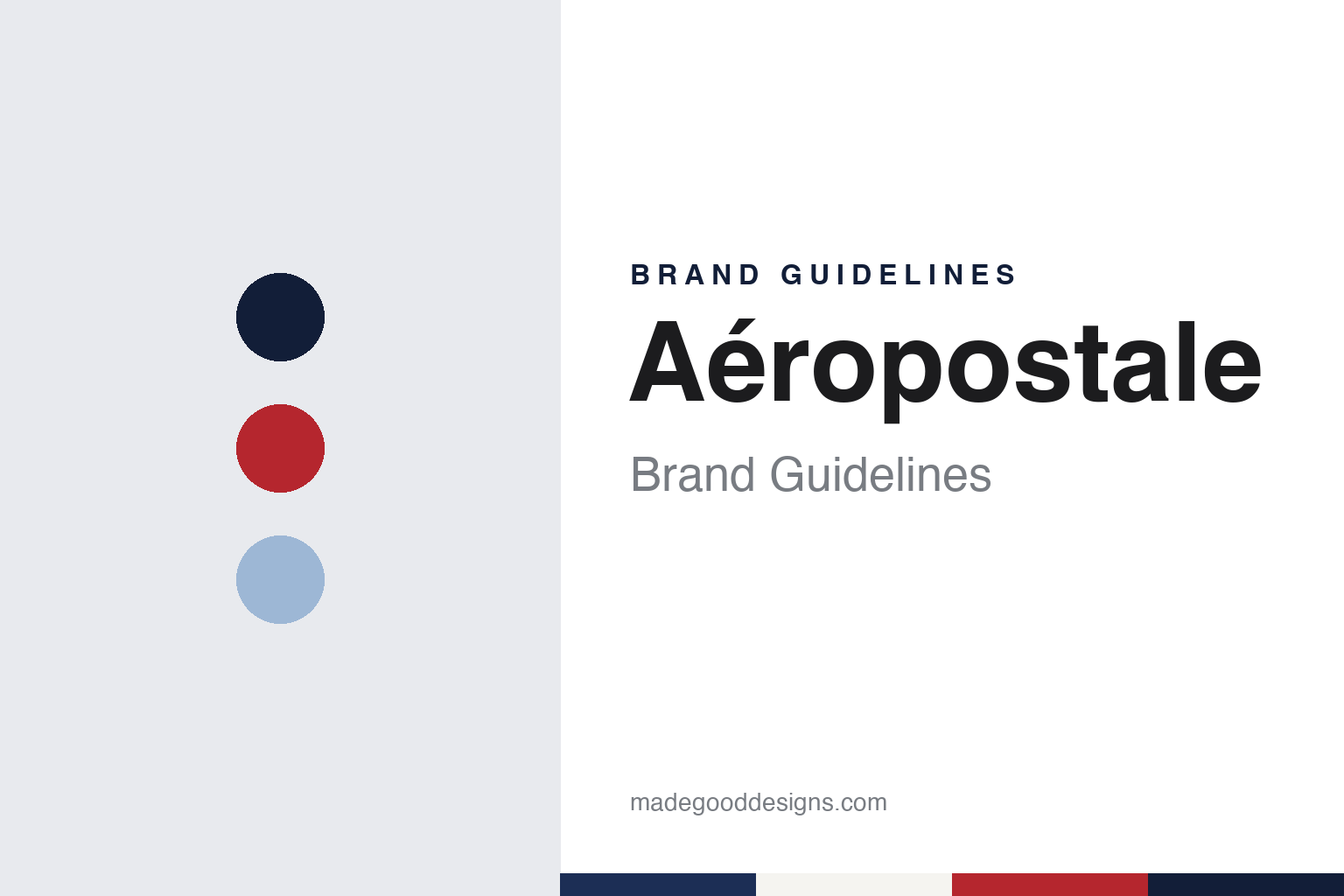
Two constants: an airmail navy, postal red and sky blue palette and a collegiate sans register. Abstract homage — not an Aéropostale product or mark; no logo, tee or store front is reproduced.
A department-store idea
Macy’s, two mall stores and a French name.
Aéropostale began inside a department-store group. English Wikipedia says the brand was created by Macy’s, and that R. H. Macy & Co. opened the original Aéropostale stores in 1987, in Thousand Oaks, California, and Short Hills, New Jersey. From the outset it was a shopping-mall retailer of casual apparel and accessories, aimed mainly at teenagers and young adults.
The name is French. Wikipedia, citing a video the company posted on YouTube, says the English pronunciation is a simplified version of the French word for an airmail service, and it records the many ways shoppers in the United States have said it, from “arrow-PAUSE-tall” to the spelling pronunciation “arrow-post-ALL.” The written name keeps the acute accent on the é, while the brand’s own social media and product graphics also use the clipped form Aero; a 2019 Retail Insider report quotes the brand’s hashtag “#InAero” and refers to “Aero jeans” and “an Aero hoodie.”
Over time the business built sub-brands around the main label. Wikipedia records P.S. from Aéropostale, a line for younger children that began in 2009 and has since been discontinued, and a secondary surf and skate brand, Jimmy’Z, whose stores were styled as more upscale than the parent chain and were closed in fiscal 2009. It also lists a range of current sub-labels for girls and boys sold under the Aéropostale banner.
Aéropostale grew up alongside the other teen outfitters of the American mall. Wikipedia names Abercrombie & Fitch, its sister brand Hollister Co. and American Eagle Outfitters as its main competitors, the same set of stores a shopper would often find on a single concourse, each with its own logo tee, fragrance and store front competing for the same customer.
Colour
Bankruptcy, mall owners and Catalyst Brands.
The brand’s ownership changed hands in 2016. CNN Money reported on 4 May 2016 that the teen retailer had filed for bankruptcy after a long run of quarterly losses, and Wikipedia records that its shares had been delisted from the New York Stock Exchange the previous month. In September 2016 Fortune reported that a bankruptcy judge had approved a plan under which Aéropostale would emerge from Chapter 11 owned in part by the mall operators Simon Property Group and General Growth Properties. Wikipedia names the full consortium as the brand-licensing firm Authentic Brands Group, Simon, General Growth and the investment firms Gordon Brothers and Hilco.
Under its new owners the brand returned to markets it had left. Retail Insider reported in November 2019 that New York-based Aéropostale was coming back to Canada, which it had left in the spring of 2016, first through shop-in-shop spaces inside Bluenotes stores in partnership with YM Inc. and through a Canadian online shop. Wikipedia says that after 2017 the company licensed design, production and distribution in Europe to the London-based LDN Fashion Design group, and that licensees operate Aéropostale stores in the Middle East, Asia, Europe and Latin America. In the United States the brand is also sold through third-party retailers such as Target, Wikipedia adds.
The latest change came in January 2025. CNN reported on 9 January 2025 that JCPenney was combining with Sparc Group, the operator that owned Lucky Brand, Eddie Bauer, Nautica and Aéropostale, to form a new company called Catalyst Brands. USA Today reported the same day that the shareholders behind the new company include Simon Property Group, Brookfield, Authentic Brands Group and Shein. Wikipedia describes Aéropostale as currently owned by Catalyst Brands, and notes that in some of Catalyst’s arrangements the brand name and other intellectual property sit with Authentic Brands Group while the stores operate under a licence.
The result is a brand whose name, logo and stores have passed from a department-store founder to a public company of its own, and then into a group of mall-based labels backed by landlords and a brand-licensing firm.
Typography
Design and documentation.
Inside a shopping centre, a clothing brand is read long before anyone touches a garment. The store front works as a full-height sign: the fascia, the window displays and the view through the entrance all set an expectation from the far side of the concourse. Some fronts stay open and bright so the merchandise does the talking; others use louvred shutters, dark glass or deep doorways that make the shop feel like a place to step into rather than a counter to walk past.
The carrier bag carries that identity out of the building. A recognisable colour, a printed wordmark or a photograph turns every shopper into a moving advertisement across the mall and the car park, and the bag often outlives the purchase as a reused tote.
Logo tees do a similar job on the body. A wordmark, an emblem or a founding date printed across the chest makes the customer part of the brand’s visual system.
Scent and lighting complete the picture. A signature fragrance, music, warm or low lighting and a particular fixture palette are designed choices too, and a brand guide that ignores them describes only part of what the shopper experiences.
Aa
A collegiate sans — the register of a chest print and a hoodie arc. (Specimen set in Archivo, a sans-serif STAND-IN; NOT the Aéropostale logo.)
Aéropostale
A name, an abbreviation and a chest print.
Aéropostale’s identity rests on its name. A French word for airmail gives a mall clothing brand a hint of travel and a ready set of associations, from the accent on the é to the idea of letters and stamps, without the company needing to tell a founding story. The pronunciation debate recorded by Wikipedia shows that the name has been spoken in many different ways in the United States, and that the company itself has put out a guide to saying it.
The shorter form Aero does practical work. On a logo tee, a hoodie or a social-media hashtag, four letters fit where a ten-letter word with an accent would not, and the Retail Insider report of 2019 shows the brand using “#InAero” and the Aero name for its jeans and hoodies. The full name and the abbreviation work as a pair: one for the store fascia and the label, the other for graphics and conversation.
The ownership history has kept the name constant while the business around it changed. Through Macy’s, a public listing, a Chapter 11 sale to a consortium of landlords and licensors, overseas licensees and the formation of Catalyst Brands, the Aéropostale wordmark has remained the asset that each owner bought into.
For a design guide, Aéropostale shows how a borrowed foreign word, an abbreviation and a chest print can carry a mall brand through several changes of owner. Compare its old mall rivals in the American Eagle brand guidelines and the Hollister Co. brand guidelines. For this guide we use airmail navy, postal red and sky blue with a collegiate sans, an unofficial interpretation; no product or logo is reproduced.
Explore & save
Keep Aéropostale’s identity on hand — save it to a board in the Made Good inspiration library.
Aéropostale identity set
Pin the Aéropostale airmail navy, postal red and sky blue palette and the collegiate sans register to your own board.