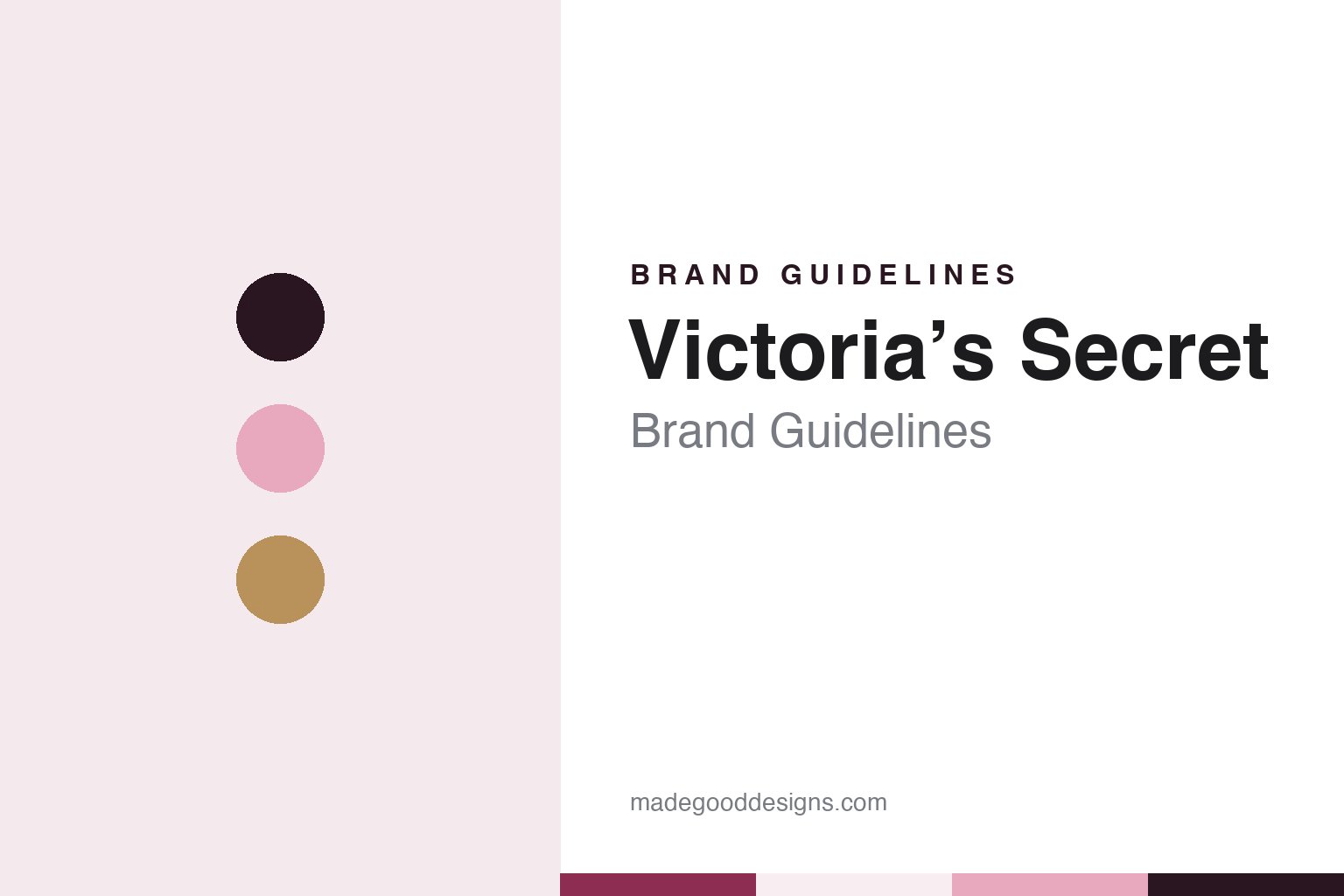
Victoria’s Secret Brand Guidelines
The lingerie name that borrowed Victorian London.
Aa
Two constants: a boudoir berry, blush pink and antique gold palette and a high-contrast serif register. Abstract homage — not a Victoria’s Secret product or mark; no logo, bag or store front is reproduced.
A store for buying lingerie
Palo Alto, a Victorian name and a mail-order catalog.
Victoria’s Secret was founded in 1977 by Roy Raymond and his wife Gaye Raymond. English Wikipedia dates the founding to 12 June 1977 and places the opening store in the Stanford Shopping Center in Palo Alto, California, on the San Francisco peninsula. It quotes Raymond, via Newsweek, describing how uncomfortable he had felt buying lingerie for his wife in a department store, and says the shop was conceived as a place where men could feel at ease doing so.
The name was chosen for its associations. Wikipedia says it refers to Queen Victoria and the refinement associated with the Victorian era, while the “secret” was what lay hidden beneath the clothes. The business added a mail-order catalog early on, and a San Francisco store on Sutter Street followed in 1982, later moving to the Powell Street frontage of the Westin St. Francis hotel, Wikipedia records.
In 1982 Raymond sold the company to Les Wexner. CNBC reported in 2021 that L Brands had bought Victoria’s Secret in 1982, adding it to a stable of mall chains that already included Express, Lane Bryant and The Limited, and that at the time the business consisted of a small group of stores plus its catalog. Wikipedia says Wexner reoriented the brand toward women shoppers and that the stores were redesigned to evoke the Victorian era. It also records that the catalog kept a practice Raymond had begun: printing a London address for the company, although its real headquarters was in Columbus, Ohio.
Under Wexner the brand moved into the American shopping mall and widened its range. Wikipedia lists its own line of fragrances from 1991, an entry into cosmetics in 1998, the Miracle Bra in 1993, the Body by Victoria line in 1999, and PINK, a brand for teenagers and young women, announced in 2002. Its account of the catalog through the 1980s and 1990s draws heavily on contemporary reporting in The New York Times and the Los Angeles Times.
Colour
Angels, a runway show and a spin-off.
The brand’s signature marketing device was a stage show. Wikipedia says Wexner discussed a company fashion event with the marketing executive Ed Razek in 1994, and that the Victoria’s Secret Fashion Show began in New York in 1995, featuring models the company promoted as its Angels. The New York Times, writing in June 2021, described the Angels’ wings, elaborate pieces of rhinestones and feathers, and the jewelled Fantasy Bra as defining images of that era.
That era ended in stages. The Guardian reported on 22 November 2019 that Victoria’s Secret had cancelled its annual televised fashion show after audiences for the broadcast declined. On 16 June 2021 The New York Times reported that the company was replacing the Angels with the VS Collective, a group of women known for their achievements, among them the footballer Megan Rapinoe, who would advise the brand, appear in its advertising and promote it on Instagram. The newspaper also reported that the company had a new executive team and was forming a board on which all but one seat would be held by women.
The corporate structure changed in the same year. CNBC reported on 20 July 2021 that Victoria’s Secret and Bath & Body Works, the two remaining brands of L Brands, were separating; the lingerie business would list as a separate public company named Victoria’s Secret & Co. on 3 August 2021, while L Brands itself would take the Bath & Body Works name. CNBC quoted the company’s leadership saying the brand had gone too far with its Angels and its sex-focused marketing, and that it was setting out to rebuild its foundations.
Wikipedia records the expansion that preceded the split: from 2008 the brand opened outlets in international airports, franchised stores in cities overseas and company-owned stores in Canada and the United Kingdom, and in 2016 it stopped mailing the catalog that had been part of the business since its earliest years.
Typography
Design and documentation.
Inside a shopping centre, a clothing brand is read long before anyone touches a garment. The store front works as a full-height sign: the fascia, the window displays and the view through the entrance all set an expectation from the far side of the concourse. Some fronts stay open and bright so the merchandise does the talking; others use louvred shutters, dark glass or deep doorways that make the shop feel like a place to step into rather than a counter to walk past.
The carrier bag carries that identity out of the building. A recognisable colour, a printed wordmark or a photograph turns every shopper into a moving advertisement across the mall and the car park, and the bag often outlives the purchase as a reused tote.
Logo tees do a similar job on the body. A wordmark, an emblem or a founding date printed across the chest makes the customer part of the brand’s visual system.
Scent and lighting complete the picture. A signature fragrance, music, warm or low lighting and a particular fixture palette are designed choices too, and a brand guide that ignores them describes only part of what the shopper experiences.
Aa
A high-contrast serif — the register of a catalog cover and a boutique fascia. (Specimen set in Bodoni Moda, a serif STAND-IN; NOT the Victoria’s Secret logo.)
Victoria’s Secret
A borrowed era, a catalog and a stage.
Victoria’s Secret’s identity was built on borrowed setting. The name points to Queen Victoria and nineteenth-century London; the catalog, Wikipedia says, carried a London address for a business run from Ohio; and the stores were redesigned to evoke the Victorian era. Together these give a Californian lingerie shop the air of an older English house, much as a period interior gives a boutique its mood.
The catalog was the brand’s long-running medium. For decades it put the name, the photography and the product range into homes before many customers ever visited a store, and its end in 2016 marked a shift in how the brand reached people. PINK added a second, more casual identity aimed at a younger customer, with its own name and its own look.
The runway show turned the brand into an annual broadcast, and its signature props, the wings and the Fantasy Bra described by The New York Times, became recognisable images in their own right. The decision to stop the televised show in 2019 and to replace the Angels with the VS Collective in 2021 shows a brand changing a visible device rather than its name.
For a design guide, Victoria’s Secret shows how a name, a period setting, a catalog and a stage show can work as one identity, and how the parts can be retired or replaced while the name stays. Compare its former L Brands sibling in the Bath & Body Works brand guidelines and Wexner’s earlier mall chain in the Express brand guidelines. For this guide we use boudoir berry, blush pink and antique gold with a high-contrast serif, an unofficial interpretation; no product or logo is reproduced.
Explore & save
Keep Victoria’s Secret’s identity on hand — save it to a board in the Made Good inspiration library.
Victoria’s Secret identity set
Pin the Victoria’s Secret boudoir berry, blush pink and antique gold palette and the high-contrast serif register to your own board.