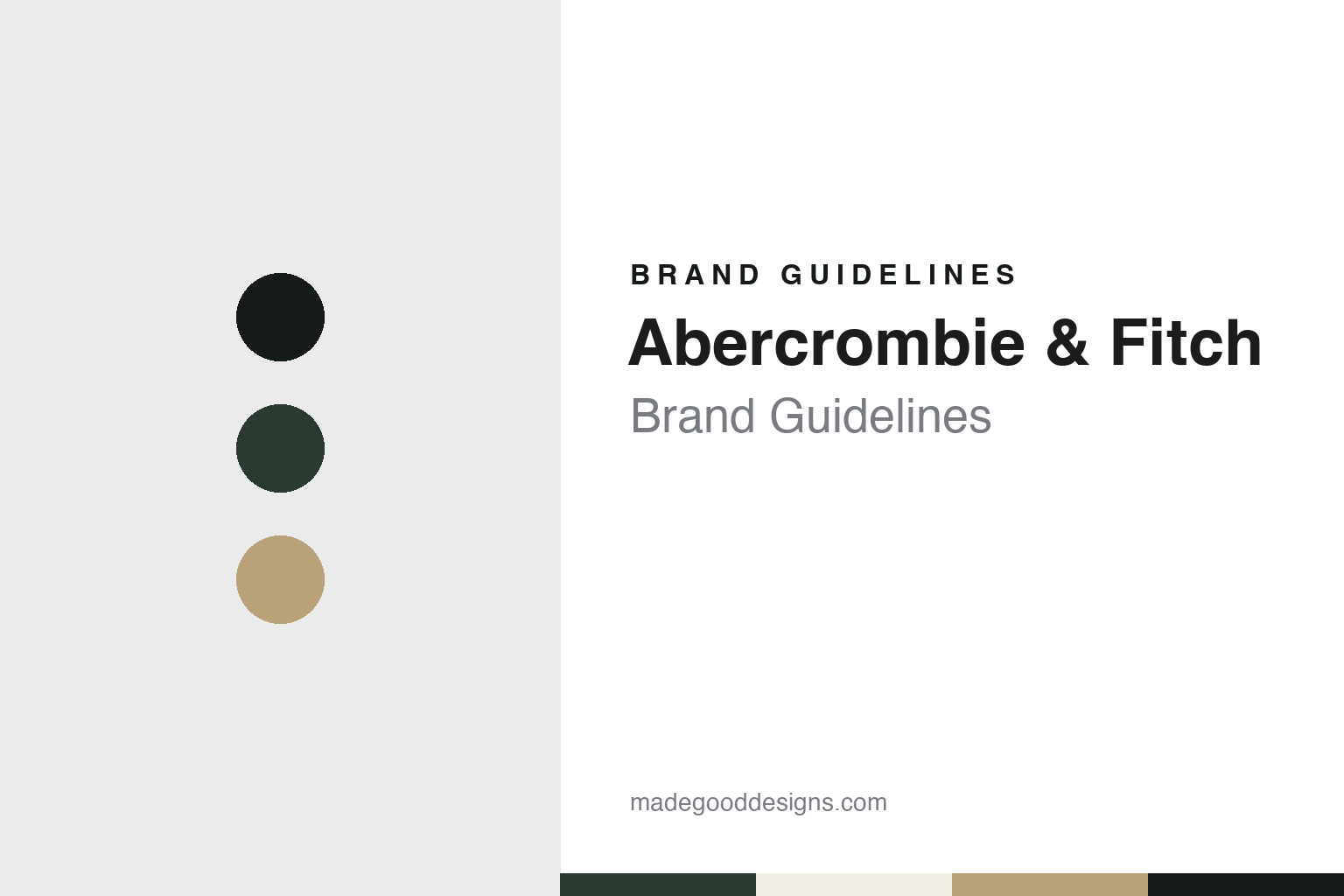
Abercrombie & Fitch Brand Guidelines
From expedition outfitter to a logo-free mall brand.
Aa
Two constants: a lodge green, canvas tan and linen palette and a heritage serif register. Abstract homage — not an Abercrombie & Fitch product or mark; no moose, logo or shopping bag is reproduced.
Abercrombie Co.
A sporting outfitter in Manhattan and a lawyer who bought in.
Abercrombie & Fitch began as an outfitter in New York City run by David T. Abercrombie. English Wikipedia dates the business to 1892 and describes it as an outfitter for the elite outdoorsman; the Ohio State University’s Historic Costume & Textiles Collection, in its online exhibit The Columbus Fashion Story, says Abercrombie opened a small waterfront shop on South Street in Manhattan in 1898 under the name Abercrombie Co.
The second name on the door belonged to a customer. Ezra Fitch, a lawyer, bought a significant stake in the business, which Wikipedia dates to 1900, and in 1904 the company was incorporated as Abercrombie & Fitch Co. The partners disagreed about direction. The Ohio State exhibit says Abercrombie wanted to keep an outdoor-gear store while Fitch wanted to widen into general retail, and that Abercrombie sold his shares in 1907; Wikipedia says Fitch was the sole owner from 1907 to 1928. The exhibit also dates the company’s catalogue to 1907.
In its early decades the company was an expedition and sporting outfitter. Wikipedia says it was known for shotguns, fishing rods, boats and tents, and that it outfitted Theodore Roosevelt’s safari and Admiral Richard E. Byrd’s expedition to Antarctica. Its flagship stood on Madison Avenue at East 45th Street in Manhattan. That heritage of canvas, field gear and named expeditions is the material the brand would draw on, decades later, when it was remade for a much younger customer.
By the 1970s the old business was struggling. Wikipedia says the company filed for Chapter 11 protection in 1976 and closed the Madison Avenue flagship in 1977. The name outlived the company: in 1978 the Houston sporting-goods chain Oshman’s bought the Abercrombie & Fitch name and mailing list and relaunched it as a mail-order retailer of hunting wear and novelty items, later opening stores in Beverly Hills, Dallas and New York, according to Wikipedia.
Colour
The Limited, Mike Jeffries and a spin-off.
In 1988 Oshman’s sold the brand and its operations to The Limited, Les Wexner’s Columbus retail group, which also owned Victoria’s Secret; both Wikipedia and the Ohio State exhibit give that year. Under its new owner Abercrombie & Fitch moved away from hunting gear toward clothing with a preppy outdoor theme that, in the Ohio State exhibit’s words, recalled the company’s original roots while aiming at young adults.
Mike Jeffries was hired as chief executive in 1992, and Wikipedia says the company was spun off from The Limited as a separate, publicly traded business in 1996. The Jeffries years built the image the brand became known for. Wikipedia describes black-and-white advertising photography by Bruce Weber, usually shot outdoors, and store greeters dressed as models. The Ohio State exhibit dates the launch of the A&F Quarterly, a combined magazine and catalogue, to 1997.
The company added brands under the same roof. A line for children and pre-teens named abercrombie, later Abercrombie Kids, launched in 1998, and Hollister followed in 2000, described by the company at launch as a concept built around a laid-back California lifestyle, according to Wikipedia. The lingerie and loungewear label Gilly Hicks and the activewear line Your Personal Best later joined the group.
The head office, which the company calls the Home Office, is a campus in New Albany, Ohio, outside Columbus, designed by Anderson Architects, Wikipedia says; it includes model stores where layouts and in-store atmosphere for each brand are developed and tested.
The turn came in 2014. On 29 August 2014 Refinery29 reported that Abercrombie would remove logo-branded merchandise from its North American stores by the same time the following year, quoting chief operating officer Jonathan Ramsden, via WWD, as saying American consumers were no longer “walking billboards.” The same report listed the introduction of black clothing to the range and an end to the “models-only” staffing policy. Jeffries resigned in December 2014, and Fran Horowitz became chief executive in February 2017, according to Wikipedia, which also records that in 2015 store staff were retitled from “models” to “brand representatives.”
Typography
Design and documentation.
Inside a shopping centre, a clothing brand is read long before anyone touches a garment. The store front works as a full-height sign: the fascia, the window displays and the view through the entrance all set an expectation from the far side of the concourse. Some fronts stay open and bright so the merchandise does the talking; others use louvred shutters, dark glass or deep doorways that make the shop feel like a place to step into rather than a counter to walk past.
The carrier bag carries that identity out of the building. A recognisable colour, a printed wordmark or a photograph turns every shopper into a moving advertisement across the mall and the car park, and the bag often outlives the purchase as a reused tote.
Logo tees do a similar job on the body. A wordmark, an emblem or a founding date printed across the chest makes the customer part of the brand’s visual system.
Scent and lighting complete the picture. A signature fragrance, music, warm or low lighting and a particular fixture palette are designed choices too, and a brand guide that ignores them describes only part of what the shopper experiences.
Aa
A heritage serif — the register of an outfitter’s catalogue and a shop sign. (Specimen set in Cormorant Garamond, a serif STAND-IN; NOT the Abercrombie & Fitch logo.)
Abercrombie & Fitch
Two surnames, a moose and a deliberate retreat from the logo.
The Abercrombie & Fitch identity starts with a partnership name. Two surnames joined by an ampersand date the brand to 1904, when the company took the name of its founder and the customer who bought into it. The pair parted ways within a few years, but the double name stayed, and it is the element that carried across every owner: Fitch alone, then the post-bankruptcy buyer Oshman’s, then The Limited, then the public company created by the spin-off.
The second layer is the brand’s period as a visible logo. In the Jeffries era logo-branded merchandise carrying the moose was part of the range in North America, and the stores were staged around Bruce Weber’s black-and-white photographs and greeters styled as models. The A&F Quarterly, launched in 1997, carried the same image into print. Refinery29’s 2014 report said the moose logo would still be seen in stores outside North America after the change.
The third layer is the retreat. From 2014 the company chose to sell most of its clothing in North America without the logo on the front, and from 2015 it changed how staff were described and dressed. Fran Horowitz has led the company as chief executive since 2017. The outfitter heritage of 1892 to the 1970s, with Roosevelt’s safari and Byrd’s expedition, still sits behind the name as its founding story.
The brand family adds a further register. Hollister, launched in 2000, has its own California-themed identity; Abercrombie Kids uses the shortened family name; and Gilly Hicks and Your Personal Best each carry a separate label, all run from the New Albany campus where model stores are used to test layouts.
For a design guide, Abercrombie & Fitch shows how a two-surname outfitter name can be rebuilt by successive owners, worn as a logo and then deliberately taken off the clothes while staying on the door. Compare it with its sister brand Hollister and with Victoria’s Secret, which shared the same Limited parent. For this guide we use lodge green, canvas tan and linen with a heritage serif, an unofficial interpretation; no product or logo is reproduced.
Explore & save
Keep Abercrombie & Fitch’s identity on hand — save it to a board in the Made Good inspiration library.
Abercrombie & Fitch identity set
Pin the Abercrombie & Fitch lodge green, canvas tan and linen palette and the heritage serif register to your own board.