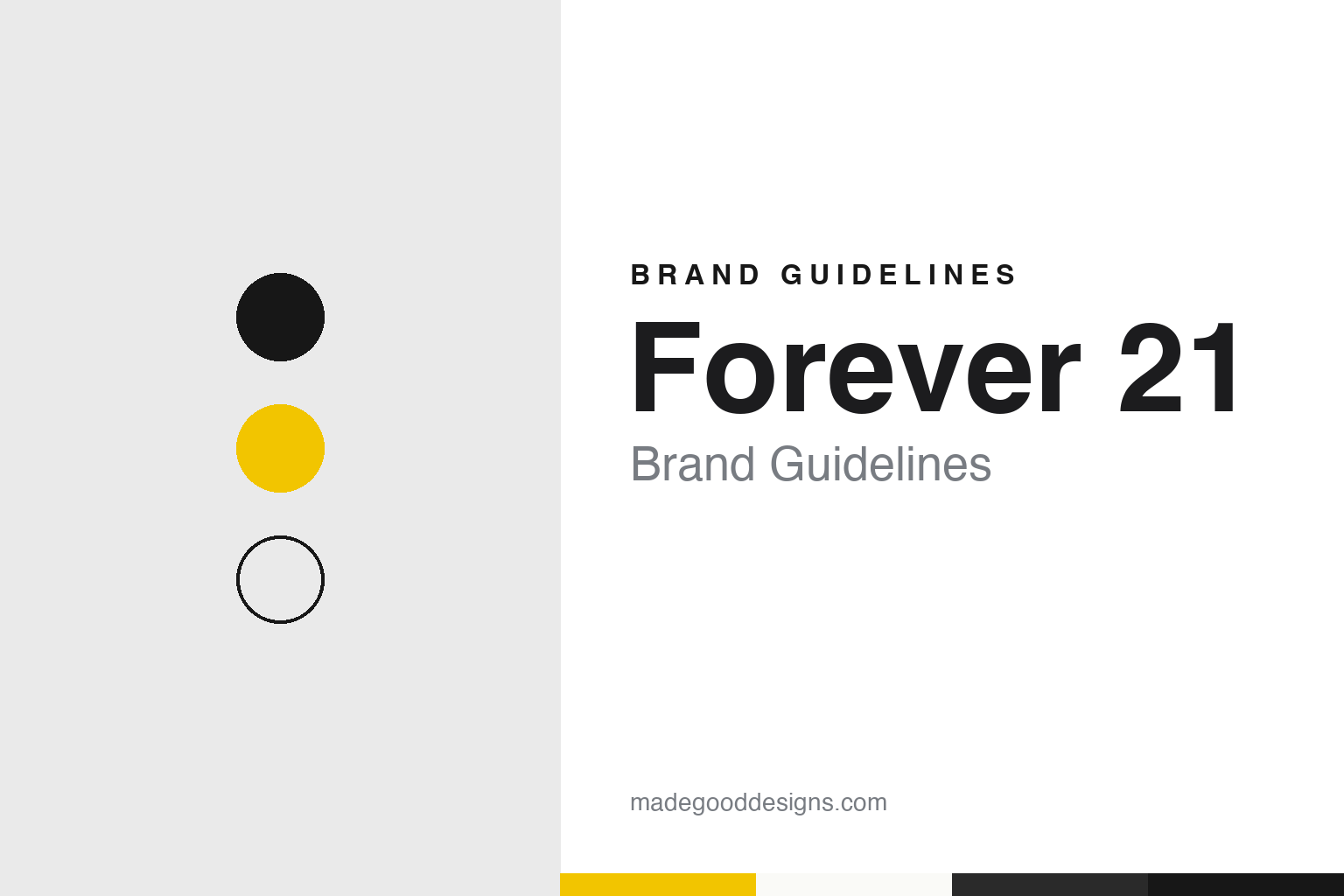
Forever 21 Brand Guidelines
Fashion 21 on Figueroa Street, renamed and carried in a yellow bag.
Aa
Two constants: a bag yellow, graphite and tissue palette and a mall fascia sans register. Abstract homage — not a Forever 21 product or mark; no logo, bag or sign is reproduced.
Fashion 21
A Figueroa Street shop, a new name and a family business.
Forever 21 began as Fashion 21. The Los Angeles Times reported in February 2005 that the retailer opened its original store, then called Fashion 21, on Figueroa Street in Los Angeles in 1984. The New York Times, profiling the chain in May 2007, named its founders and owners as Do Won Chang and Jin Sook Chang, a couple who had immigrated from South Korea, and said the small shop on Figueroa Street in downtown Los Angeles was aimed mainly at schoolgirls. English Wikipedia gives the opening date as 16 April 1984 and places the shop in the Highland Park district, and says the Changs later changed the name from Fashion 21 to Forever 21.
According to The New York Times, the shop did well enough for the Changs to add new stores at a rate of roughly one every six months, and by the early 1990s Forever 21 had become a familiar presence in shopping malls. The company stayed in Los Angeles: in September 2001 the Los Angeles Times described it as based in the city’s downtown garment district. It also stayed in the family. The 2007 profile described Jin Sook Chang as keeping an almost invisible public profile and sending a merchandising vice-president to speak for her, and NPR noted in 2020 that the company had long described itself as a family-owned business.
The Changs’ Christian faith became part of the brand’s packaging. The New York Times reported in 2007 that the stores’ trademark yellow shopping bags carried the stamp “John 3:16” near the bottom, a reference to the Bible verse. The newspaper presented the verse reference as an outward sign of the Changs’ spirituality, in a profile in which the owners themselves declined to be interviewed.
The business model was built on speed. The same profile said Forever 21 delivered its own interpretations of runway looks within weeks, and described daily deliveries of new stock to its stores.
Colour
New formats, two bankruptcies and a brand held by Authentic.
As the chain grew it tried new names and formats alongside the main stores. The Los Angeles Times reported in 2005 that Forever 21 had introduced larger XXI Forever stores in 2001 and was about to open an accessories shop called ForLove21, at the Glendale Galleria. The same report described an agreement to take over the leases of the Texas teen chain Gadzooks, which a Forever 21 executive said would initially continue to trade under the Gadzooks name. The New York Times wrote in 2007 that the company had opened a showpiece store in Pasadena, California, in a former Saks Fifth Avenue building with silver candelabra at the door, selling women’s, men’s and children’s clothing, and that it also ran free-standing For Love accessories shops and the website Forever21.com. Wikipedia records that Forever 21 opened the beauty chain Riley Rose in 2017.
Forever 21 filed for Chapter 11 bankruptcy protection in September 2019, NPR reported. In February 2020 the business was bought by the brand-management firm Authentic Brands Group together with the mall owners Simon Property Group and Brookfield Property Partners, NPR said, and the new owners planned to keep operating its stores in the United States and abroad. Wikipedia says the Simon and Authentic joint venture SPARC Group took over management after the sale, and that SPARC and the online retailer Shein took stakes in each other in August 2023; Retail Dive described the same year’s arrangement as a partnership allowing Forever 21 and Shein to sell each other’s goods.
The US operating company filed for Chapter 11 again in March 2025 and wound down its American stores, Retail Dive reported. Retail Dive also reported that Authentic Brands Group kept the brand’s intellectual property throughout, and in September 2025 Authentic announced new partners to run Forever 21’s US e-commerce and wholesale business, while the brand continued to trade through stores and pop-ups in some international markets. A day later Authentic told Retail Dive it was in advanced discussions with a retail operating partner to open new US stores and would share details in the coming year. Authentic Brands Group has held the Forever 21 brand since 2020.
Typography
Design and documentation.
A fashion retailer’s identity is met first on the street. The fascia above the shopfront carries the name at a scale meant to be read from across the road, so the wordmark may need to work in illuminated letters, in flat paint and in vinyl on glass. Inside, the same mark returns at a smaller size on till points, fitting-room doors and wayfinding signs, and the colour that sits behind it can be as recognisable as the letters themselves.
The shopping bag leaves the shop with the customer. Paper, plastic or fabric, with twisted or flat handles, a bag carries the name out of the shop and down the street, and its design can be as plain as one colour field, one mark and generous margins.
Swing tags and woven labels do quieter work. The tag carries size, care and code information, but its card weight, colour and typeface also signal which line or sub-brand a garment belongs to.
Window displays change with the seasons. Seasonal schemes, mannequin styling and printed graphics let a retailer refresh its look without touching the fascia, while the logo on the fascia stays the same.
Aa
A mall fascia sans — the register of a shopfront sign and a shopping bag. (Specimen set in Montserrat, a sans-serif STAND-IN; NOT the Forever 21 logo.)
Forever 21
A number in the name, a yellow bag and a set of sub-brands.
Forever 21’s identity has been carried by a short list of devices. One is the number. The original name, Fashion 21, already contained it, and the change to Forever 21 kept the numeral while swapping the opening word; later formats reused it again as XXI Forever in Roman numerals and as ForLove21 for accessories, so that the number links the main banner and its offshoots.
Another is the yellow bag. The New York Times called the yellow shopping bags a trademark of the stores in 2007, with the John 3:16 stamp printed near the bottom. The third is the store itself. The 2007 profile contrasted the bright, tidy Los Angeles shops with busier Manhattan branches, and described the Pasadena store, set in a former Saks Fifth Avenue building, as the company’s showpiece.
Since 2020 the brand has been managed as a licensed name rather than as a family retailer. Authentic Brands Group, which also holds other American fashion names, has used partners for e-commerce, wholesale and international stores, and Wikipedia records collaborations in 2022 with Hervé Léger, Sports Illustrated and Barbie. With the US stores closed in 2025, the yellow bag and the shop fascia are no longer part of American malls, and the name now reaches US shoppers mainly online and through partner retailers.
For a design guide, Forever 21 shows how a single numeral can tie together a family of store names, and how a coloured shopping bag can become the part of a retail identity that customers carry home. Compare it with H&M and Zara, two other chains built around fast-changing ranges. For this guide we use bag yellow, graphite and tissue with a sans, an unofficial interpretation; no product or logo is reproduced.
Explore & save
Keep Forever 21’s identity on hand — save it to a board in the Made Good inspiration library.
Forever 21 identity set
Pin the Forever 21 bag yellow, graphite and tissue palette and the mall fascia sans register to your own board.