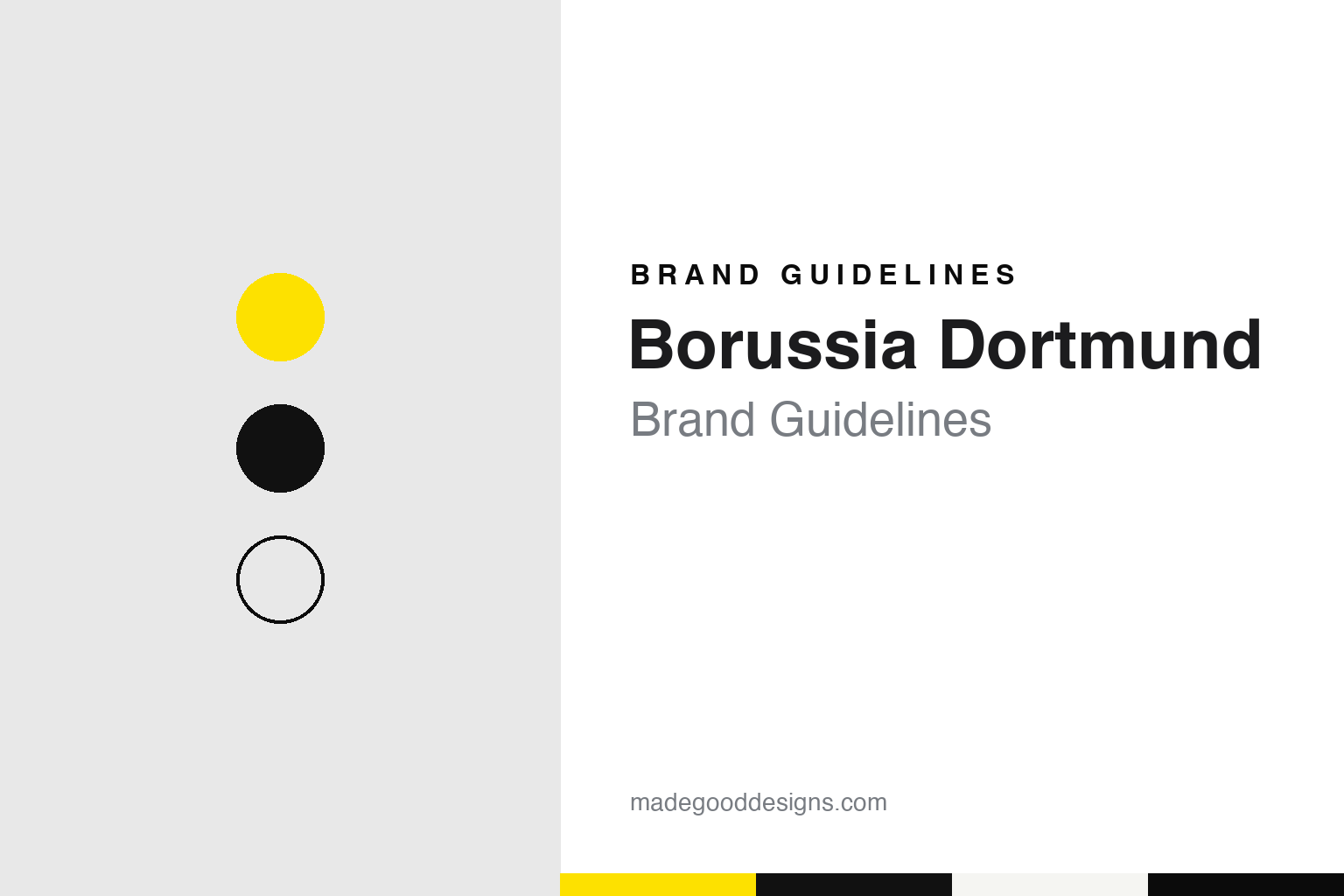
Borussia Dortmund Brand Guidelines
A brewery name, a lemon-yellow shirt and three letters.
Aa
Two constants: a lemon yellow, crest black and terrace white palette and a condensed stand sans register. Abstract homage — not a Borussia Dortmund product or mark; no crest, shirt or logo is reproduced.
Borussia
A pub meeting, a closed door and a brewery sign.
Borussia Dortmund grew out of a church youth group. German Wikipedia says the Catholic youth association Dreifaltigkeit (Trinity) was set up in November 1901 for the parish of the same name in the north-east of Dortmund, and that its members, many of them young steelworkers and miners, played football on the fields around the Borsigplatz from 1906 at the latest. The parish chaplain, Hubert Dewald, opposed the football and the culture around it, and the conflict between the association’s leadership and the young players grew.
It came to a head on 19 December 1909. German Wikipedia says members met in a side room of the pub Wildschütz to discuss founding a club independent of the church; some left the meeting and told Dewald, who arrived to break it up and was refused entry. The remaining eighteen founded the club. English Wikipedia lists them, among them Franz and Paul Braun, Franz, Julius and Wilhelm Jacobi and Heinrich Unger, who German Wikipedia says became its chairman.
The name was improvised. Because the founding was spontaneous, German Wikipedia says, there were no name proposals in advance, and according to an anecdote the word Borussia was chosen because an advertising sign for the nearby Borussia brewery hung on the pub wall. Borussia is the Latin name for Prussia, but German Wikipedia notes that the choice was probably not meant as an expression of national pride. The member club’s full name, German Wikipedia shows, is Ballspielverein Borussia 09 e. V. Dortmund, the source of the initials BVB.
The colours took a few years to settle. English Wikipedia says the team originally played in blue and white striped shirts with a red sash and black shorts. German Wikipedia records that in 1912 three other Dortmund clubs, Rhenania, Britannia and Deutsche Flagge, joined Borussia, and that on 14 February 1913 BVB adopted the club colours and a lemon-yellow shirt with a black “B” as its playing kit. The black and yellow gave the club its nickname, die Schwarzgelben.
Professional football is run by Borussia Dortmund GmbH & Co. KGaA, which English Wikipedia says was floated on the stock market in October 2000; its managing partner is wholly owned by the member club, Borussia Dortmund e.V.
Colour
BVB 09, a lion and a return.
The crest is built from the letters BVB and the year 09 in black on a yellow ground. German Wikipedia says the club crest was designed and introduced in the 1920s.
There was one notable interruption, and it came from a sponsor. German Wikipedia says that for the opening season after the club returned to the Bundesliga in 1976, BVB presented the Dutch tobacco company Samson as its shirt sponsor. Along with a lion as a mascot, the deal brought a change to the crest on the shirt: from 1976 to 1978 it was a round badge with the head of a lion in the centre, the logo of the Samson tobacco brand of the firm Theodorus Niemeijer, surrounded by the lettering “Borussia Dortmund”. From 1978 the crest was replaced again by the classic black “BVB 09” on yellow.
The kit has carried the black and yellow through several makers. English Wikipedia says Puma has been the club’s main equipment supplier since the 2012–13 season. Shirt fronts have occasionally been used for messages rather than sponsors: German Wikipedia records that for a home match on 21 December 2018 the club played in special shirts on which the sponsor’s logo was replaced by the words “Danke Kumpel”, a tribute marking the end of hard-coal mining in Germany with the closure of the last colliery, Prosper-Haniel in Bottrop.
The club’s origins also appear in its graphics. English Wikipedia says that in November 2012 Borussia Dortmund KGaA set up a charitable trust, leuchte auf, whose logo is a star formed by the streets that meet at the Borsigplatz, where the club was founded.
Typography
Design and documentation.
A football club’s identity is usually built from a small set of parts that supporters learn to read at a glance. The crest sits at the centre: a shield, roundel or monogram that may carry a city emblem, a founding year, a letter cipher or an animal. Crests are redrawn every few decades, often to simplify detail for screens, embroidery and small sizes, and each redraw tends to prompt debate among supporters about what should be kept.
Colour pairs carry as much weight as the crest. Two colours, set as vertical stripes, hoops, halves or a plain shirt with contrasting trim, can identify a club from the far side of a stadium. Kit makers interpret those colours each season, adding their own marks on the chest and sleeves, so a club’s look is always shared between its own badge and a manufacturer’s logo.
Beyond the official marks, supporters add a third layer: banners, flags and choreographies painted in club colours, with hand-made lettering that often echoes the crest. For a design guide, the useful lesson is how few elements carry the whole identity, and how carefully each one is protected.
Aa
A condensed stand sans — the register of a crest monogram and a block number on a terrace. (Specimen set in Barlow Condensed, a sans-serif STAND-IN; NOT the Borussia Dortmund logo.)
Borussia Dortmund
A stadium without a track, and a stand in yellow.
The home ground is a large part of the brand. English Wikipedia says the Westfalenstadion, named after the home region of Westphalia, replaced the neighbouring Stadion Rote Erde in 1974. Dortmund had not been planned as a host of the 1974 World Cup; when Cologne withdrew its plans, the funds set aside for a stadium there were reassigned to Dortmund. German Wikipedia says the official opening took place on 2 April 1974 with a friendly against the club’s Ruhr rivals from Gelsenkirchen, and describes the ground as built in a typically English style, without a running track.
The South Stand has its own name. Goal.com, in a feature dated 18 March 2015, described the terrace as officially the Südtribüne (South Stand) but better known as the Yellow Wall, noted that it becomes seated for European matches, and said it was built in the early 1970s and rebuilt on a larger scale in the 1990s. The same feature said the stadium had no running track around the pitch, which let the club present it as a “pure” football ground. German Wikipedia says that when the stadium opened, the north and south stands were reserved for standing spectators.
The stadium’s name has changed with sponsors. English Wikipedia says that in 2006 the ground was renamed Signal Iduna Park after an insurance company, and that the name cannot be used at FIFA and UEFA events: during the 2006 World Cup it was called “FIFA World Cup Stadium, Dortmund”, and in UEFA club matches it is known as “BVB Stadion Dortmund”. In 2008 the club opened a museum, the Borusseum, inside the stadium.
For a design guide, Borussia Dortmund shows how a club can keep one colour pair and three letters at the centre of its identity, and let its supporters on one terrace become a part of the visual identity. Compare it with Puma, the club’s kit supplier since 2012–13, and Bayern Munich, another Bundesliga club. For this guide we use lemon yellow, crest black and terrace white with a sans, an unofficial interpretation; no product or logo is reproduced.
Explore & save
Keep Borussia Dortmund’s identity on hand — save it to a board in the Made Good inspiration library.
Borussia Dortmund identity set
Pin the Borussia Dortmund lemon yellow, crest black and terrace white palette and the condensed stand sans register to your own board.