Bayern Munich Brand Guidelines
A gymnastics-club breakaway that wears the flag of Bavaria on its chest.
Aa
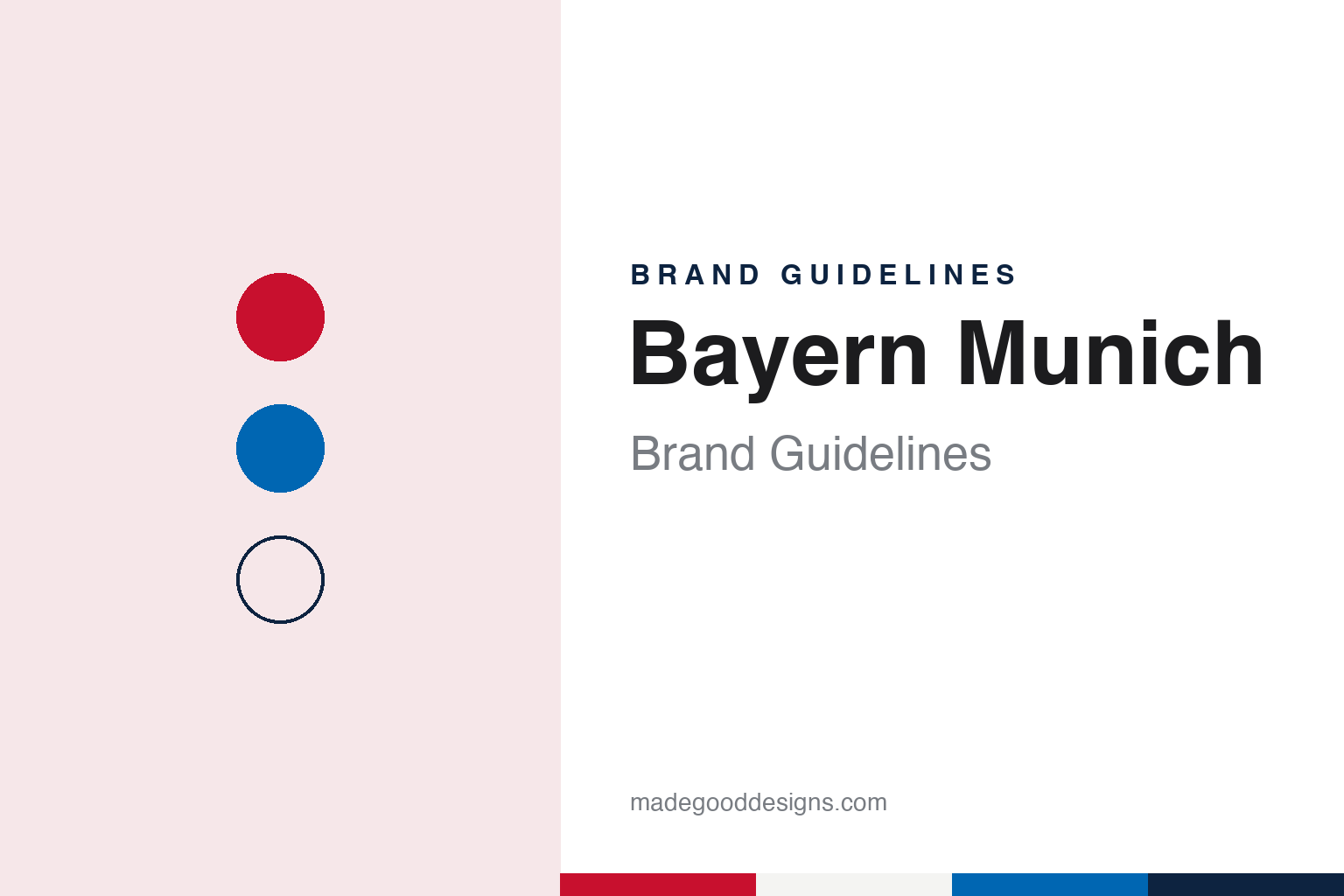
Two constants: a shirt red, lozenge blue and lozenge white palette and a condensed matchday sans register. Abstract homage — not a Bayern Munich product or mark; no crest, shirt or logo is reproduced.
Fußball-Club Bayern München
A walkout, a new club and a name taken from the region.
Bayern Munich began with a walkout. English Wikipedia says the club was formed by members of a Munich gymnastics club, MTV 1879. On 27 February 1900 a meeting of that club decided its footballers would not be allowed to join the German Football Association, the DFB. Eleven members of the football section left the meeting and, the same evening, founded Fußball-Club Bayern München. Wikipedia names Franz John as the man who led them.
The name says where the club wanted to belong. Bayern is the German name for Bavaria, the state of which Munich is the capital, and the founders chose a regional name rather than a district or a street. That choice still shapes the visual identity: the club’s crest and its stadium both draw on Bavarian symbols more than on anything specific to the city.
The early years were spent moving between organisations. Wikipedia says that in 1905 Bayern joined a larger sports club, MSC, and from 1919 to 1924, it was the football department of TSV Jahn Munich. Each of those arrangements left a trace on the badge or the kit, as the sections below describe. The club’s president from the period, Kurt Landauer, left Germany in the 1930s; Wikipedia says he returned from exile in 1947 and served as president again until 1951.
The modern organisation took shape around the professional team. Wikipedia says professional football is run by FC Bayern München AG, a privately held joint-stock company, and that the majority of it is owned by the members’ club, FC Bayern München e.V. Three Bavarian companies hold minority stakes: Adidas since 2002, Audi since 2009 and Allianz since 2014. The club announced the Allianz agreement on 11 February 2014, describing the insurer as its third strategic partner after Adidas and Audi, and noting that all three are headquartered in Bavaria. The headquarters and training ground are at Säbener Straße in Munich.
Colour
From four interlaced letters to a red ring and the lozenges of Bavaria.
The crest has been redrawn several times, and English Wikipedia sets out the main stages. The original badge was a monogram: the letters F, C, B and M, stylised and woven into a single symbol, printed in blue. It read as a set of initials more than a picture, in the manner of many club badges of the period.
The years inside TSV Jahn produced a different mark. Wikipedia says the crest used from 1919 to 1924 carried the words “Bayern FA”, where FA stood for Fußball-Abteilung, the football department. It was a badge that described the club’s administrative position, and it was dropped once Bayern stood on its own again.
The decisive change came in 1954, when, according to Wikipedia, the colours of Bavaria were included in the crest. The Bavarian state flag is a pattern of white and blue lozenges, known in German as the Rauten, and once they entered the badge they became its fixed centre. The crest has changed in several steps since the 1954 version. For long stretches it was printed in a single colour, either blue or red. The current version is blue, red and white: the Bavarian lozenges sit in the middle, enclosed by a red ring on which FC Bayern München is written in white.
That arrangement gives the club two separate sources of colour. The red comes from the shirts, the blue and white from the regional flag, and the badge holds them together. Wikipedia notes that the original club constitution named the colours as white and blue, so the lozenges also return the crest to the founders’ choice.
Outside the crest, the club uses other recurring symbols. Wikipedia describes “Mia san mia”, Bavarian for “we are who we are”, as a well-known club motto, and says the club mascot since 2004 has been Berni, an anthropomorphic bear.
Typography
Design and documentation.
A football club’s identity works across a wide range of surfaces. The crest sits at the centre of it: a compact mark that has to read on a shirt seen from the far side of a stadium, on a television scoreboard graphic, on a phone app icon and on a stitched scarf. Clubs revise their crests from time to time, usually simplifying detail, tightening outlines or redrawing lettering so the mark reproduces cleanly at small sizes and in a single colour.
Kit colours carry the identity as much as any logo. A club’s home colours are often older than its crest, and supporters recognise them at a glance, so designers tend to treat them as fixed while the cut, trim and pattern of the shirt change from season to season. Away and third kits give more room for experiment.
Shirt sponsors add a second brand to a highly visible surface a club owns, which means the crest, the kit maker’s mark and the sponsor’s wordmark have to sit together without crowding. Stadium signage, from gate numbers to the name on the stand roof, extends the same system into architecture, wayfinding and the backdrop of every broadcast.
Aa
A condensed matchday sans — the register of a shirt number and a turnstile sign. (Specimen set in Barlow Condensed, a sans-serif STAND-IN; NOT the Bayern Munich logo.)
Bayern Munich
Red shorts, red shirts and a stadium that changes colour.
The red arrived by decree. English Wikipedia says the early team played in white shirts with black shorts until 1905, when joining MSC meant the footballers had to wear red shorts. For much of the early history the home kit was white and maroon. The modern red took over in stages: red and blue striped shirts in 1968–69, red and white stripes between 1969 and 1973, an all-white kit with single red and blue vertical stripes in 1973–74, and from 1974 a largely all-red home kit with white trim. Wikipedia lists variations since: red and blue stripes again from 1995 to 1997, an all-navy home shirt with a red chest band in 1997, and a Rotwein, or red-wine, shirt between 2001 and 2003 that recalled the pre-1960s colours. In 2013–14 the home shirt carried a watermark of Bavarian lozenges, the crest pattern turned into a fabric print.
Wikipedia names Adidas as the club’s kit manufacturer since 1974, and Deutsche Telekom as shirt sponsor since the 2002–03 season. Inside World Football, in a report by Mark Baber dated 2 May 2015, said Bayern had announced a ten-year extension of its deal with Adidas, carrying an agreement that had been due to end in 2020 on to 2030.
The stadium extends the colour system into architecture. Bayern has played at the Allianz Arena since the 2005–06 season, after decades at the Olympiastadion. Wikipedia says the arena was designed by the Swiss architects Herzog & de Meuron, that construction began on 21 October 2002, and that it officially opened on 30 May 2005. Its outer skin is made of inflated ETFE-foil panels, each of which can be lit independently in white, red or blue. Wikipedia says the panels are lit red for Bayern home games and white for Germany national team matches, so on a match night the building itself carries the club colour. A club museum, the FC Bayern Erlebniswelt, opened inside the arena in May 2012.
For a design guide, Bayern Munich shows how a club can keep a regional flag at the centre of its badge while letting the shirt supply a second, louder colour. Compare it with Adidas, the club’s kit maker and a shareholder since 2002, and Real Madrid, another club whose crest was shaped by a crown, a ring and a regional band. For this guide we use shirt red, lozenge blue and lozenge white with a sans, an unofficial interpretation; no product or logo is reproduced.
Explore & save
Keep Bayern Munich’s identity on hand — save it to a board in the Made Good inspiration library.
Bayern Munich identity set
Pin the Bayern Munich shirt red, lozenge blue and lozenge white palette and the condensed matchday sans register to your own board.