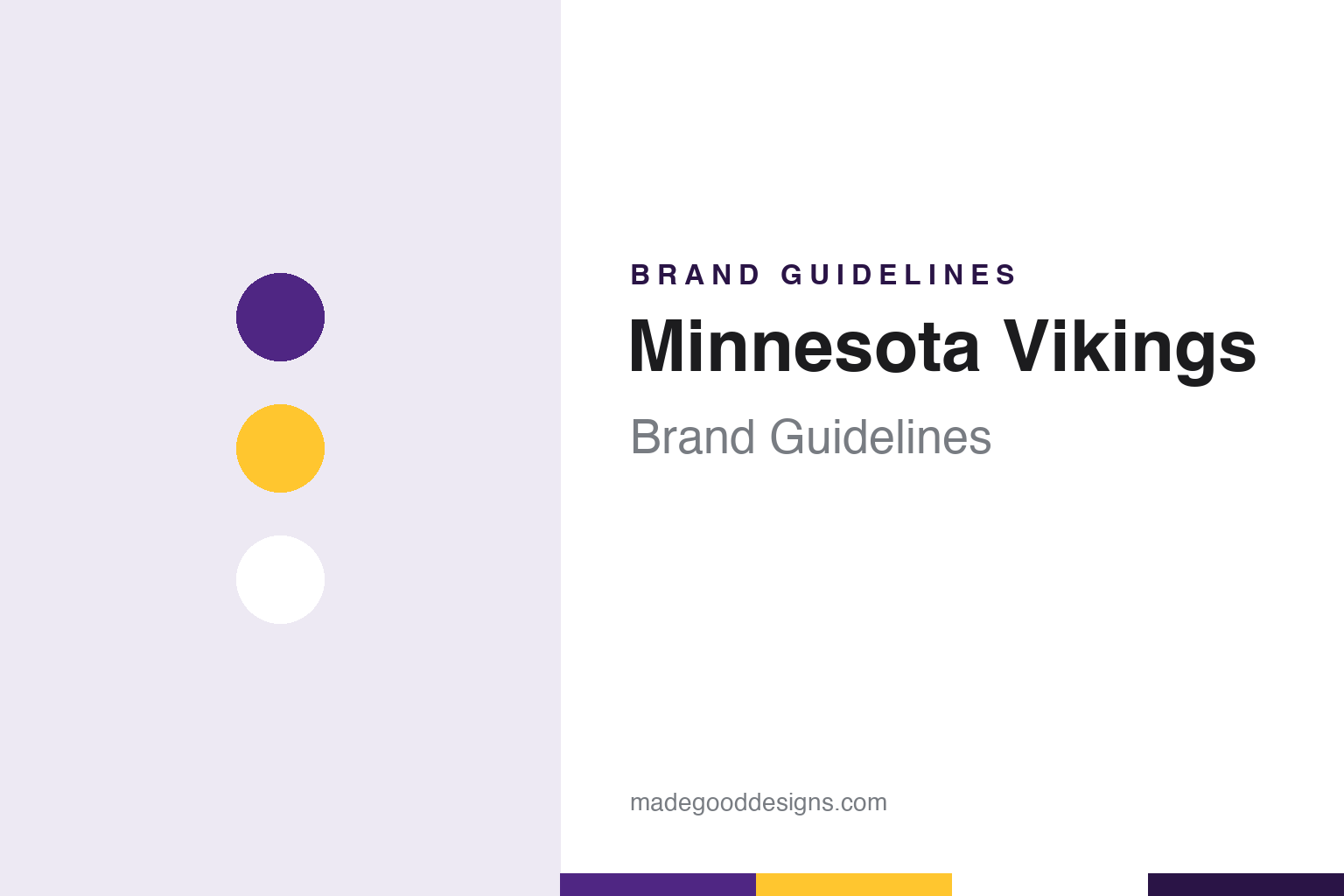
Minnesota Vikings Brand Guidelines
From a 1960 franchise and a Nordic name to a purple helmet with a white horn.
Aa
Two constants: a purple, gold and white palette and a condensed athletic sans register. Abstract homage — not a Minnesota Vikings product or mark; no helmet, uniform or logo is reproduced.
Minnesota
A switched league, a Nordic name and a cartoonist’s pen.
The Minnesota Vikings began with a change of league. English Wikipedia says that in August 1959 the Minnesota businessmen Bill Boyer, H. P. Skoglund and Max Winter were awarded a franchise in the new American Football League, and that five months later, under pressure from the NFL, the group, joined by Bernard H. Ridder, walked away from that agreement. MNopedia, the online encyclopedia of the Minnesota Historical Society, says Minnesota was added to the National Football League on 28 January 1960 at the owners’ meeting in Miami, Florida, with play to begin in 1961.
The name came that autumn. MNopedia says that on 27 September 1960 it was announced that the team would be called the Minnesota Vikings, in recognition of the Nordic traditions of the northern United States, and that the club’s official colours were purple and gold. Wikipedia makes the same point, saying the name reflects Minnesota’s place as a centre of Scandinavian American culture. It adds a smaller thread: Ole Haugsrud, who joined the ownership through a clause from his sale of the old Duluth Eskimos, had gone to Central High School in Superior, Wisconsin, whose teams were also called the Vikings and wore a similar purple and yellow.
The look was drawn by a newspaper cartoonist. Wikipedia says the horned helmet, the purple and gold uniforms and the original Norseman logo were designed by Karl Hubenthal, a cartoonist at the Los Angeles Examiner. The general manager Bert Rose and the coach Norm Van Brocklin both knew Hubenthal from their years with the Los Angeles Rams organisation.
The first homes were in the suburbs and then downtown. MNopedia says the Vikings played their first regular-season home game at Metropolitan Stadium in Bloomington on 17 September 1961, and moved in 1982 to the Hubert H. Humphrey Metrodome in downtown Minneapolis. Wikipedia adds that in May 1981 the club opened a headquarters and practice site in Eden Prairie named Winter Park, after the founder Max Winter, who served as team president from 1965 to 1987.
Colour
Two primary marks, one horn and a long run of the same uniform.
The identity has two primary marks. Wikipedia says one is the profile of a blond Norseman and the other a white Viking horn, both reflecting the state’s Scandinavian heritage. The helmet is purple with a horn on each side, outlined in gold. The original uniform paired white pants and gold trim with purple or white jerseys, and the sleeves carried the Northwestern stripe pattern in white with gold trim, switched to purple on the white jersey. From 1969 through 1973 the club also had a stripeless purple jersey for warm-weather games.
The set stayed close to Hubenthal’s design for decades. Wikipedia says the logos and uniforms essentially remained the same from the 1961 debut to 1995, and that the uniforms were redesigned in 2006, keeping the colours but adding trim lines to the shoulders, sleeves and the sides of the jerseys and pants. The horn on the helmet was made slightly more defined at the same time, and purple pants were added to the set.
The Norseman was redrawn in 2013. On 14 February 2013, Wikipedia says, the club unveiled a tweaked logo with updated shading, a reshaped horn and base, a thicker moustache and face, brighter gold tones and a shorter braid. New uniforms followed on 25 April 2013, presented at the team’s annual draft party.
Alternates now lean on the two extremes of the palette. The league’s Color Rush programme in 2016 produced an all-purple uniform with gold numbers and pant stripes, which Wikipedia says later became known as the Primetime Purple set. The club wore all white at home for a “Winter Whiteout” game on 24 December 2022, painting the field logo and end zones white with purple accents, and on 6 June 2024 it unveiled an all-white “Winter Warrior” uniform with a satin white helmet and a metallic grey stripe inspired by the metal strips on Viking helmets. A 2023 throwback revived the 1960s purple jersey with gold-trimmed numbers, grey facemasks and throwback horn decals on the current matte purple helmet, and a 2026 “Rivalries” uniform added ivory and metallic gold accents, Nordic knot striping and rune symbols to a deep purple base.
Typography
Design and documentation.
A professional football identity is built from a small set of parts that have to work together at very different sizes. The helmet decal is a compressed version of the identity: a mark that sits on a curved shell, is seen from the side at a distance and has to read in a single colour against a painted surface. Many clubs keep the helmet mark separate from the primary logo used on print and screens, and the two are often redrawn on different schedules.
Colour names are part of the system. Clubs and their uniform suppliers give their tones proper names, and those names travel from style guides onto merchandise labels and broadcast graphics, which helps keep a shade consistent across fabric, paint and pixels.
Throwback uniforms let a club revisit an earlier set without retiring the current one, so an older wordmark, numeral style or helmet colour can return for a single season or a few games. Stadium naming adds another layer: when naming rights change, the building’s signage, tickets and wayfinding are rebranded while the team’s own marks stay the same.
Aa
A condensed athletic sans — the register of a stadium wordmark and a sideline banner. (Specimen set in Oswald, a sans STAND-IN; NOT the Minnesota Vikings logo, wordmark or numerals.)
The horn and the hall
Owners, a glass-roofed stadium and the sound of a horn.
The ownership has changed hands several times since the founders. Wikipedia says Zygi Wilf and five partners bought the Vikings from Red McCombs in 2005, and the Wilf family has owned the club since then, with Zygi Wilf as chairman.
The current home opened in 2016 on the site of the Metrodome. Wikipedia says the club spent the 2014 and 2015 seasons at the University of Minnesota’s open-air stadium while U.S. Bank Stadium was built, that the Dallas firm HKS was selected as architect in September 2012 with Mortenson as construction manager, and that the design uses a skylit roof of ETFE and glazed entrances with giant pivoting doors to bring in natural light. The first NFL game in the building was a preseason game on 28 August 2016.
The Norse theme runs through the game-day programme. Wikipedia says the mascot Ragnar, based on the Norse saga figure Ragnar Lodbrok, appeared from 1994 to 2015, and that Viktor the Viking, a muscle-bound, moustachioed character in a number 1 jersey, was introduced in 2007. The same year the club began sounding the Gjallarhorn in pre-game ceremonies. The fight song “Skol, Vikings” dates from around the team’s founding, and the word skol is an anglicisation of the Scandinavian skål, meaning “cheers”. Fans wear purple “Helga hats” with white horns and blonde braids.
For a design guide, the Minnesota Vikings show how a name taken from regional heritage can set the whole visual system, from a horn on the helmet to a profile on the logo and a pair of colours that have barely moved since 1961. Compare a division neighbour in our Green Bay Packers brand guidelines, the league itself in our NFL brand guidelines and the uniform maker in our Nike brand guidelines. For this guide we use Vikings purple, gold and horn white with a condensed sans, an unofficial interpretation; no product or logo is reproduced.
Explore & save
Keep Minnesota Vikings’s identity on hand — save it to a board in the Made Good inspiration library.
Minnesota Vikings identity set
Pin the Minnesota Vikings purple, gold and horn white palette and the condensed athletic sans register to your own board.