Green Bay Packers Brand Guidelines
A meat-packer’s sponsorship, green and gold, and a G in a football shape.
Aa
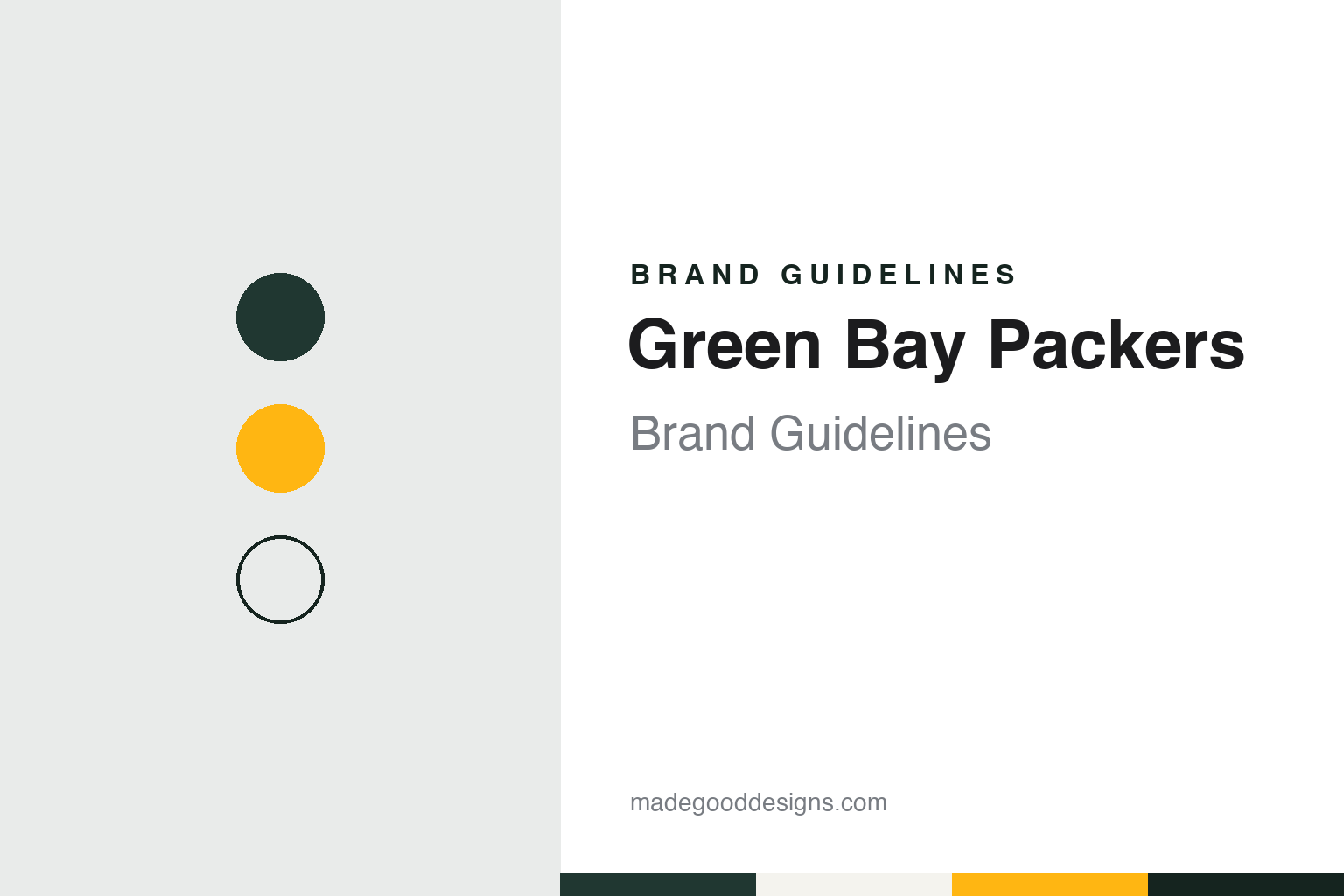
Two constants: a hunter green, athletic gold and jersey white palette and a condensed helmet sans register. Abstract homage — not a Green Bay Packers product or mark; no helmet, uniform or logo is reproduced.
Indian Packing
A sponsor’s name on a town team.
The Green Bay Packers were founded in Green Bay, Wisconsin, on 11 August 1919, by two former high-school football rivals, Earl “Curly” Lambeau and George Whitney Calhoun, according to English Wikipedia. The Pro Football Hall of Fame’s team history dates the club to August 1919, when the Indian Packing Company agreed to sponsor a local professional football team under Lambeau’s direction.
The name came with the money. Wikipedia says Lambeau, who worked for the meat-packing company, asked his employer to pay for uniforms and equipment, and that the company agreed on the condition that the team be named after its sponsor. An early newspaper article called the new side “the Indians”, Wikipedia says, but by the time it played its opening game the name “Packers” had taken hold. The club kept the name after its sponsor changed: Indian Packing was bought in 1920 by the Acme Packing Company, which continued to back the team, and Wikipedia says the club played its opening NFL season with “ACME PACKERS” across its jerseys.
That season followed a franchise award. On 27 August 1921 the Packers were admitted to the American Professional Football Association, the league formed the year before, which renamed itself the National Football League a year later. The Pro Football Hall of Fame’s history also records the club’s entry into the league in 1921. Wikipedia says financial trouble cost the team its franchise within the year, and that Lambeau found new backers and regained it the following year.
Those backers shaped the club’s structure. Wikipedia says the group, known as “The Hungry Five”, formed the Green Bay Football Corporation, and that its original articles of incorporation, enacted in 1923, directed that any money left after expenses on a sale of the franchise would go to the local Sullivan-Wallen Post of the American Legion to build a soldiers’ memorial. Wikipedia describes that clause as a way of removing any financial reason for shareholders to move the club away from Green Bay.
Colour
Stockholders, stadiums and a change of colours.
The Packers are owned by stockholders rather than by an individual, a partnership or a company. The Pro Football Hall of Fame describes the club as a community-owned non-profit organisation. Wikipedia says that what corporate documents call “common stock” carries no equity interest, pays no dividends, cannot be traded and brings voting rights and an invitation to the annual meeting rather than any financial return. At the annual meeting in November 1997, Wikipedia says, shareholders voted to replace the American Legion post as the beneficiary of any residual assets with the Green Bay Packers Foundation. Wikipedia also says the NFL’s later ownership rules do not fit the structure, and that the Packers’ corporation was grandfathered when those rules were set in the 1980s.
The club’s home grounds have changed more often than its town. Wikipedia lists early seasons at Bellevue Park and Hagemeister Park, then home games at City Stadium from 1925 to 1956. The Hall of Fame’s history records that from 1937 to 1994 the Packers split their home schedule between Green Bay and Milwaukee County Stadium, and that the team now plays all its home games at Lambeau Field. That stadium opened in 1957 as a new City Stadium, and the street outside it was renamed Lombardi Avenue in 1968, Wikipedia says.
The colours have changed too. Wikipedia says Lambeau, a Notre Dame alumnus, borrowed that university’s navy blue and gold, so the early Packers were often called the “Bays” or the “Blues”. By 1950 the club had replaced navy with kelly green while keeping a lighter athletic gold; navy lingered as a secondary colour, mainly on sideline capes, before it was dropped. In 1958 the kelly green gave way to a darker hunter green, and Wikipedia says that green and athletic gold have been the team colours since. The present combination of green or white jerseys with metallic gold trousers was adopted soon after Vince Lombardi arrived as coach in 1959.
Wikipedia records several returns to the older look. To mark the NFL’s 75th anniversary in 1994, the Packers joined a league-wide throwback programme and wore navy blue and gold again, and they wore blue-and-gold 1930s-style uniforms for a Thanksgiving Day game against the Detroit Lions in 2001.
Typography
Design and documentation.
A sports team’s visual identity works across surfaces that rarely sit still. The crest or primary mark has to hold up on a jersey chest, a cap front, a centre-court decal and a phone-sized app icon, so designers tend to favour bold silhouettes, a limited set of flat colours and outlines that survive embroidery, screen printing and paint. Secondary marks and monograms carry the identity where the full crest would be too busy, such as a sleeve, a helmet side or a social-media avatar.
Wordmarks do a different job. A team name set in custom lettering has to read from the upper deck and on a television graphic at once, which is why many wordmarks use condensed or slab-serif letterforms, generous tracking and a consistent arch or baseline. Uniform numbers follow league rules on size and contrast, and teams often commission a dedicated numeral set so that a 6 and an 8 stay distinct at a distance. Arena and stadium signage then repeats the same palette and letterforms on scoreboards, concourse wayfinding and court or field markings, turning the venue itself into part of the brand system.
Aa
A condensed helmet sans — the register of a jersey number and a stadium sign. (Specimen set in Oswald, a sans-serif STAND-IN; NOT the Green Bay Packers logo.)
The G
A football-shaped letter on a gold helmet.
The helmet came before the letter. Wikipedia says the Packers stopped wearing leather helmets in 1951 and adopted the metallic gold plastic shell they have worn since. The G followed a decade later. According to the Associated Press, reporting on 3 October 2023, John Gordon was an art student at St. Norbert College in 1961 and was working as an assistant to the Packers’ equipment manager, Gerald “Dad” Braisher, when he was given the chance to design the team’s logo under Lombardi. Recalling the episode in a video for the college, Gordon said Braisher came back from a meeting with Lombardi saying the coach wanted “a ‘G’ in a football shape”, the AP reported.
The AP report says Gordon’s sketch was approved within a day, that the original football-shaped G has been modified over the years into the present oval, and that Gordon’s name and sketch are shown in the Packers Hall of Fame at Lambeau Field. Writing on 18 August 2015, the Packers team historian Cliff Christl said Braisher was involved but asked Gordon to sketch the letter, and that the Packers and the Packers Hall of Fame recognise the artwork as Gordon’s.
The date of the letter’s debut is documented through photographs. Christl wrote that the Packers wore the G for the opening time in their annual intra-squad game on 5 August 1961 at old City Stadium, and that Jeff Ash, a digital producer at the Green Bay Press-Gazette, checked the paper’s practice photographs from the opening of training camp on 17 July to 4 August that year. Christl wrote that there was no announcement of the change in advance and nothing said about it afterwards.
The meaning of the letter has been disputed in public. In a separate column on 24 September 2015, Christl wrote that the G stands for Green Bay, and that a story told by a former NFL running back at a Super Bowl media day, that it stood for “greatness”, was unfounded. Wikipedia quotes a Packers communications official saying nothing in the club’s history supports the “greatness” reading.
For a design guide, the Green Bay Packers show how a sponsor’s name, a borrowed college palette recast in green and a single letter drawn by a student assistant can settle into a fixed identity for a club that has stayed in Green Bay since 1919. Compare it with NFL, the league the Packers joined in 1921, and New York Yankees, another club defined by a monogram on its headwear. For this guide we use hunter green, athletic gold and jersey white with a sans, an unofficial interpretation; no product or logo is reproduced.
Explore & save
Keep Green Bay Packers’s identity on hand — save it to a board in the Made Good inspiration library.
Green Bay Packers identity set
Pin the Green Bay Packers hunter green, athletic gold and jersey white palette and the condensed helmet sans register to your own board.