Los Angeles Lakers Brand Guidelines
A name from Minnesota’s lakes, and a purple an owner called Forum blue.
Aa
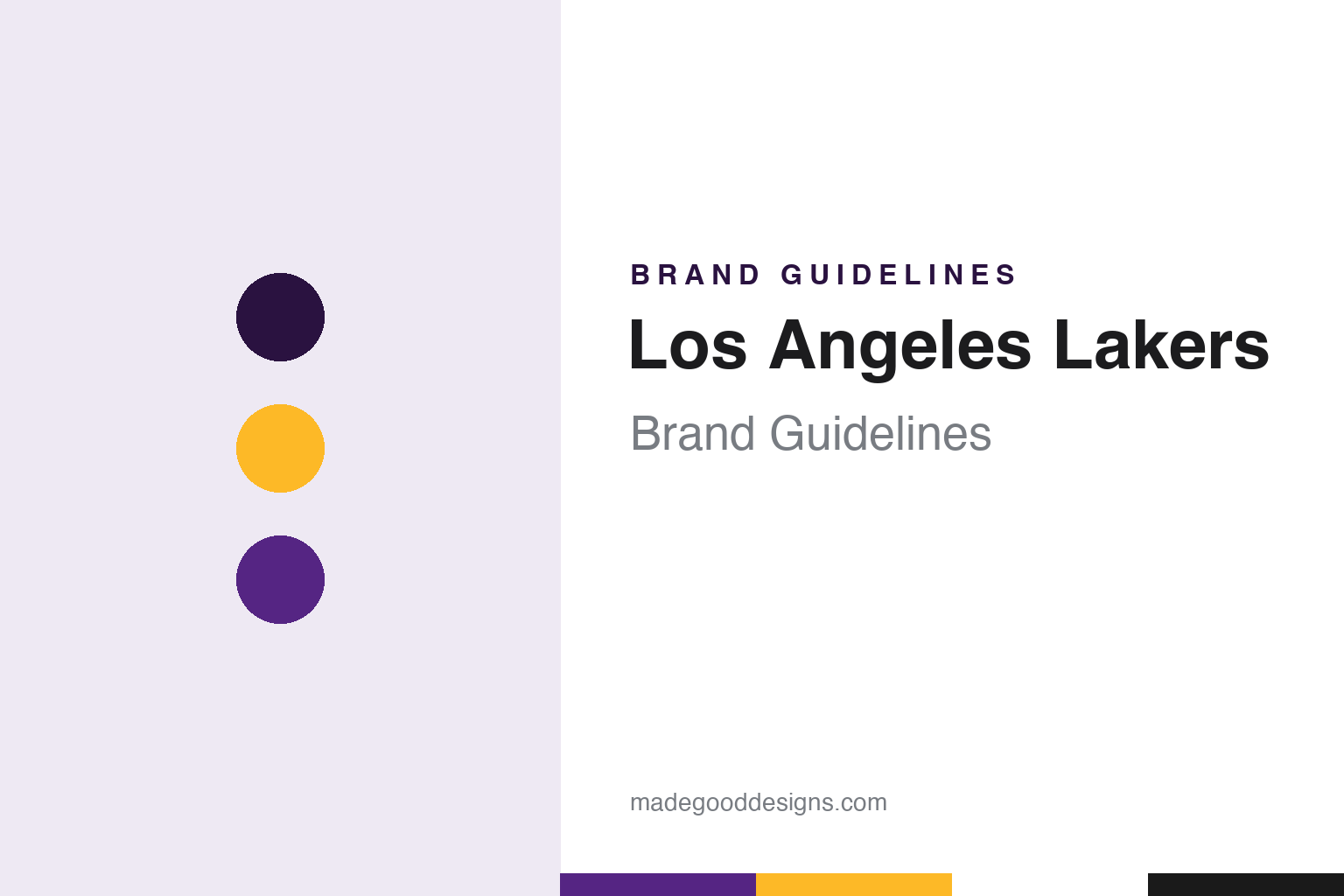
Two constants: a Forum purple, Lakers gold and court white palette and a slanted script and block numerals register. Abstract homage — not a Los Angeles Lakers mark; no logo, jersey or wordmark is reproduced.
A lake-country name
A Detroit franchise, two Minneapolis buyers and a state nickname.
The Lakers did not begin in Los Angeles, or even in Minnesota. English Wikipedia traces the franchise to the Detroit Gems of the National Basketball League, founded by the Dearborn businessmen Morris Winston and C. King Boring, who played the 1946–47 season. The Gems struggled, and after that single season the club changed hands.
The buyers were Ben Berger and Morris Chalfen. Stew Thornley, author of the Lakers history Basketball’s Original Dynasty, writes that in 1947 the pair bought and relocated what he calls a near-extinct NBL franchise. By his account they received little more than some equipment and a piece of paper saying that they owned a team in the league; no players came with the deal, because the league had already assigned the Detroit players elsewhere. Thornley says Berger and Chalfen started from scratch, hiring Max Winter as general manager and John Kundla as coach before looking for players.
The name came from the new home state. Wikipedia says the club, rechristened in Minneapolis, took the name Lakers from Minnesota’s nickname, “Land of 10,000 Lakes,” and credits the Minneapolis sportswriter Sid Hartman with a behind-the-scenes part in putting the deal and the team together. The name stayed with the club after it left the lakes behind, which is why a team in Southern California still carries a Minnesota label.
The early uniforms were not purple. Wikipedia’s history of the team’s logos and uniforms says the Minneapolis road uniform was powder blue with gold trim and carried the abbreviation “MPLS” before switching to the team nickname in block lettering, while the home uniform was white with powder blue and gold trim. In the last Minneapolis seasons the gold was dropped, the blue became royal blue and four stars surrounded the front of the jersey. The club has since revived the look several times: the MPLS uniforms returned as throwbacks in the 2001–02 and 2017–18 seasons, and the white home uniform came back in 2022–23 to mark the franchise’s 75th anniversary.
Colour
Bob Short’s move, Jack Kent Cooke’s Forum and the Buss years.
Ownership changed again in the late 1950s. Thornley writes that a civic drive raised money from local firms and individuals to buy the club from Berger and keep it in Minneapolis, and that the attorney and trucking businessman Bob Short was elected president. The arrangement did not hold. On 28 April 1960, Thornley records, Short announced that the Lakers would move to Los Angeles.
Wikipedia says the club kept its blue and white on arrival, adding a cursive “Los Angeles” script to the jerseys, with royal blue road uniforms trimmed in white and powder blue and the word “Lakers” on the legs of the shorts.
The next owner reshaped the brand. Arena Digest, marking the building’s 50th anniversary on 28 December 2017, recorded that the Lakers relocated to Los Angeles in 1960 and were bought by Jack Kent Cooke in 1965. Cooke then built his own arena in Inglewood. Arena Digest says he called it the Forum to connect it with the Roman Forum, and that the building made its debut on 30 December 1967. The same piece notes that when Great Western Bank later bought naming rights, the Forum’s exterior colour, which it describes as “California sunset red,” was painted blue.
In 1979 the team passed to Jerry Buss. The Los Angeles Times reported on 18 June 2025 that the Lakers had been a family-run business since Buss bought the franchise in 1979, in a deal that also included the Los Angeles Kings and the Forum, and that he sold the Kings to Bruce McNall in 1988. The paper said control went into a family trust after Buss died in 2013, with his daughter Jeanie Buss serving as the team’s governor.
The same report, and ESPN on the same day, described an agreement to sell majority ownership to Mark Walter, the Los Angeles Dodgers’ controlling owner, who had held a stake in the Lakers since 2021; ESPN said Jeanie Buss would remain governor. On 12 August 2026 ESPN reported that Walter, majority owner since the NBA approved his bid in October 2025, had agreed to sell the Lakers to Josh Kushner and Bob Iger, a sale that needed approval from the league’s board of governors.
Typography
Design and documentation.
A sports team’s visual identity works across surfaces that rarely sit still. The crest or primary mark has to hold up on a jersey chest, a cap front, a centre-court decal and a phone-sized app icon, so designers tend to favour bold silhouettes, a limited set of flat colours and outlines that survive embroidery, screen printing and paint. Secondary marks and monograms carry the identity where the full crest would be too busy, such as a sleeve, a helmet side or a social-media avatar.
Wordmarks do a different job. A team name set in custom lettering has to read from the upper deck and on a television graphic at once, which is why many wordmarks use condensed or slab-serif letterforms, generous tracking and a consistent arch or baseline. Uniform numbers follow league rules on size and contrast, and teams often commission a dedicated numeral set so that a 6 and an 8 stay distinct at a distance. Arena and stadium signage then repeats the same palette and letterforms on scoreboards, concourse wayfinding and court or field markings, turning the venue itself into part of the brand system.
Aa
A slanted script over heavy block numerals — the register of a gold home jersey and an arena scoreboard. (Specimen set in Oswald, a condensed sans STAND-IN; NOT the Los Angeles Lakers logo or wordmark.)
Los Angeles Lakers
A purple with another name, and a gold jersey worn at home.
The purple and gold arrived seven years after the move. Wikipedia’s history of the team’s uniforms says that after Cooke bought the club and moved it into the Forum, he outfitted the Lakers in purple and gold, and that the purple was known as “Forum blue” until the early 1980s. The opening purple-and-gold set used a slanted “Lakers” script and white numbers with gold or purple drop shadows; with small changes to the striping it lasted until 1977–78.
From then on the changes were refinements. Before 1978–79, Wikipedia says, the gold uniform switched to purple numbers with white drop shadows, a year before Buss bought the team. In the early 1980s the jerseys and shorts were sometimes made in mismatched shades of purple, which was corrected later that decade, and before 1986–87 the number font shrank and the script was straightened. A new set for 1999–2000 removed the drop shadows, modernised the “Lakers” script and returned white numbers to the gold uniform; Nike, then the team’s supplier, gave it a “wishbone” collar.
Wikipedia says the current primary logo, used since 2001, sets “Los Angeles Lakers” in purple on a gold basketball, and that the current wordmark dates from the 1999–2000 season. In 2002–03 the club added a white alternate uniform, designed by Jeanie Buss as a tribute to the broadcaster Chick Hearn, together with an alternate logo of a purple “L” beside a gold ball. A black “Hollywood Nights” uniform with purple and gold trim was worn from 2013–14 to 2016–17. When Nike took over the league’s uniforms in 2017, the white became the Association jersey, the gold the Icon and the purple the Statement; before 2018–19 the drop shadows returned, with gold numbers on the purple uniform.
For a design guide, the Los Angeles Lakers show how a club can carry a borrowed name across a continent and then let one owner’s colour choice, even one he gave its own name, become the identity, refined in numerals and scripts but never replaced. Compare it with the NBA, whose uniform rules shape the Lakers’ kit, and the Boston Celtics, another NBA team covered in this series. For this guide we use Forum purple, Lakers gold and court white with a condensed sans, an unofficial interpretation; no product or logo is reproduced.
Explore & save
Keep Los Angeles Lakers’s identity on hand — save it to a board in the Made Good inspiration library.
Los Angeles Lakers identity set
Pin the Los Angeles Lakers Forum purple, Lakers gold and court white palette and the slanted script and block numerals register to your own board.