Avis Brand Guidelines
The airport rental firm that kept its red through two slogans and many owners.
Aa
Two constants: a counter red and white palette and a condensed counter sans register. Abstract homage — not an Avis asset; no logo, sign or vehicle is reproduced.
Willow Run
A pilot, an airport and a name on the counter.
Avis began in 1946, founded by Warren Avis. NPR reported in April 2007 that Avis, a pilot, came up with the idea when he could not find ground transportation after landing, and a 2013 Slate column by Seth Stevenson described him as an Air Force officer who saw an opening for rental cars at airports at a time when most rental lots, Hertz’s among them, were in city centres. The company’s own timeline places the start at Willow Run Airport outside Detroit — English Wikipedia puts the airport in Ypsilanti, Michigan — and says counters at Miami airport followed soon after.
Warren Avis did not stay long. NPR reported that he sold his interest in the business in 1954, and the company timeline names the buyer as the Boston financier Richard S. Robie. In a 2007 NPR interview, Trish Kalmbach, president of Avis Enterprises, who worked with him for many years, recalled that he had set up an Avis Rent A Car credit card for corporate customers so that they could take a car from the counter without leaving a cash deposit, and she confirmed that the slogan arrived after he had sold the company.
The company timeline sets out the next steps. Franchise operations began in Europe, Canada and Mexico in 1953; in 1956 an investment group led by the Amoskeag Company took control and formed Avis, Inc. as a holding company; Avis Europe set up corporate offices in the United Kingdom in 1960; and in 1962 the investment bank Lazard Freres & Company bought Avis. Robert Townsend became president the same year, and it was Townsend, Print magazine reported in 2014, who asked Bill Bernbach of the agency Doyle Dane Bernbach to give the company’s image a lift.
The answer became the line “We try harder.” Print recounted that the campaign scored poorly in testing, with half the people questioned disliking it, and that Bernbach went ahead regardless; Stevenson’s Slate column credits DDB copywriter Paula Green with the construction, built openly around Avis’s second place behind Hertz. Slate and Wikipedia date the campaign to 1962, while the company timeline and Design Week date its debut to 1963. Print noted that the phrase entered everyday speech and even turned up on lapel buttons.
Colour
From ITT and an employee buyout to Avis Budget Group.
Wikipedia and the company timeline list the owners in sequence: ITT Corporation from 1965; a return to public ownership when ITT spun Avis off in 1972; Norton Simon from 1977; Esmark in 1983 and Beatrice in 1984, each time as part of a larger takeover; the investment firm Wesray Capital in 1986; and in 1987 an employee stock ownership plan. The Los Angeles Times reported on 3 October 1987 that Avis had been sold to its employees just four days before Hertz’s own sale was announced.
The ITT years left a lasting piece of the brand. Auto Rental News reported in 2013 that the Wizard reservation system, developed by Avis with a team from its then parent ITT, went live in 1972, running from a mainframe at the company’s headquarters in Garden City, New York; a former franchisee remembered the terminal that arrived at his counter as a large machine resembling an IBM typewriter, finished in what he called unmistakable Avis red. Wizard numbers, the magazine said, became part of the company’s loyalty programme.
Carmakers entered the picture next. The company timeline says Avis signed a worldwide advertising and marketing agreement with General Motors in 1979 and began featuring GM cars, including Chevrolet models, in its fleet, and that GM became a minority shareholder in 1989. HFS Incorporated acquired Avis in 1996, the company returned to the stock market through a public offering in 1997, and in 2001 Cendant bought the shares it did not already own and moved the headquarters from Garden City to Parsippany, New Jersey.
Cendant bought the U.S. assets of Budget in 2002, and in 2006, the company timeline says, it separated into four companies, with the car-rental business continuing as Avis Budget Group. In 2011 Avis Budget Group acquired Avis Europe plc, reuniting the brand with its licensee for Europe, the Middle East, Africa and Asia, and Wikipedia records a January 2013 agreement to acquire the car-sharing company Zipcar. Avis Budget Group has owned Avis since that 2006 renaming, and runs it from Parsippany alongside Budget.
Typography
Design and documentation.
A car-rental brand is met in a handful of places before anyone sits behind the wheel: an airport sign pointing to a counter or a garage level, the counter itself, a shuttle bus that loops between terminals and lots, and the lot signage that marks rows, return lanes and exits. Each is a different surface with a different job, from a backlit panel read from across a terminal hall to a painted bus side seen in motion and a small paper or plastic key tag handed over at the end of the process.
That spread of surfaces is what a rental wordmark, its colours and any symbol beside it have to cover, at very different sizes and distances. The same name may appear on a uniform, a bay marker, a receipt and a mobile app, and the business behind it may have changed hands more than once since the sign was first painted.
Each guide that follows sets out who started the name, who has owned it since and how its marks have changed, and separates what independent sources record from what the company says about itself.
Aa
A condensed counter sans — the register of an airport sign and a rental agreement. (Specimen set in Barlow Condensed, a sans-serif STAND-IN; NOT the Avis logo.)
Avis
A red wordmark, an italic lean and two slogans.
The Avis identity rests on a colour and a sentence. Wikipedia illustrates a logo used from 1964 until December 2012, and when Avis replaced it in the United States in 2012, Design Week reported on 5 September that the new identity dropped the previous condensed italic logo while keeping the company’s red and white palette. Avis said at the time that there were no plans to bring the new identity to the United Kingdom.
The same redesign replaced the slogan. Design Week and Auto Rental News both reported in 2012 that “We try harder” was giving way in American advertising to “It’s Your Space”, a campaign by the agency Leo Burnett Business built around business travellers who use a rental car as a place to prepare for a meeting or recharge between appointments. Avis Budget Group’s chief marketing officer, Jeannine Haas, told Auto Rental News that the older motto was not being abandoned, calling it “fully embedded in the Avis DNA”, and the magazine noted that the company’s Twitter handle was still AvisWeTryHarder.
Red runs through the brand’s working history as well as its advertising. The 1972 Wizard terminals arrived at Avis counters in the company colour, according to the franchisee interviewed by Auto Rental News, and the red and white pairing that Design Week described in 2012 is the one the company chose to keep when it straightened the italic out of its wordmark.
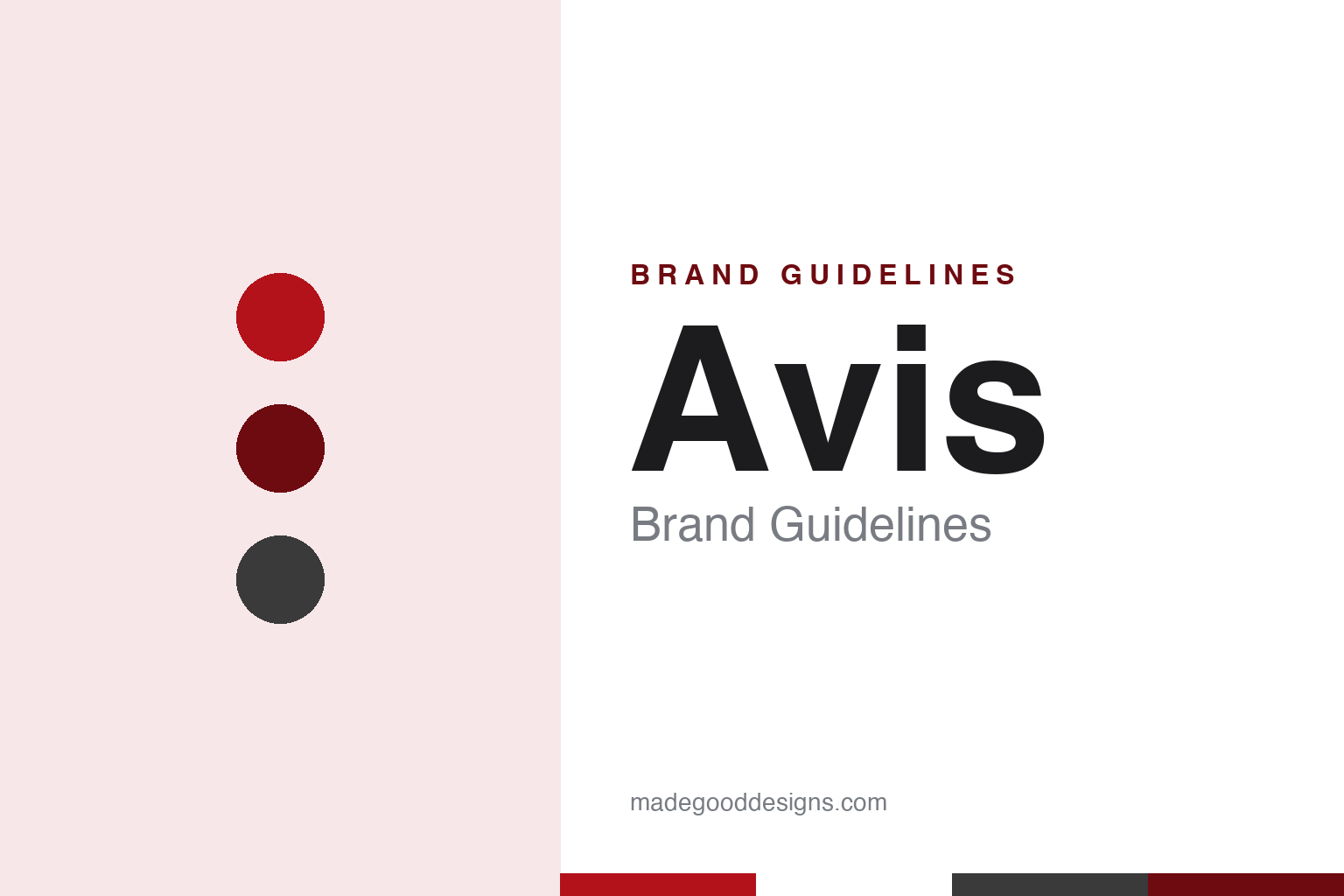
For a design guide, Avis shows how a short line of copy and a single colour can carry a brand through a long line of owners and a redrawn logo without needing anything else to hold it together. Compare it with Hertz, the rival its advertising was built around, and Budget, its stablemate under Avis Budget Group. For this guide we use counter red, deep red and graphite with a condensed sans, an unofficial interpretation; no product or logo is reproduced.
Explore & save
Keep Avis’s identity on hand — save it to a board in the Made Good inspiration library.
Avis identity set
Pin the Avis counter red, deep red and graphite palette and the condensed counter sans register to your own board.