Hertz Brand Guidelines
The Chicago rental business that kept its yellow through a century of owners.
Aa
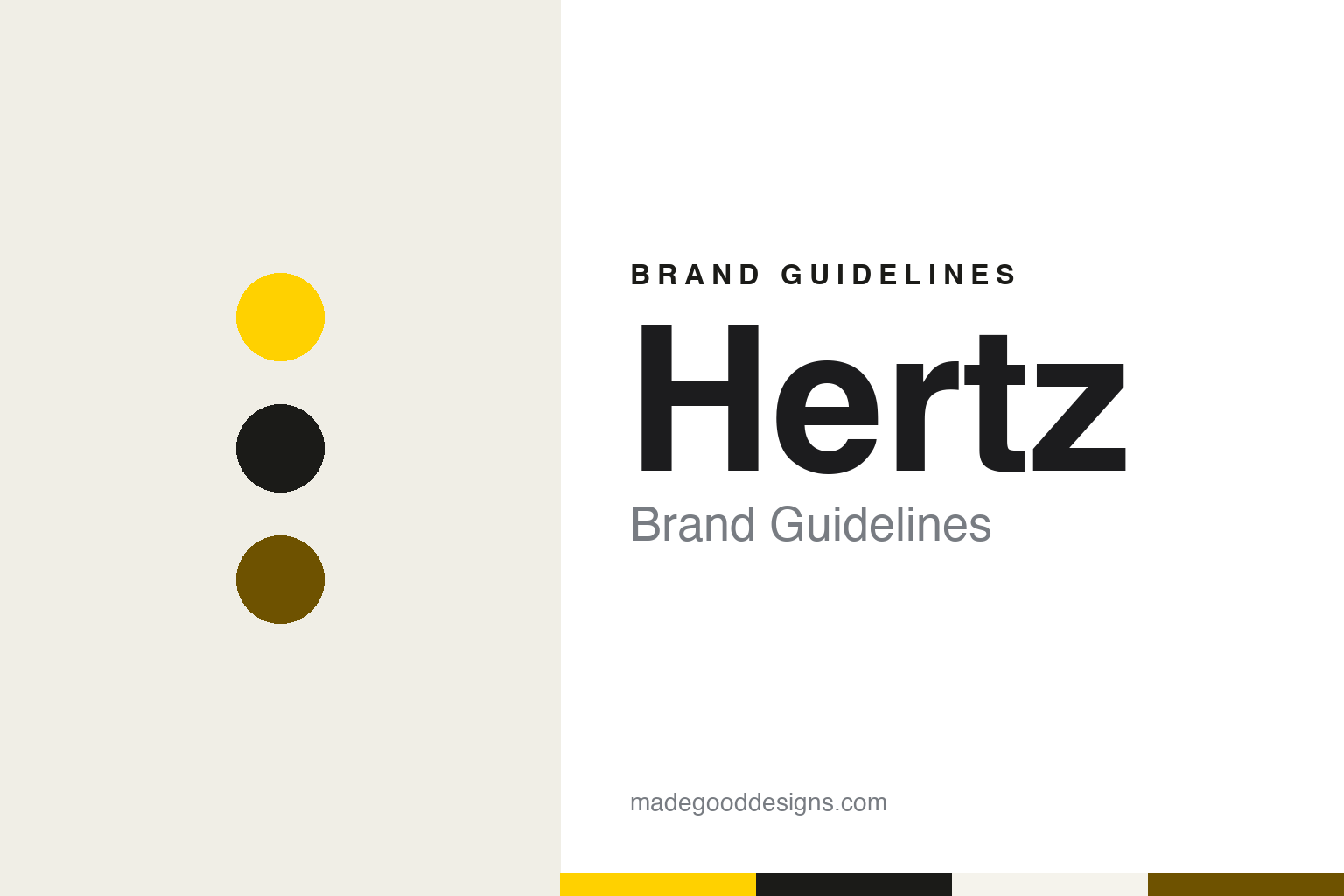
Two constants: a signature yellow and canopy black palette and a heavy counter sans register. Abstract homage — not a Hertz asset; no logo, sign or vehicle is reproduced.
Rent-a-Car Inc.
A Chicago start, a new owner and a new name.
Hertz began as someone else’s business. In 1918 Walter L. Jacobs started renting cars in Chicago with a small fleet of Model T Fords, which, the Los Angeles Times reported in February 1985, he painted and maintained himself. His father was a manufacturers’ representative in the city, and Jacobs called the venture Rent-a-Car Inc. In 1923 he sold it to John D. Hertz. Both the Los Angeles Times and the Chicago Tribune reported in 1985 that Jacobs stayed on as president under the new owner, retiring at the end of 1960 and remaining a director of the corporation until 1968.
John Hertz was already a figure in Chicago motoring. English Wikipedia says he began selling cars in 1905 for Walden W. Shaw, whose family held a dealership for imported Berliet automobiles, and persuaded Shaw to put traded-in cars to work for hire as taxis. The business that grew out of that arrangement included the Yellow Cab Corporation and a company building its own cabs, which Hertz named Yellow Truck and Coach Manufacturing Company. After buying Jacobs’s operation, Wikipedia says, Hertz renamed it the Hertz Drive-Ur-Self System, and from 1924 cars for the drive-it-yourself trade were built under the Hertz name, among them the Model D-1, offered as a tourer or a sedan until its production ended in 1927.
The name then passed to a carmaker. Wikipedia dates the sale of the rental business to General Motors to 1927, and the Los Angeles Times obituary says Jacobs continued as president under GM as well. Wikipedia credits the GM years with a rental charge card, a rental counter at Chicago’s Midway Airport in 1932, a one-way rental plan in 1933, and expansion into Canada in 1938 and France in 1950. In 1985 the Los Angeles Times quoted a Hertz spokesman who credited Jacobs with creating the franchised agencies that Hertz still maintained, and with introducing credit cards and airport locations to the business.
In 1953 General Motors sold the business to Omnibus, a group of investors that Jacobs, according to the Los Angeles Times, helped form. Wikipedia says John Hertz led the repurchase through The Omnibus Corporation, which he renamed The Hertz Corporation, and that its shares began trading on the New York Stock Exchange in 1954. In the same period it bought a New York truck-leasing company, Metropolitan Distributors, and in 1965 it opened an equipment-rental division with a branch in Houston, Texas.
Colour
An electronics group, an airline holding company, Ford and private equity.
The decades that followed brought a run of owners. Wikipedia says The Hertz Corporation became a subsidiary of the Radio Corporation of America (RCA) in 1967, and that in 1985 RCA sold it to UAL Inc., the parent company of United Airlines. The Los Angeles Times reported on 3 October 1987 that UAL, which had renamed itself Allegis earlier that year and had gathered Hertz together with the Westin and Hilton International hotel chains, was selling Hertz to Park Ridge Corp., a group formed by Ford Motor Co. and Hertz’s own management under Frank A. Olson, who chaired both Allegis and Hertz at the time. The newspaper reported that Hertz would sit inside Ford’s financial services division until the carmaker reduced its holding.
Wikipedia says Hertz moved its headquarters from Midtown Manhattan to Park Ridge, New Jersey, in 1988, and that Ford sold the business in 2005 to the private equity firms Clayton, Dubilier & Rice, The Carlyle Group and Merrill Lynch Global Private Equity, which returned Hertz Global Holdings to the New York Stock Exchange in November 2006. In November 2012 Hertz completed its purchase of Dollar Thrifty Automotive Group of Tulsa, Oklahoma, bringing the Dollar and Thrifty brands under the same roof, and in May 2013 the company announced that its worldwide headquarters would move to Estero, Florida. Wikipedia says the new building there was completed in 2015, and that the equipment-rental business was separated on 1 July 2016 as the independently listed Herc Rentals.
On 22 May 2020 Hertz filed for Chapter 11 bankruptcy protection in a United States court in Delaware, Reuters reported, and Wikipedia says the company emerged from it on 1 July 2021. Today Hertz Global Holdings, headquartered in Estero, operates the Hertz brand alongside Dollar, Thrifty and Firefly, according to Wikipedia. Wikipedia also records how far the brand travelled under its successive owners: into South America in 1961, and into China in 2002, where it later formed a partnership with the rental company China Auto Rental.
The fleet itself became a marketing tool. Wikipedia says that in 1966 Hertz worked with the racing driver and car designer Carroll Shelby on the Shelby GT350-H, a version of his modified Ford Mustang built for Hertz rental counters, and that in 2006 it revived the idea with the Ford Mustang GT-H, followed by specially modified Chevrolet Corvettes in 2008.
Typography
Design and documentation.
A car-rental brand is met in a handful of places before anyone sits behind the wheel: an airport sign pointing to a counter or a garage level, the counter itself, a shuttle bus that loops between terminals and lots, and the lot signage that marks rows, return lanes and exits. Each is a different surface with a different job, from a backlit panel read from across a terminal hall to a painted bus side seen in motion and a small paper or plastic key tag handed over at the end of the process.
That spread of surfaces is what a rental wordmark, its colours and any symbol beside it have to cover, at very different sizes and distances. The same name may appear on a uniform, a bay marker, a receipt and a mobile app, and the business behind it may have changed hands more than once since the sign was first painted.
Each guide that follows sets out who started the name, who has owned it since and how its marks have changed, and separates what independent sources record from what the company says about itself.
Aa
A heavy counter sans — the register of an airport canopy and a rental key tag. (Specimen set in Archivo, a sans-serif STAND-IN; NOT the Hertz logo.)
Hertz
From a shadowed slab to black letters on yellow.
Yellow is the constant in the Hertz identity. When the company introduced a new corporate identity programme in December 2009, Auto Rental News reported that the new logo “leverages its signature yellow color”, and that the programme reached well beyond the mark: facility interiors and exteriors, signage and employee uniforms were all part of it, with newly branded sites due to appear in Atlanta, Chicago, Frankfurt and Shanghai, and LCD screens replacing much of the fixed signage.
The redesign came from Landor’s New York office. In a May 2010 interview with Communicate magazine, Landor executive creative director Richard Ford described the older Hertz look as black-dominant, with black canopies and black buildings, and a wordmark that leaned on a heavy drop shadow and was hard for marketers to handle. The work reversed that emphasis from black to yellow. Paula Rivera of Hertz told the magazine that the previous logo set yellow letters shadowed in black, while the new one placed black letters inside a yellow box; Ford said the team also made the yellow a little darker and less lemony, and that dropping the shadow let the type sit more cleanly on a yellow ground.
Yellow appears in older records too. Wikipedia says that in December 1959 a large rooftop sign was installed on the Texas School Book Depository in Dallas, reading HERTZ RENT A CAR in red on yellow above a CHEVROLETS panel in yellow on black, with a display that alternated between the time and the temperature; the sign was removed in 1979 and its metal plates are held by the Sixth Floor Museum at Dealey Plaza. The same year, Wikipedia says, the agency Norman, Craig & Kummel gave Hertz the line “Let Hertz put you in the driver’s seat”, which the vocal group the Hi-Lo’s sang in commercials and which ran in print, on signs and on television into the early 1960s.
For a design guide, Hertz shows how a single colour can outlast a long sequence of owners — a carmaker, an electronics group, an airline holding company, a Ford-backed buyout and private equity — while the wordmark itself was reworked from a shadowed slab into black letters on a yellow field. Compare it with Ford, which backed the 1987 buyout and sold Hertz in 2005, and United Airlines, whose parent owned it in the mid-1980s. For this guide we use signature yellow, canopy black and deep gold with a sans, an unofficial interpretation; no product or logo is reproduced.
Explore & save
Keep Hertz’s identity on hand — save it to a board in the Made Good inspiration library.
Hertz identity set
Pin the Hertz signature yellow, canopy black and deep gold palette and the heavy counter sans register to your own board.