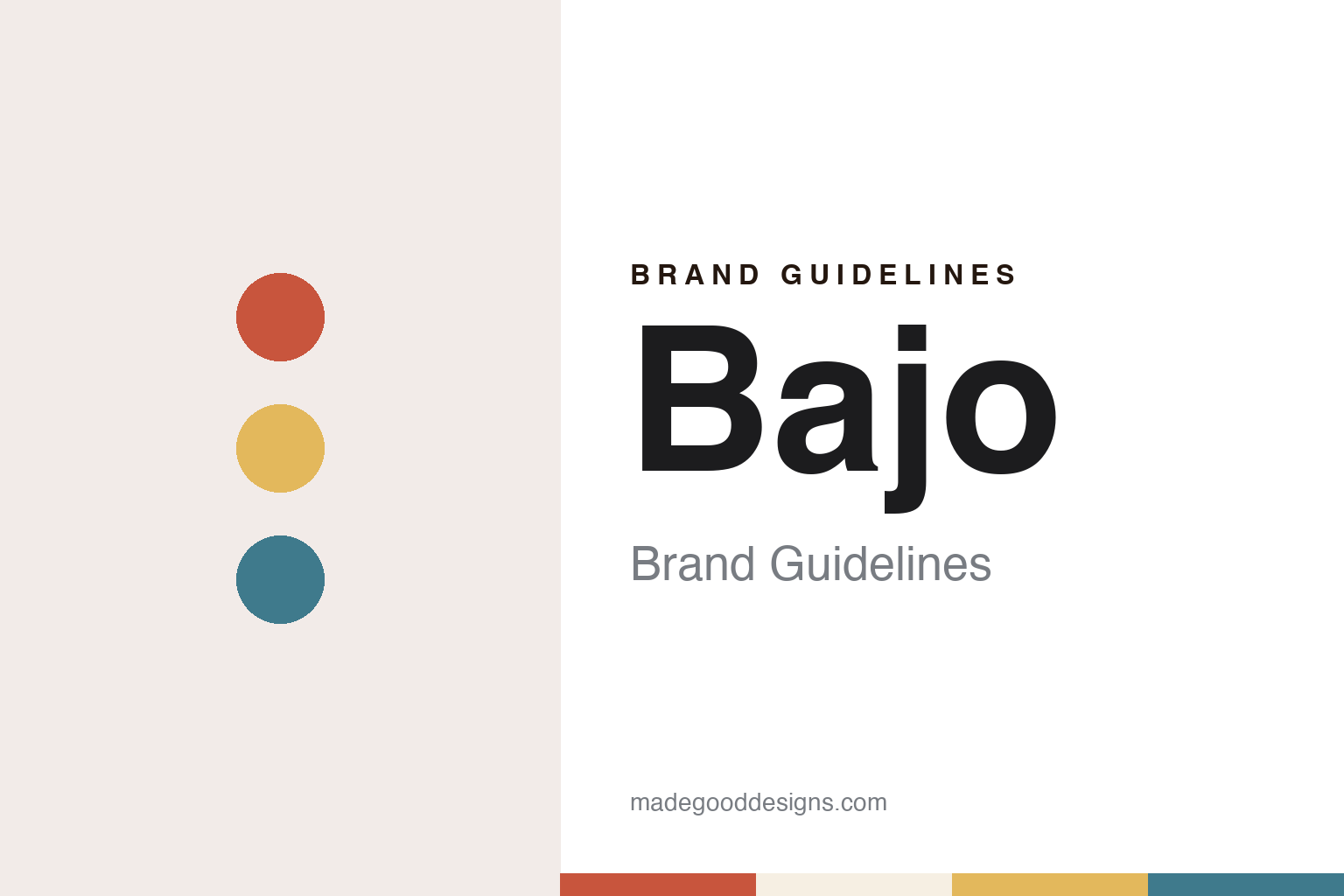
Bajo Brand Guidelines
The Kraków architects’ wooden-toy workshop.
Aa
Two constants: a rust red, birch gold and slate blue palette and a bookish serif register. Abstract homage — not a Bajo product or mark; no box, logo or toy is reproduced.
Architects in the workshop
A family name, shortened by one letter.
Bajo is a family business named after its founders. The company’s own story says the name comes from the surname of Wojciech and Barbara Bajor, with the final letter dropped in favour of a registered-trademark symbol. It describes both founders as designers and academic teachers at the architecture faculty of the Kraków University of Technology, and lists them today as the company’s head designers and chief executives.
Wojciech Bajor wrote his own account of how he came to toys. In a short text signed in Kraków in June 2010, published by the Kraków branch of the Association of Polish Architects (SARP), he describes himself as an architect working in three fields — teaching in the sculpture studio of the Kraków architecture faculty, strategies for public space, and the design of wooden toys — and says he took up designing wooden toys in 1990. He describes building a factory, training its staff and developing his own technologies and sales, and calls the work the biggest confrontation with reality in his life.
The same text sets out the training behind the toys. Wojciech Bajor writes that he studied in Kraków at three institutions: mathematics and physics at the Jagiellonian University, a course he says he never finished; architecture at the Kraków University of Technology; and painting at the Academy of Fine Arts. He writes that in the late 1970s he moved to the countryside near the Beskid mountains.
The company places its own start in the early 1990s, at the beginning of Poland’s political and economic transition. It says that in 1993 it rented an old carpentry workshop, which it later bought and renovated; that it opened a shop in Kraków in the spring of 1994; that it exhibited at the Poznań fair that year; and that it has shown at the Nuremberg toy fair since 1995. Wojciech Bajor’s 2010 text likewise says his designs appear at the Nuremberg fair and in shops abroad.
Colour
Plain boxes, painted wood.
Bajo’s look starts with the wood. The company says its main timbers include birch, sycamore, beech, oak and walnut, that much of what it uses is hardwood from certified suppliers, and that it also works with timber from old orchards and with offcuts from furniture and parquet makers. It says it finishes the toys with water-based paints and oil, and that other materials in the range include cardboard, wool felt and organic cotton. The Polish consumer site Dobre Zakupy, run by the Ekonsument association, describes the brand’s materials in the same terms in its brand profile.
Packaging is where the company makes its clearest statement about identity. It says its boxes are plain, single-colour cardboard, and that this restraint has itself become part of the Bajo brand. It recalls choosing raw cardboard printed in a single colour at a time when other brands favoured glossy, colourful boxes, and says customers at first found the choice hard to accept before it became a defining trait. The same thinking, the company says, extends to shipping, where it uses cardboard filling in place of plastic. The aim it describes is a durable, timeless toy meant to be handed on rather than replaced, and Dobre Zakupy notes that Bajo repairs toys and replaces missing parts so that they stay in use for longer.
Bajo has also widened the circle of designers whose work carries its name. The company says it took part in the Bambini European design programme in 2010, a step it says brought new skills and technologies into the factory, and that in 2013, as a new generation of designers joined, it launched TOBE, a design collective that adds wooden and soft toys by several designers to the core range and explores new materials. It has also produced a licensed collection based on The Gruffalo and The Gruffalo’s Child by Julia Donaldson and Axel Scheffler, the company says.
Typography
Design and documentation.
The seven brands in this group are all toy names: small foot, Bajo, Moluk, Magna-Tiles, Kaloo, Guidecraft and Lilliputiens. Toy brands in general sit at many different points in the trade, from family workshops that still carry a founder’s idea to labels that now belong to larger groups, and a single brand can be sold everywhere from a small independent shop to a department store or an online marketplace.
A toy brand’s identity is usually carried less by a single object than by a box, a name, a colour and a way of drawing, because the company behind the name may have changed hands, moved its production or grown far beyond the place where it started. That makes the questions behind each name worth asking plainly: who started it, who owns it now, and where its toys are actually designed and made.
Each guide separates what independent sources record from what the company says about itself — its founding story, its owners over time, where its toys are made and how its boxes and logos have changed — and marks plainly what rests only on the company’s own word.
Aa
A warm, bookish serif. (Specimen set in Lora, a serif STAND-IN; NOT the Bajo logo.)
Bajo
A village workshop under a mountain.
Bajo says it is based in Kamionna, a small village in the Małopolska region of southern Poland, at the foot of the mountain of the same name. The company says the roof of its factory is covered with solar panels and that it has been increasing its use of renewable energy. It also says it divided production into simple, repeatable steps so that people without specialist toy-making skills could take part, and that it has employed people who find it hard to get work. Dobre Zakupy similarly reports that the company employs older people and people with disabilities. Bajo also says it stays in contact with customers, and that a second generation often plays with the same toys.
The brand keeps a city-centre presence as well. Dobre Zakupy lists a Bajo shop on Grodzka Street in Kraków. The company says Poland’s accession to the European Union in 2004 helped its reputation abroad.
For a design guide, Bajo shows a toy brand shaped by architects: a family name trimmed into a mark, painted hardwood forms, and deliberately plain single-colour boxes — compare Grimm’s, the German maker of painted wooden toys, and goki, another European wooden-toy brand. For this guide we use rust red, birch gold and slate blue with a serif, an unofficial interpretation; no product or logo is reproduced.
Explore & save
Keep Bajo’s identity on hand — save it to a board in the Made Good inspiration library.
Bajo identity set
Pin the Bajo rust red, birch gold and slate blue palette and the bookish serif register to your own board.


