Balmex Brand Guidelines
A diaper-cream name that changed hands again and again and landed with a family company.
Aa
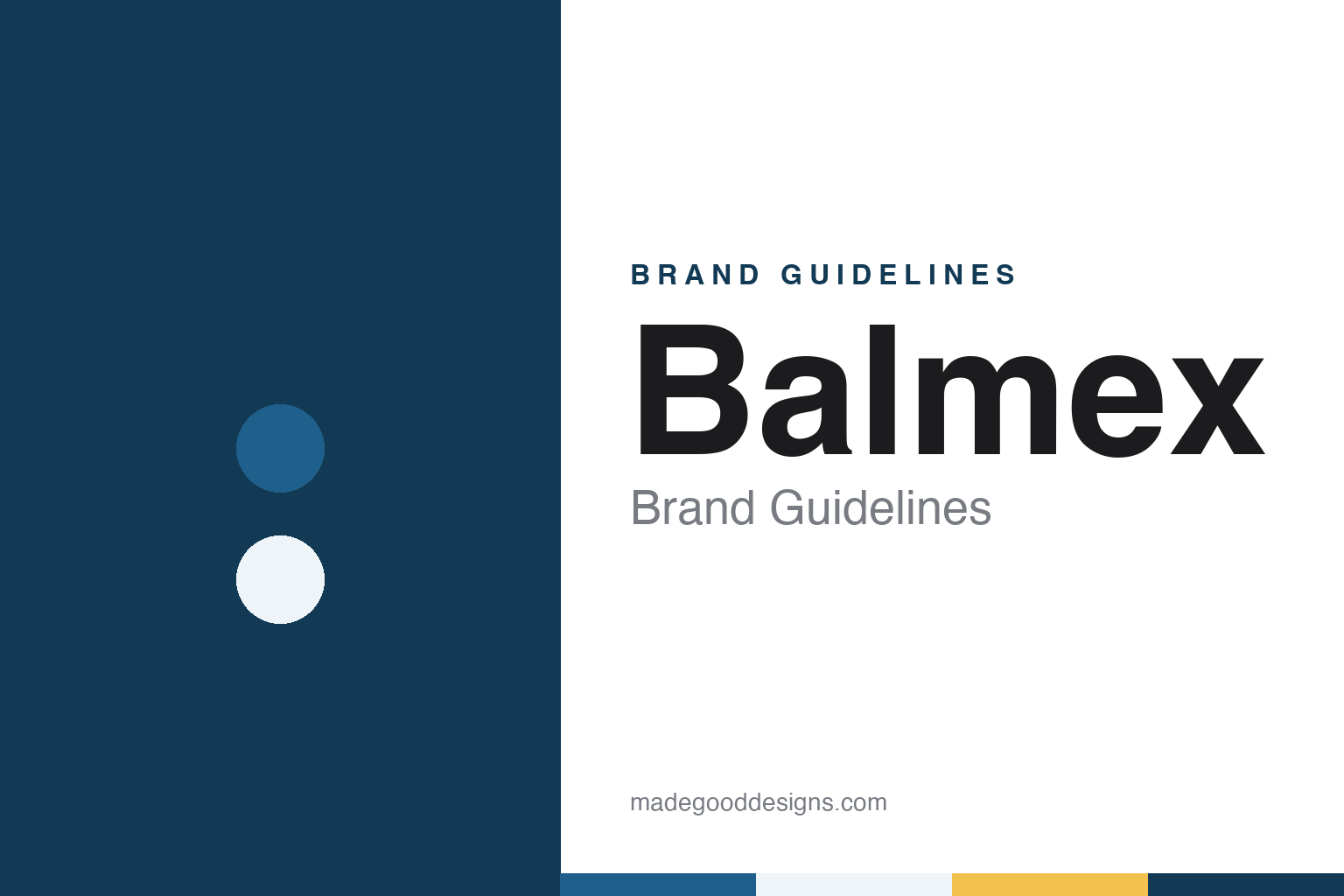
Two constants: a blue, navy and yellow palette and a rounded sans register. Abstract homage — not a Balmex product or mark; no tube, stick or logo is reproduced.
A name that moved between owners
Block Drug, Johnson & Johnson and a federal order.
Balmex is a brand easiest to follow through the companies that have held it. English Wikipedia’s article on Block Drug Company, the Jersey City business known for denture-care and other household health names, lists Balmex among its products, describing it as a line of diaper ointments sold alongside Polident, Poli-Grip, Nytol, Tegrin, Lava soap and Sensodyne. The article draws on the International Directory of Company Histories. Block Drug itself was bought by GlaxoSmithKline in 2001, Wikipedia says.
By 2006 the name belonged to Johnson & Johnson. A notice published in the Federal Register on 18 December 2006, setting out the Federal Trade Commission’s analysis of Johnson & Johnson’s proposed purchase of Pfizer Consumer Healthcare, describes Johnson & Johnson as a supplier of diaper-cream products under its Balmex, Aveeno and Johnson’s No More Rash brands, and Pfizer as the owner of Desitin. Because the purchase would bring both names under one roof, the agreement placed on the public record required Johnson & Johnson to divest its Balmex business, together with the Pfizer businesses Zantac, Cortizone and Unisom.
The buyer was a Tennessee company. English Wikipedia’s article on Chattem, the Chattanooga business that began as the Chattanooga Medicine Company, records that in October 2006 Chattem announced it would acquire a group of brands arising from the Johnson & Johnson and Pfizer combination — ACT, Unisom, Cortizone 10, Kaopectate and Balmex — and that it expected to take possession of them around January 2007.
Chattem itself did not stay independent. Wikipedia records that on 21 December 2009 the French drug group Sanofi said it was acquiring Chattem, citing The Economic Times of 22 December 2009, and that the business later took the name Opella as Sanofi’s consumer health arm.
Colour
Stockholm, then a family company in New Jersey.
The next owner came from Sweden. Chain Drug Review reported on 27 April 2015 that Moberg Pharma AB of Stockholm had acquired the baby-care and skin-care brand Balmex from Chattem Inc., which it described as the United States consumer health division of Sanofi. Moberg said it would sell the products through its existing over-the-counter channel in the United States, in chain drugstores, mass retailers and specialty baby stores. The report listed the range at the time as a diaper cream, a diaper cream stick and a multipurpose ointment, and noted an adult-care cream introduced in 2013. Peter Wolpert, Moberg’s chief executive, called the brand “a great fit” for the company’s portfolio, and Jeff Vernimb, general manager of Moberg Pharma North America, spoke of building on the brand’s equity.
Moberg kept the name until 2018. In a release published on 28 February 2018, Moberg Pharma announced an agreement to divest Balmex to Randob Labs, recalling that it had acquired the brand from Chattem in April 2015 and saying that its role in the portfolio had shrunk after acquisitions in 2016. A second release, dated 27 April 2018, confirmed that the divestment to Randob Labs had been completed. Wolpert said the sale let the company focus its resources on its larger brands.
Randob Labs tells its own story on its current website. CrossingWell Consumer Health says it was founded in 1979 as Randob Labs and has been family-held since then, with the sleep aid Dormin as its early flagship. The company says Dan Creagan took over sales in the 1980s, bought Randob in the early 1990s and added Sting-Kill; that his son Jim Creagan became president in the early 2010s; that Balmex was the start of a run of acquisitions under his leadership; and that Randob Labs rebranded as CrossingWell Consumer Health in 2022. CrossingWell, formerly Randob Labs, has owned Balmex since 2018, and the Balmex website’s footer carries a 2026 CrossingWell Consumer Health copyright.
Typography
Design and documentation.
Baby-care brands live on a small set of containers: the squeeze tube, the wide screw-top tub, the pump bottle and the printed diaper pack. Each one leaves only a little room for a name, so the identity has to work at the size of a changing-table shelf as well as on a store fixture, and it is often read from across a room or upside down in a bag.
Because many of these names have changed owners several times, the pack is frequently the steadiest thing about them. A tube may carry the same word through decades in which the company printed on the back has changed, and a refreshed logo or a new colour band is often the only visible sign that a business has been sold. That makes the plain questions worth asking: who made the product originally, who owns the name now, and how its labels have changed.
Each guide separates what independent, dated sources record from what a company says about itself — its founding story, its owners over time and its packaging — and describes products by name and category only.
Aa
A rounded sans — the register of a short brand name on a soft, small-format pack. (Specimen set in Nunito, a rounded sans STAND-IN; NOT the Balmex logo.)
A family of well-loved brands
A short name, plain descriptors and a family-company frame.
The current presentation places Balmex inside a family-company story. The Balmex website, read in October 2026, presents the products under the brand name with plain descriptors, and it introduces a second line for grown-ups, Balmex AdultAdvantage, beside the baby range. A section headed “Top our family-owned brands” describes CrossingWell’s portfolio as a “family of well-loved brands”, so the parent company’s own identity — founded by family, focused on wellness, in its words — frames the baby-care name.
The architecture works by addition. The 2015 Chain Drug Review report describes a range made up of a diaper cream, a stick format of the same cream and a multipurpose ointment, with an adult-care cream added in 2013; the current website keeps the name at the front and adds descriptors such as Baby and AdultAdvantage after it. Across the owners recorded here — Block Drug, Johnson & Johnson, Chattem under Sanofi, Moberg Pharma and Randob Labs, now CrossingWell — the word itself has not changed, while the company name on the back of the pack has changed with every sale.
That sequence is what makes Balmex useful as a case study. CrossingWell says on its own website that, after acquiring heritage brands, it invests in updated packaging, refreshed branding and national marketing; for Balmex the result is a brand presented as part of a family portfolio rather than as a stand-alone pharmaceutical name.
The colours here are not a published specification. No public brand book sets out Balmex’s tones or its typeface, so the harbour blue, deep navy and sunny yellow used in this guide are our own interpretation of a baby-care shelf, chosen so the dark accent holds up as small text and the light ground reads as a nursery register.
For a design guide, Balmex shows how a short baby-care name can pass through a federal divestiture order and a series of owners by keeping its word fixed and letting each new company add descriptors around it. Compare it with Desitin, the name whose purchase forced Balmex’s sale in 2006, and Aquaphor, another ointment name on the same baby-care shelf. For this guide we use harbour blue and deep navy on cloud white with a rounded sans, an unofficial interpretation; no product or logo is reproduced.
Explore & save
Keep Balmex’s identity on hand — save it to a board in the Made Good inspiration library.
Balmex identity set
Pin the Balmex blue, navy and yellow palette and the rounded sans register to your own board.