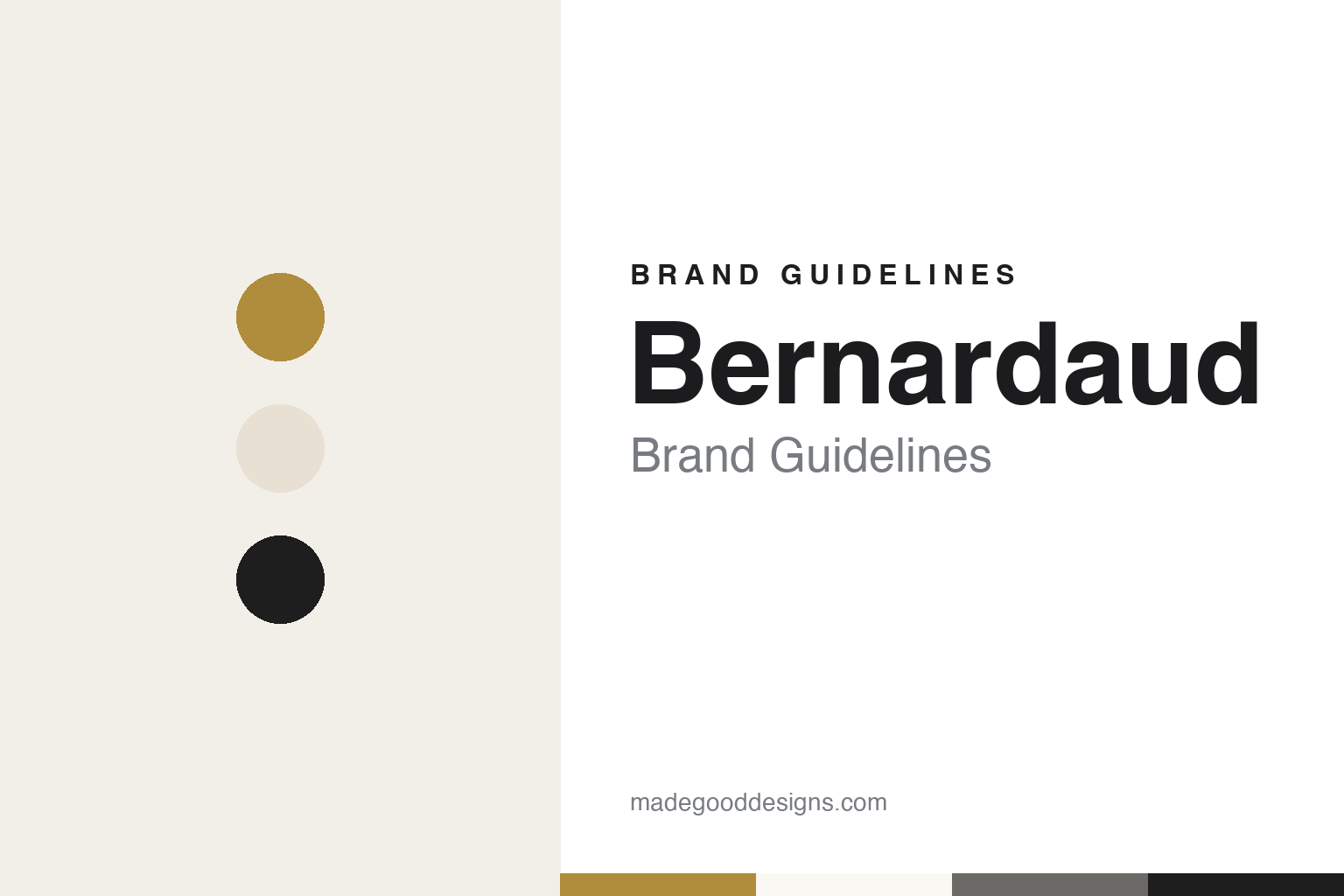
Bernardaud Brand Guidelines
Limoges white, a gold line, a family name.
Aa
Two constants: a Limoges white and gold palette and a Didone serif register. Abstract homage — not a Bernardaud asset or mark; no logo, backstamp or pattern is reproduced.
A Limoges works takes a family name
Limoges, 1863 to 1929.
Bernardaud is a porcelain maker in Limoges, in central France, and its story begins with a works that did not yet carry the family name. The regional business paper Le Journal des Entreprises, in a history of the company published on 11 March 2025, says the factory was created in 1863 by two Limoges industrialists, at a time when porcelain was expanding in the region and dozens of makers were working there. All of them used local kaolin, the white clay at the heart of porcelain paste.
The same article places the house in a longer local story. It says the kaolin deposit was discovered in 1768, that makers stamped their production “porcelaine de Limoges” from 1771, and that the geographical indication for Limoges porcelain in its current form was recognised in 2017.
The name came from inside the workshop. Le Journal des Entreprises says Léonard Bernardaud started as an apprentice there, became a partner in 1883 and bought all the shares in 1900, giving the manufactory his name. Its timeline describes him by then as the former apprentice who had become head of the commercial side.
Léonard looked abroad early. The paper says he turned to export, beginning with the United States, where he opened a shop in New York in 1911. It notes that the American market for Limoges porcelain had been opened earlier by the New York merchant David Haviland, who after years of importing set up his own manufactory in Limoges in 1842. More than a century later the two names would come together.
The next generation kept the business going through hard years. Le Journal des Entreprises says Léonard’s sons Jacques and Michel came through the crisis of 1929 and formed the house’s early partnerships with international artists for its collections. It describes artist collaboration as a tradition that runs through Bernardaud’s history, naming the painter Fernand Léger, the designer Raymond Loewy and the artist Jeff Koons among those whose work the house has produced.
Colour
Kilns, a second site and new materials.
After the Second World War the works moved to industrial production. Le Journal des Entreprises says that in 1949 Bernardaud installed tunnel kilns, around thirty metres long, running around the clock and fired with town gas instead of coal. The paper says the steady heat produced stronger, more even pieces and raised production capacity.
Pierre Bernardaud took charge in 1962, according to the same history. He opened a new site in 1979 at Oradour-sur-Glane, about twenty kilometres from Limoges, and moved the production of white porcelain there, ahead of decoration. New techniques were tried at the plant, including the isostatic press, adopted in the 1980s for plates. The paper also records a television advertisement on the French broadcaster ORTF in 1969, one year after such spots had been permitted, with a jingle it says stayed with a generation of viewers.
Bernardaud has also grown by acquisition. Le Journal des Entreprises says an earlier purchase came in 1986, when Bernardaud bought the Manufacture Royale, a Limoges works dating from 1771. The paper says Bernardaud can reproduce historical services, including pieces from the time of Marie-Antoinette, mainly for museums and through the Manufacture Royale.
Michel Bernardaud has headed the company since 1994, according to the paper, and under him the range widened beyond the table. Le Journal des Entreprises lists lithophanes from 1991, jewellery from 1998, then decorative objects such as vases and lamps, furniture, and porcelain bottles and flacons for cognac and cosmetics houses in the early 2000s. It adds porcelain façades: a Dolce & Gabbana boutique in Paris in 2007 and the law courts in Limoges in 2016.
The paper describes the house’s current layout: white porcelain is made at Oradour-sur-Glane, where automated arms work alongside hand finishing; the head office and decoration workshop are in Limoges; and the former workshop for white tableware has become a museum open to the public.
Typography
Generations, sites and a second brand.
A porcelain house carries its identity in places a reader might not think of as branding. The first is the factory mark: a small device painted or printed on the underside of a piece, often in underglaze blue, which has served for centuries as signature, guarantee and date code at once. Collectors read changes in a mark’s drawing, colour or wording to place a piece in time, which makes the backstamp a quiet but exacting part of the visual system.
The second is the pattern name. Services are catalogued under names and numbers that stay in use for generations, so a pattern works almost like a sub-brand, with its own motif, border and shape family. Cobalt blue, the pigment that survives high firing under the glaze, recurs across many European houses and often doubles as the house colour on packaging and print.
Finally there is place. The factory town and the museum attached to a manufactory act as brand surfaces in their own right: archives of shapes and moulds, showrooms, and the backdrop for how a house tells its own history. For designers, the lesson is that a heritage identity can live in a mark, a name and an address as much as in a logo.
Aa
A Didone serif — a high-contrast register for a house of white porcelain and gold. (Specimen set in Bodoni Moda, a serif STAND-IN; NOT the Bernardaud logo or any Bernardaud typeface.)
Bernardaud
Two brands under one family.
Bernardaud remains in the hands of the family that gave it its name. Le Journal des Entreprises said in March 2025 that the company is still directed by the Bernardaud family, represented by its fifth and sixth generations. Charles Bernardaud, Michel’s son, joined in 2017 to run the new-technologies branch. Frédéric Bernardaud, the chief executive’s brother, is creative director and spoke to the paper about plans for new shops in Miami and Tokyo and about reviving Haviland.
Haviland is the newest part of the story. In an interview published on 6 February 2025, Le Journal des Entreprises said that by signing the purchase of its long-standing competitor Haviland in December, Bernardaud had opened a new page in its history. It described Charles Bernardaud as managing director of both Bernardaud and Haviland and a representative of the sixth generation, with the company still chaired by his father, Michel. The paper said the group would run two distinct brands while continuing to develop diversifications such as technical ceramics. Its March 2025 history dated the purchase to mid-December 2024, and described Haviland, founded in 1842, as the last major historic rival.
The 2025 history also lists where the house sells and works. It names Oradour-sur-Glane for white porcelain, Limoges for the head office and decoration workshop, and Bernardaud shops in Paris, Lille, Bordeaux, Limoges, New York, Tokyo and Dubai. It says the United States has remained the house’s main export market since the New York shop of 1911, followed by Japan and the Middle East.
Across these changes the house has kept its working pattern: plain white porcelain made at one site, then decorated in Limoges, under a family name the works has carried since 1900.
For a design guide, Bernardaud shows how a family name, a town and a material can stand together as a single identity across generations of one family. Compare Haviland, the Limoges house it bought in 2024, and Meissen, another European porcelain manufactory. For this guide we use Limoges white, gold and kiln grey with a Didone serif, an unofficial interpretation; no product or logo is reproduced.
Explore & save
Keep Bernardaud’s identity on hand — save it to a board in the Made Good inspiration library.
Bernardaud identity set
Pin the Bernardaud Limoges white and gold palette and the Didone serif register to your own board.


