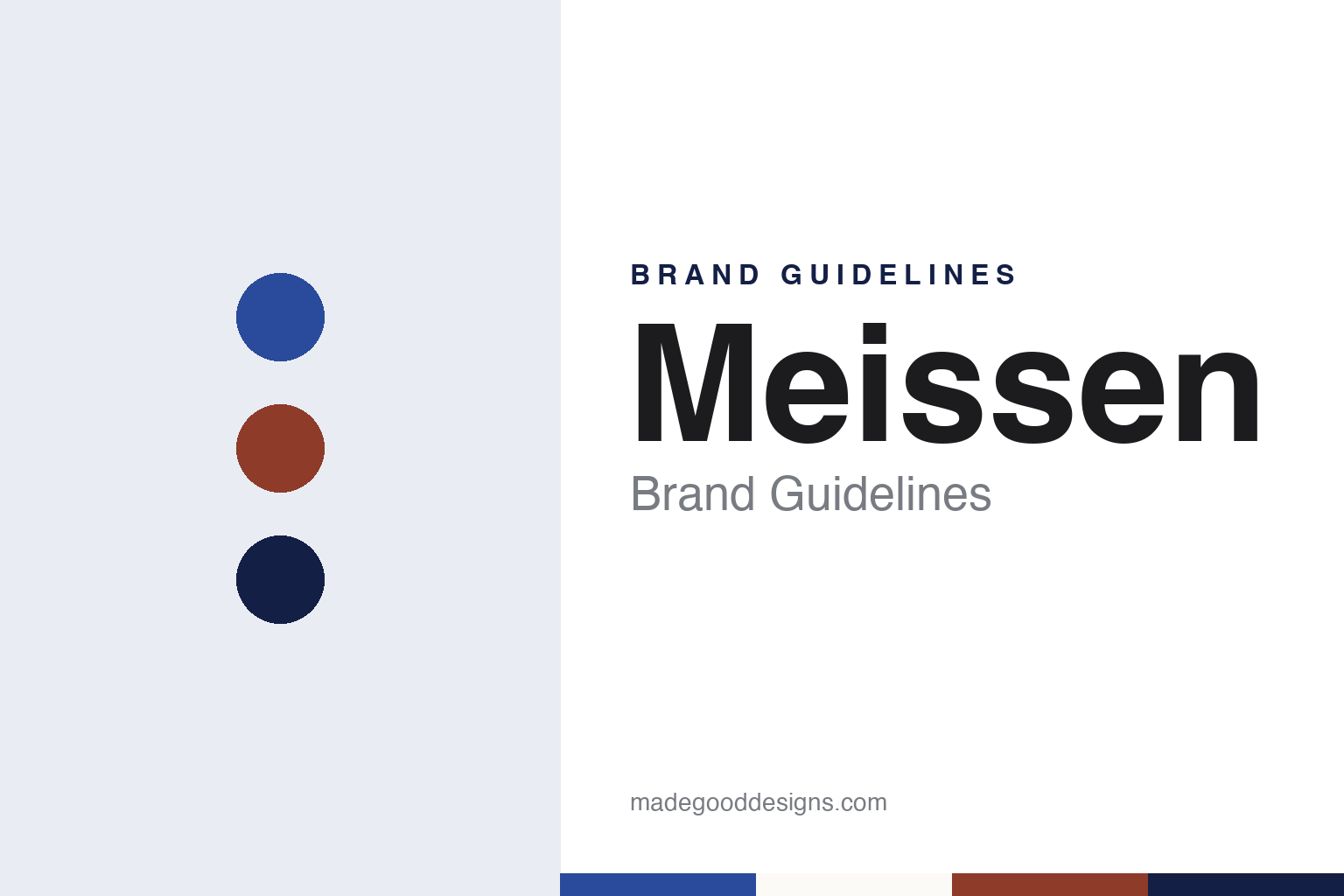
Meissen Brand Guidelines
Two swords from a Saxon coat of arms, painted by hand.
Aa
Two constants: a swords blue, Böttger red and Saxon navy palette and a Baroque serif register. Abstract homage — not a Meissen asset or mark; no logo, crossed swords or wordmark is reproduced.
An alchemist, a castle and a royal manufactory
Dresden and Meissen, 1705 to 1865.
Meissen porcelain began with a search for gold. The National reported on 31 January 2010 that Augustus the Strong, Elector of Saxony and King of Poland, had taken hold of a young alchemist, Johann Friedrich Böttger, who had claimed he could make gold, and that in 1705 the king confined him in the Albrechtsburg, the castle above the town of Meissen, to speed up his research. Böttger never made gold. His experiments, the paper said, led instead to the secret of white porcelain in 1708.
The German Patent and Trade Mark Office, the DPMA, tells the same story in its series on traditional East German brands, last updated on 10 December 2025. It says that in 1707 Böttger produced a red stoneware, still registered today as the word mark Böttgersteinzeug, and that a laboratory protocol of 15 January 1708 records the moment white “Colditz clay” and alabaster were added to his mixture. English Wikipedia credits the earlier experiments to the mathematician Ehrenfried Walther von Tschirnhaus, who supervised Böttger and whose work Böttger continued from 1708.
The manufactory followed. Wikipedia says the king established the Royal-Polish and Electoral-Saxon Porcelain Manufactory in 1709 and placed Böttger’s laboratory in the Albrechtsburg, with production starting officially in 1710. The National dated the public announcement to 23 January 1710, when the Saxon court made the foundation of the company known. The DPMA says the whole manufactory was initially housed in the castle.
Böttger’s red stoneware, known in English as Böttger ware, came before the white body. Wikipedia describes it as a refined, very hard stoneware modelled on Chinese Yixing teapots and on Baroque silver shapes, and says glazed white porcelain went on the market in 1713. Keeping the recipe, the arcanum, secret proved hard. The DPMA says the arcanist Samuel Stöltzel deciphered it and took it to Vienna, where a rival manufactory opened in 1718.
The castle was home for more than a century and a half. The DPMA says the manufactory moved in 1865 to the nearby Triebisch valley, where the Meissen State Porcelain Manufactory is still based. The National described the works there in 2010 as a red-brick factory in the town of Meissen, and reported that it draws its kaolin clay from its own mine.
Colour
A mark borrowed from the Electorate of Saxony.
Meissen’s visual identity rests on one sign: two crossed swords, painted in blue under the glaze. The DPMA explains why the mark was needed. Once the recipe had left Saxony, the manufactory had to tell its own porcelain apart from copies, and it began to mark its goods. The key step was technical. The DPMA says the blue underglaze colour was developed at Meissen in 1720, which at last made it possible to mark porcelain in a way that would survive the firing.
The swords themselves came from heraldry. The DPMA says the manufactory inspector Johann Melchior Steinbrück proposed using the swords from the coat of arms of the Electorate of Saxony. English Wikipedia adds that they are the arms of the Elector as Arch-Marshal of the Holy Roman Empire, that the mark was introduced in 1720 and that a decree made its use consistent after 1731. The DPMA gives the same date, saying the crossed swords were generally established from 1731 onwards.
Before then, letters did the job. Both sources list monograms such as AR for Augustus Rex, K.P.M. for Königliche Porzellan-Manufaktur, M.P.M. for Meissener Porzellan-Manufaktur and K.P.F. for Königliche Porzellan-Fabrik. The DPMA says these letter sequences were common until 1730. The K.P.M. initials later became the name of the Berlin manufactory founded in 1763; see KPM Berlin.
The swords were never a fixed drawing. The DPMA says each mark was painted by hand, initially in an inconsistent and irregular way, and that stars, dots, numbers and other signs were added at times, often according to the taste of the director of the day. Wikipedia says these variations allow approximate dating of a piece, and names a “dot period” in which a dot appears between the hilts. In the eighteenth century, it adds, the mark was often painted crudely and was not considered important.
The mark also has a legal history. The DPMA says that after the imperial act on the protection of trade marks came into force, the manufactory registered its marks on 20 May 1875. From 1948, it says, a year sign has been stamped into the base of each piece as an additional marking, so that the year of production can be shown.
Ownership has changed with the state around the manufactory. Wikipedia says that since 1991 it has traded as the Staatliche Porzellan-Manufaktur Meissen GmbH, owned by the Free State of Saxony. The National described it in January 2010 as wholly owned by the state of Saxony, with Christian Kurtzke, a former Boston Consulting Group executive, brought in as manager in 2008.
Typography
Swords, monograms and a year sign.
A porcelain house carries its identity in places a reader might not think of as branding. The first is the factory mark: a small device painted or printed on the underside of a piece, often in underglaze blue, which has served for centuries as signature, guarantee and date code at once. Collectors read changes in a mark’s drawing, colour or wording to place a piece in time, which makes the backstamp a quiet but exacting part of the visual system.
The second is the pattern name. Services are catalogued under names and numbers that stay in use for generations, so a pattern works almost like a sub-brand, with its own motif, border and shape family. Cobalt blue, the pigment that survives high firing under the glaze, recurs across many European houses and often doubles as the house colour on packaging and print.
Finally there is place. The factory town and the museum attached to a manufactory act as brand surfaces in their own right: archives of shapes and moulds, showrooms, and the backdrop for how a house tells its own history. For designers, the lesson is that a heritage identity can live in a mark, a name and an address as much as in a logo.
Aa
A Baroque serif — after the court lettering of eighteenth-century Saxony. (Specimen set in Cormorant Garamond, a serif STAND-IN; NOT the Meissen logo, the crossed swords or any Meissen typeface.)
Meissen
Colours, modellers and services with names.
Behind the mark sits a design history told through people and services. English Wikipedia says Johann Jakob Irminger was charged with designing new vessels, and that Johann Gregor Herold, who became director in 1720, introduced a range of bright overglaze enamel colours in 1723. It credits a signature underglaze Meissen Blue to Friedrich August Köttig. Painters combined Japanese Kakiemon flowers with Chinese famille verte into a style called Indianische Blumen, “Indian flowers”, and from the 1730s coloured grounds framed panels of decoration.
Sculpture followed. Wikipedia says the modeller Johann Jakob Kirchner made large statues of Baroque saints, and that his assistant Johann Joachim Kändler took over as chief modeller in 1733. Under Kändler, Meissen produced small figures of courtiers, shepherds and commedia dell’arte characters, a menagerie of large animals for Augustus’s Japanese Palace, and the Monkey Band, modelled with Peter Reinicke in 1753–1754.
Tableware patterns carry names that are still in use. Wikipedia says Kändler produced the New Cutout pattern of 1745, with its wavy edge, and is presumed to have designed the osier border that imitates woven wicker. The Swan Service, made between 1737 and 1743 for the manufactory’s director, Count Heinrich von Brühl, is still made from the original moulds. The Blue Onion pattern, Wikipedia notes, in fact copies Chinese pomegranates.
Later periods added their own looks. Wikipedia says Count Camillo Marcolini ran the manufactory from 1774 to 1813, a period of Sèvres-influenced Neoclassicism and matt biscuit porcelain that resembles white marble. In the nineteenth century, Ernst August Leuteritz reworked Rococo figures with lace and applied flowers, and lithophanes, pictures that appear when held to the light, were introduced in 1829. Erich Hösel became head of modelling in 1903. The National reported in January 2010 that Meissen had reorganised into fine living, fine dining and fine jewellery, adding wall and floor tiles, services for sushi, pasta and espresso, and a jewellery collection.
For a design guide, Meissen shows how a mark taken from a coat of arms can work as a signature for three centuries, with small dated changes that let collectors read a piece’s age. Compare KPM Berlin and Nymphenburg, two other German porcelain manufactories in this collection. For this guide we use swords blue, Böttger red and Saxon navy with a serif, an unofficial interpretation; no product or logo is reproduced.
Explore & save
Keep Meissen’s identity on hand — save it to a board in the Made Good inspiration library.
Meissen identity set
Pin the Meissen swords blue, Böttger red and Saxon navy palette and the Baroque serif register to your own board.