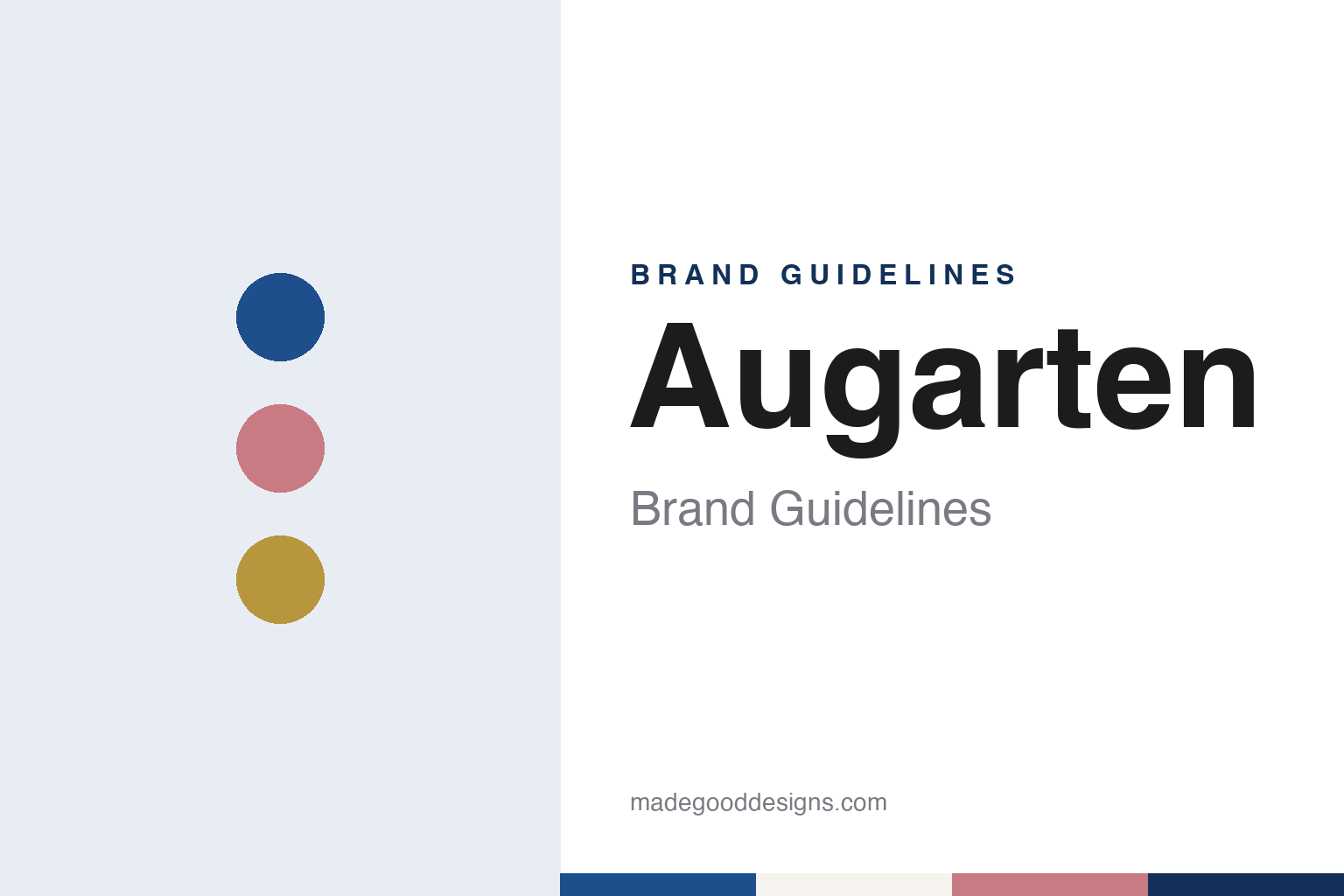
Augarten Brand Guidelines
A Viennese manufactory, marked with a blue shield since the eighteenth century.
Aa
Two constants: a shield blue, rose and gold palette and a Viennese serif register. Abstract homage — not an Augarten asset or mark; no shield, backstamp or pattern is reproduced.
An imperial privilege
Vienna, 1718.
Augarten is the name of Vienna’s porcelain manufactory, and its story begins long before the palace it is named after. German Wikipedia says the original Wiener Porzellanmanufaktur was founded in 1718 by Claudius Innocentius du Paquier, an agent of the imperial war council, who recruited craftsmen from Meissen to Vienna. The Austrian news site vienna.at, reporting on 23 March 2018 as the manufactory marked its three-hundredth anniversary, said production began under a privilege signed by Emperor Charles VI on 27 May 1718, and that du Paquier set up the Vienna works in the Rossau district.
German Wikipedia says the privilege gave du Paquier’s works protection for twenty-five years and the sole right to make porcelain in the Habsburg lands. The business moved in 1721 to a former summer palace of the Breuner family, on a site that ran along today’s Porzellangasse, the street that took its name from the manufactory in 1862. The late-Baroque style of those years, Wikipedia says, is still called the “du Paquier period.”
The works then passed to the crown. vienna.at reported that the manufactory was taken into imperial care by Empress Maria Theresa in 1744, and German Wikipedia gives 10 May 1744 as the date it became state property. Wikipedia says that under her rule the Austrian Bindenschild, the shield from Austria’s coat of arms, was introduced as a mark in blue, applied to the underside of each piece as a guard against forgery.
Wikipedia divides the following decades into periods named after style or director. It calls 1744 to 1784 the “plastic period,” the high point of Rococo figures, with the modeller Johann Joseph Niedermayer at work from 1747. Under Conrad Sörgel von Sorgenthal, director from 1784 to 1805, the house turned to straight neoclassical lines, relief gilding and cobalt blue, and Wikipedia says the term “Sorgenthal porcelain” comes from his name. In the Biedermeier years flower painting dominated. The manufactory closed in 1864, Wikipedia says, and its buildings were later demolished.
Colour
A palace in the Augarten park.
The present company dates from 1923. German Wikipedia says the Wiener Porzellanmanufaktur Augarten was opened on 2 May 1923 in Schloss Augarten, a palace in the Augarten park in Vienna’s Leopoldstadt district, in the presence of the federal president Michael Hainisch. It says the new firm took up the tradition of the manufactory closed in 1864 and partly uses its designs, and that pieces are still made by hand at the palace and a post-war extension beside it.
The 1920s brought in the designers of Viennese modernism. Wikipedia names Josef Hoffmann alongside Michael Powolny, Ida Schwetz-Lehmann, Albin Döbrich and Franz von Zülow among those who designed for Augarten in the Art Deco years. Later names it lists include Ena Rottenberg, Walter Bosse, Robert Ullmann and Friedrich Ludwig Berzeviczy-Pallavicini, and, more recently, Thomas Feichtner and Gottfried Palatin. The range runs, Wikipedia says, from chinoiserie and flower bouquets to Biedermeier, Art Deco and contemporary forms.
Ownership changed in 2003. Wikipedia says the manufactory closed after bankruptcy that year and that in September 2003 an investor group around the businessman Erhard Grossnigg bought it and formed a new company, the Neue Porzellanmanufaktur Augarten. The Vienna service of the broadcaster ORF reported on 2 January 2013 that the company had then been in Grossnigg’s hands for ten years, and quoted him, from an interview with the newspaper Kurier, calling it a piece of Austrian tradition that had to be preserved and describing his investment in a museum. At the anniversary in 2018, vienna.at reported, Grossnigg said he had never regretted buying the manufactory, and that it mattered that the old craft tradition be kept alive.
The museum opened in 2011. German Wikipedia says the Porzellanmuseum im Augarten occupies a side wing of the palace, and vienna.at also dated its founding to 2011. Visitors to the palace can take guided tours of the workshops, Wikipedia says, so the factory, the shop and the museum share one address.
Typography
Marks, patterns, places.
A porcelain house carries its identity in places a reader might not think of as branding. The first is the factory mark: a small device painted or printed on the underside of a piece, often in underglaze blue, which has served for centuries as signature, guarantee and date code at once. Collectors read changes in a mark’s drawing, colour or wording to place a piece in time, which makes the backstamp a quiet but exacting part of the visual system.
The second is the pattern name. Services are catalogued under names and numbers that stay in use for generations, so a pattern works almost like a sub-brand, with its own motif, border and shape family. Cobalt blue, the pigment that survives high firing under the glaze, recurs across many European houses and often doubles as the house colour on packaging and print.
Finally there is place. The factory town and the museum attached to a manufactory act as brand surfaces in their own right: archives of shapes and moulds, showrooms, and the backdrop for how a house tells its own history. For designers, the lesson is that a heritage identity can live in a mark, a name and an address as much as in a logo.
Aa
A Viennese serif — a nod to the house’s Biedermeier and neoclassical pieces. (Specimen set in Libre Bodoni, a serif STAND-IN; NOT the Augarten logo or shield mark.)
Augarten
The blue shield and the numbers beside it.
The shield has survived every change of owner. German Wikipedia says the blue Bindenschild is stamped on every Augarten product today, and that each piece also carries a painter’s number, a decoration number and a form number. The mark that Maria Theresa’s manufactory introduced as protection against forgery has become the signature of the 1923 company too, and the numbers beside it tie each piece to a hand, a pattern and a shape.
The anniversary in 2018 showed how the house uses its own history. vienna.at reported on 23 March 2018 that the jubilee exhibition “ewig schön” (“forever beautiful”) had opened at the Augarten museum, curated by Claudia Lehner-Jobst. It was built around an old kiln and began with the once-secret ingredients of porcelain, kaolin, quartz and feldspar, before tracing design from the Baroque and Rococo through the forms of the Wiener Werkstätte to the bright colours of the 1950s, ending in the manufactory’s own shop. Lenders included Vienna’s MAK, the Wien Museum and the princely Liechtenstein collections, and the show ran until 13 October. A book edited by Lehner-Jobst, with photographs by Sebastian Menschhorn, was published by Residenz Verlag.
Pattern names carry the house’s past into everyday use. German Wikipedia records a Maria Theresia service, created for the empress for a hunting lodge in the eighteenth century, and says that in 2014 the manufactory worked with the Austrian postal service on a porcelain postage stamp titled Wiener Rose.
For a design guide, Augarten shows a house whose mark is older than its present company, with a palace, a museum and a numbered backstamp doing the work of a brand book. Compare Meissen, whose craftsmen helped found the Vienna works, and KPM Berlin, another manufactory with a royal mark. For this guide we use shield blue, rose and gold with a serif, an unofficial interpretation; no product or logo is reproduced.
Explore & save
Keep Augarten’s identity on hand — save it to a board in the Made Good inspiration library.
Augarten identity set
Pin the Augarten shield blue, rose and gold palette and the Viennese serif register to your own board.


