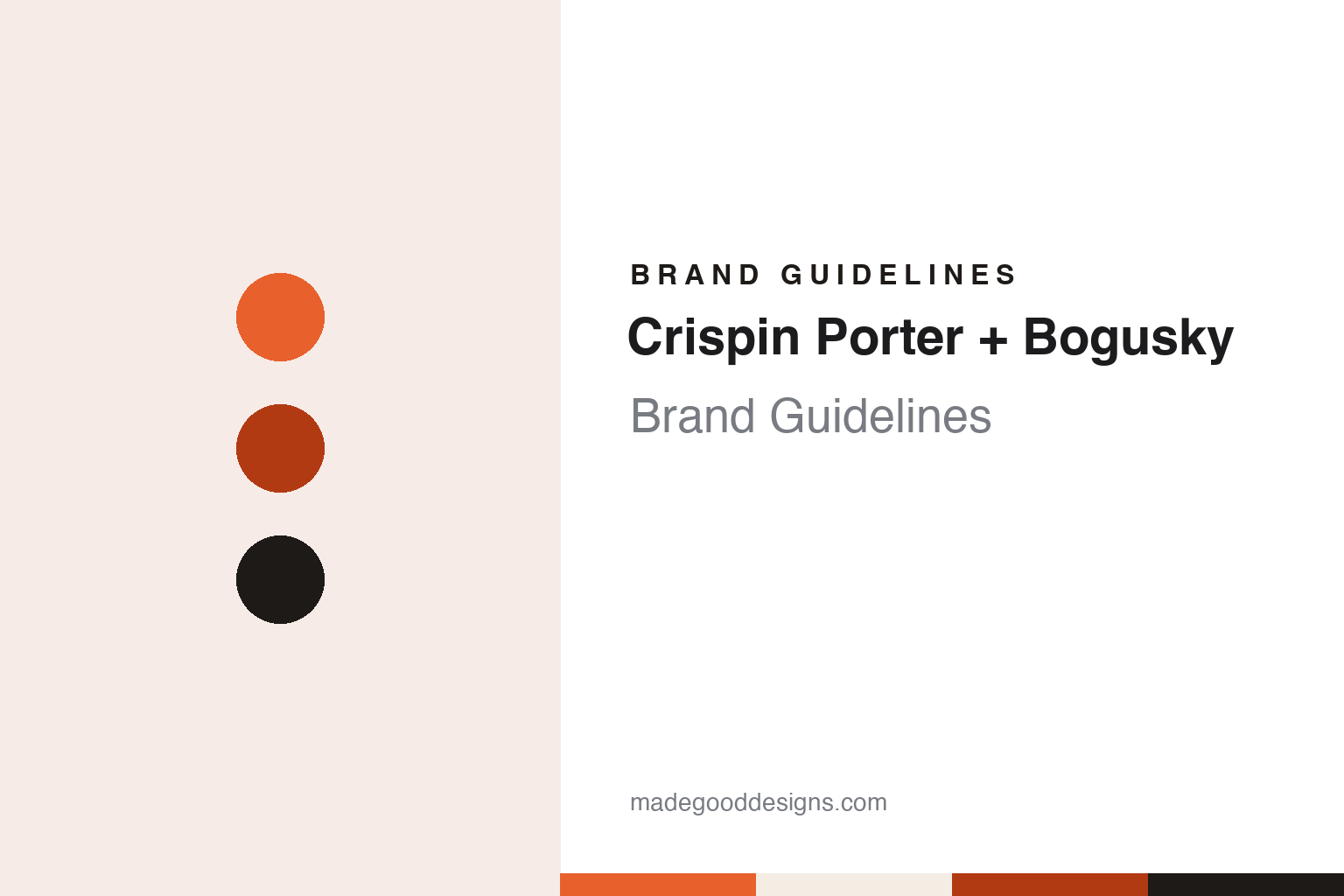
Crispin Porter + Bogusky Brand Guidelines
Three surnames, one plus sign, then a single name.
Aa
Two constants: a signal orange, rust and ink palette and a heavy grotesque register. Abstract homage — not a Crispin Porter + Bogusky or Crispin asset or mark; no logo, icon or wordmark is reproduced.
A Miami agency that took on partners
Miami, 1965.
The agency now called Crispin began with one name on the door. Campaign, in a report published on 7 May 2015, said Samuel Crispin started in advertising at an agency called Grant Advertising in 1949, later opened a Miami office for Arthur Mogge Advertising, and then founded his own business, Samuel B Crispin and Associates, in 1965. Wikipedia gives the same founding year and founder, and says the agency kept its headquarters in Miami for decades.
The second name arrived through freelance work. Campaign said Crispin developed a relationship with Chuck Porter, often hiring him to write copy, and that the pair formed Crispin & Porter in 1988. Porter told his side of the story to Shots magazine in an interview published on 4 August 2011. He said he had quit law school and moved to Miami to write advertising, and that Sam Crispin had asked him for a few years to come to the agency as creative director. Porter said he enjoyed freelancing too much to be tempted, until the two were in Jamaica after a presentation and Crispin handed him a pad and asked him to write down what he would want in order to join. Shots dated his arrival at the firm to 1988 and described the business he joined as a small Miami-based agency.
The third name followed soon after. Campaign said that, shortly after the partnership was formed, Porter hired an art director called Alex Bogusky, who would later become a name partner. That addition turned Crispin & Porter into Crispin Porter + Bogusky, the form the agency used for much of its later history.
Ownership inside the firm shifted in the 1990s. According to Campaign, Porter bought out Crispin and his son, Charles, who was the managing partner at the agency, in 1993. Crispin did not leave the building, though: Campaign said he kept an office at the agency afterwards. In its 2015 report Campaign said that Samuel Crispin had died, that the agency was by then owned by MDC Partners, and that Chuck Porter remained there as a partner and chairman.
The founder’s surname has outlasted the other two in the agency’s name. Later short forms dropped the second and third partners entirely, and the agency today trades simply as Crispin.
Colour
A plus sign, initials and a single surname.
For a design guide, the thread to follow in this agency’s identity is its name and the way it has been shortened over time. The first partnership used an ampersand: Crispin & Porter. When Bogusky became a name partner, the agency joined the three surnames with a plus sign rather than a second ampersand, giving Crispin Porter + Bogusky. In trade coverage the name was routinely compressed to the initials CP+B, which is how The Drum referred to the agency in a report on 30 November 2017.
The plus sign did not last for ever. Adweek, writing on 18 November 2019, described the agency as Crispin Porter + Bogusky, “since shortened to CPB”. By April 2024 Adweek was calling the agency simply Crispin, and Wikipedia now describes Crispin as the agency “formerly known as Crispin Porter + Bogusky”. The path runs from a founder’s full name, to a partnership name, to three surnames, to three letters with a plus sign, to three letters, and finally back to the founder’s surname alone.
The agency’s offices tell a parallel story. Adweek said in its 2019 report that in 2006 Alex Bogusky moved a portion of the agency from its then-home base of Miami to Boulder, Colorado, and quoted him as saying the move was about lifestyle, because the people who had built the agency over the years were largely from the Midwest. Wikipedia says a European arm, CP+B Europe, opened in June 2009 after the agency acquired the Swedish agency Daddy in Gothenburg, and that CP+B Canada followed in July 2010 after the acquisition of the Toronto agency Zig.
Miami, the starting point, was the next office to go. The Drum reported on 30 November 2017 that CP+B would close its Miami location, its original office, in March 2018, splitting the Miami accounts among its offices in Boulder, Los Angeles and São Paulo and centralising finance and accounting in Boulder. Porter told The Drum the agency had a lot of sentimental attachment to Miami but had decided to consolidate rather than spread itself over three offices.
Boulder was not the last stop. BusinessDen reported on 11 January 2021 that Crispin Porter + Bogusky was moving from Gunbarrel, in the Boulder area, to an office in McGregor Square in Denver’s LoDo district, with the move expected to finish that July. Wikipedia says the headquarters relocated to Denver in 2021.
Typography
A name that kept getting shorter.
An advertising agency is in the odd position of selling identity work while needing one of its own. Many agency names are simply the founders’ surnames joined together, sometimes with an ampersand, a plus sign or a slash, and over time those strings are often shortened to initials. That shortening is itself a design decision: a run of capitals reads as a mark rather than a list of people, and it survives the departure of the partners whose names it holds.
Other agencies pick a single word, an animal or a punctuation mark as the anchor, and let the typography do the rest. Because an agency rarely has a product on a shelf, its identity lives on surfaces that are easy to overlook: the reception wall, the office building and its signage, the credentials deck, the business card, the “about” page and, above all, the website, which is often rebuilt more often than the logo. For a designer studying these brands, the useful questions are how the name is set, how the mark behaves when it is shortened or extended for a new office, and how much of the agency’s self-promotion borrows the tone of the work it makes for clients.
Aa
A heavy grotesque — after an agency whose name was often seen as compact initials. (Specimen set in Archivo Black, a sans-serif STAND-IN; NOT the Crispin Porter + Bogusky or Crispin logo or any agency typeface.)
Crispin Porter + Bogusky
Owners, a returning partner and a new name.
For much of its later history the agency belonged to a holding company. Campaign described it in 2015 as owned by MDC Partners, and The Drum in 2017 and Adweek in 2018 both named MDC Partners as its parent. Clients from that period appear in trade coverage as dated facts. Shots said in 2011 that the agency had held the Burger King account for eight years and developed campaigns such as the Subservient Chicken, and Adweek in 2020 also named anti-smoking campaigns for the Truth initiative.
The third name partner left and came back. Adweek reported on 2 August 2018 that Bogusky, who had resigned from CP+B and quit the advertising industry in 2010, would return to the agency with the title of chief creative engineer, at the agency where he had spent more than 20 years. Adweek reported on 14 January 2020 that he was leaving again, a year and a half after rejoining in August 2018.
The next owner was Stagwell. The Drum described CP+B as a Stagwell-owned agency on 24 April 2023, when it reported that three other Stagwell agencies were being brought together under the CP+B banner: the creative shop Vitro, the entertainment, creative and strategy agency Observatory, and the media, performance and influencer agency MMI. Observatory kept its own branding, The Drum said, while the Vitro and MMI brands were retired. Maggie Malek, formerly chief executive of MMI, was named North America president, and Brad Simms was named as global chief executive.
The latest change is the name. Adweek reported on 17 April 2024 that the Stagwell agency Crispin had elevated Malek to chief executive and appointed Steve Denekas as chief creative officer. Adweek listed Fannie Mae, Samsung and Georgia Pacific among the clients added in 2024. Stagwell owned the agency by 2023, and it trades today as Crispin, with its headquarters in Denver.
For a design guide, Crispin Porter + Bogusky shows how a partnership name can be built up one surname at a time, compressed into initials, and then pared back to the founder’s name alone. Compare Burger King, the client behind the Subservient Chicken, and Droga5, another creative agency that became part of a larger group. For this guide we use signal orange, rust and ink with a sans-serif, an unofficial interpretation; no product or logo is reproduced.
Explore & save
Keep Crispin Porter + Bogusky’s identity on hand — save it to a board in the Made Good inspiration library.
Crispin Porter + Bogusky identity set
Pin the Crispin Porter + Bogusky signal orange, rust and ink palette and the heavy grotesque register to your own board.