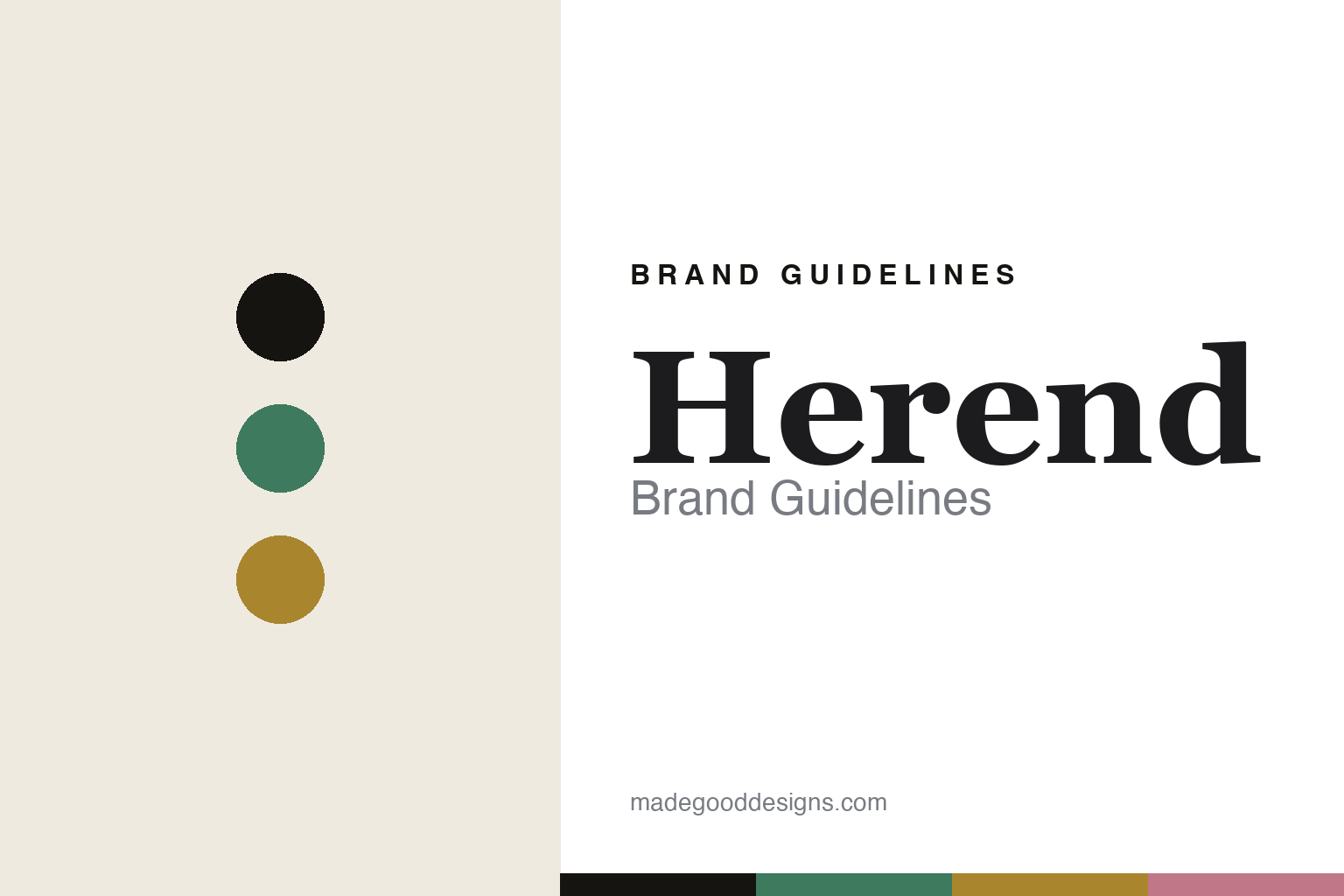
Herend Brand Guidelines
The painted porcelain.
Aa
Two constants: a green-and-gold palette and a luxury serif register. Abstract homage — not the Herend porcelain, patterns or mark.
The painted porcelain
Herend hand-paints luxury porcelain.
Herend is a lesson in hand-painting as identity. Founded in 1826 in Herend, Hungary, by Vince Stingl (originally as an earthenware works), it became the porcelain house it is known as after Mór Fischer took it over around 1839 and elevated it to fine, hand-painted porcelain. Today it is around three-quarters owned by its own management and workers, still making in Herend.
Its identity is hand-painted luxury porcelain. Its icons are patterns: the “Victoria” butterfly-and-flowers design — genuinely born when Queen Victoria ordered a service at the 1851 Great Exhibition — the “Rothschild Bird,” the “Apponyi” pattern and the elaborate figurines. Intricate, gilded, painted stroke by stroke, it is porcelain as collectible art.
(Honest notes: Vince Stingl founded it as earthenware; Mór Fischer took it over and made it a porcelain house — so we call Fischer the one who elevated it, not a founder. The Queen Victoria 1851 story is real, not myth; the charming “Rothschild Bird and the lost necklace” anecdote is brand legend. There’s no official brand hex, so these tones are an unofficial interpretation. This is design commentary and does not promote any product.)
Colour
Herend lives in a green-and-gold palette. Click a swatch to copy the hex.
Herend’s identity is ornate, gilded and Hungarian — a Herend green, an ink, a gold, a rose, and an ivory. The palette pairs a green with a gold — the register of a hand-painted, gilded porcelain. It signals luxury and craft rather than novelty. The honest caveat: with no published brand hex, these tones are an original, unofficial interpretation, not first-party values.
The lesson is a green with a gold signals a hand-painted luxury house. Herend’s world is an intricately painted, gilded plate. For designers, it is a reminder that virtuoso hand-painting and named patterns can be a two-century luxury identity. Because a mid green can fail as small text, keep type dark and let the colour live in the accents, palette and band. The takeaways: make hand-painting the identity; name the patterns; gild sparingly; and treat any single hex as unofficial.
Typography
The register is a luxury serif — ornate, Hungarian, gilded.
Herend’s identity carries a ornate, Hungarian, gilded spirit — a hand-painted, gold-trimmed plate. A high-contrast luxury serif captures the mood: it is elegant and grand, the register of imperial-era porcelain. Set in a green-and-gold palette, the luxury serif feels ornate and Hungarian — exactly the personality Herend carries. It is refined rather than plain, mirroring virtuoso hand-painting. (Herend’s real porcelain, patterns and mark are works we describe but do not reproduce, and the exact typeface is not ours to use.) Because it is not ours to use, the honest description is “a luxury serif spirit,” shown here in a stand-in. The type behaves like the brand: ornate, Hungarian and gilded.
Aa
A luxury serif spirit — ornate and Hungarian. (Specimen set in Playfair Display, a high-contrast display serif STAND-IN; NOT the Herend packaging or mark.)
Hand-painting as identity
Herend stands for hand-painted luxury porcelain.
Herend is a lesson in making hand-painting the identity. A green-and-gold palette, a luxury serif and an intricately painted plate make hand-painting the whole brand — ornate, Hungarian, gilded. The hand-painting is the differentiator. The differentiator is virtuoso, named-pattern porcelain.
For designers and brand-builders, Herend offers a clear takeaway: make the handwork the luxury. The lessons: make hand-painting the identity; name the patterns (Victoria, Apponyi); gild with restraint; and be honest about the story. It is also a reminder to stay accurate: Stingl founded it as earthenware, Fischer elevated it to porcelain, the Queen Victoria story is real, and the palette here is an unofficial interpretation. Herend made hand-painting the brand — proof that virtuoso craft can be the difference.
Explore & save
Keep Herend’s identity on hand — save it to a board in the Made Good inspiration library.
Herend identity set
Pin the green-and-gold palette and the luxury-serif register to your own board.