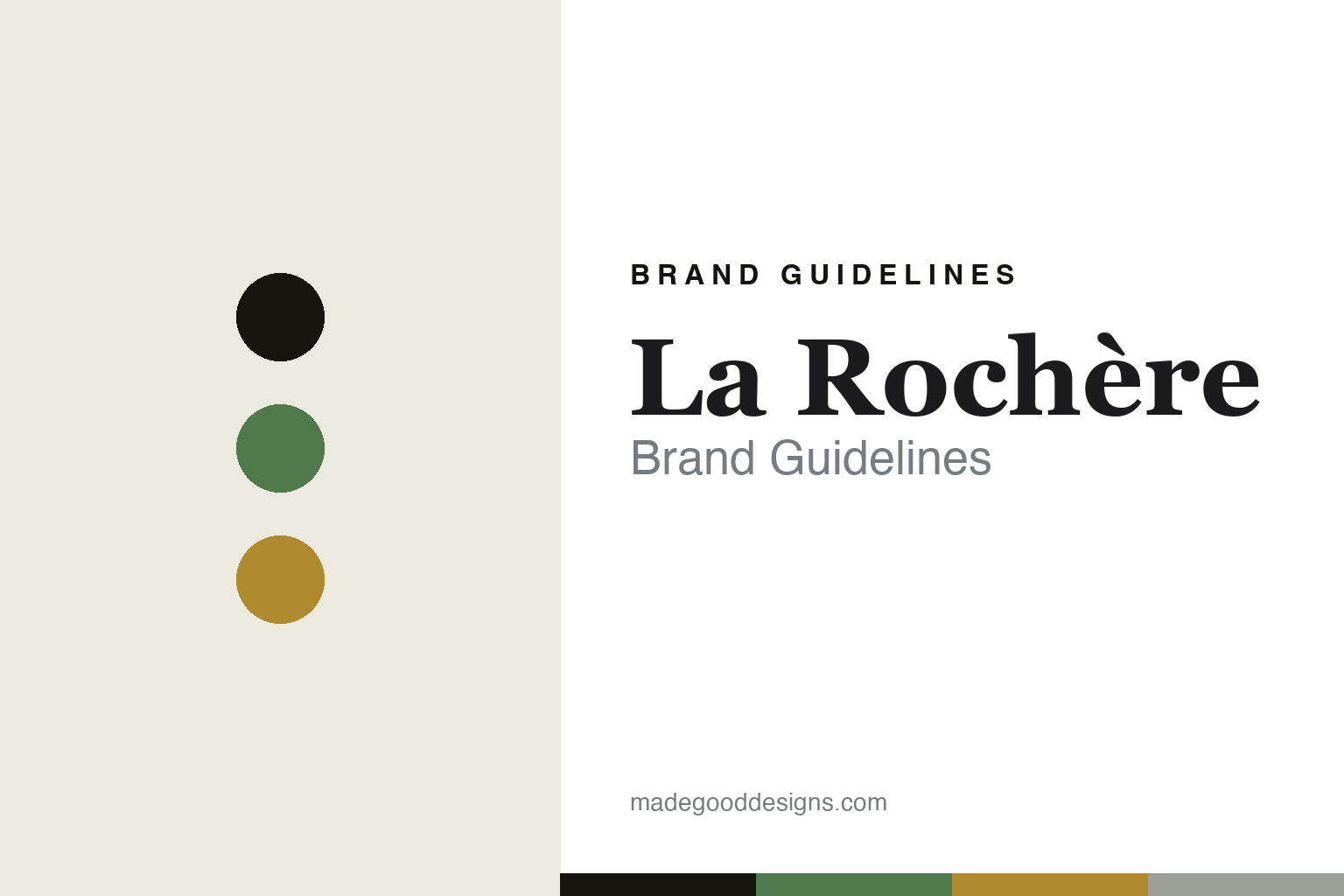
La Rochère Brand Guidelines
The bee tumbler.
Aa
Two constants: a green-and-gold palette and a heritage serif register. Abstract homage — not the La Rochère glass or packaging.
The bee tumbler
La Rochère embosses glass with a bee.
La Rochère is a lesson in a relief motif as identity. Founded in 1475 in Passavant-la-Rochère, in the Haute-Saône of France, it is one of the oldest continuously operating art-glassworks in Europe — an “Entreprise du Patrimoine Vivant” (Living Heritage) house still blowing and pressing glass.
Its identity is pressed glass with an embossed relief. La Rochère works in several techniques, but its emblematic piece is the Abeille (Bee) tumbler and goblet — pressed glass carrying an embossed relief bee, a bistro-table classic recognised across France. The raised pattern, moulded into the glass itself, is the signature: decoration that is the form.
(Honest notes: the “oldest glassworks” label is a qualified, third-party phrasing — “the oldest traditional art-glassworks still in activity in Europe” — not a slogan on the brand’s own site, so we hedge it. La Rochère is multi-technique (also mouth-blown), and roughly half its output is architectural building glass, so it’s a heritage manufacture, not a pure tableware house. The bee is often linked to the Napoleonic/imperial emblem, which we present as folklore. There’s no official brand hex, so these tones are an unofficial interpretation. This is design commentary and does not promote any product.)
Colour
La Rochère lives in a green-and-gold palette. Click a swatch to copy the hex.
La Rochère’s identity is heritage, embossed and French — a bistro green, an ink, a bee gold, a clear grey, and a cream. The palette pairs a green with a gold — the register of a French bistro table and a golden bee. It signals heritage and craft rather than novelty. The honest caveat: with no published brand hex, these tones are an original, unofficial interpretation, not first-party values.
The lesson is a green with a gold signals a heritage pressed-glass house. La Rochère’s world is an embossed glass on a café table. For designers, it is a reminder that a relief moulded into the glass — decoration as form — can be a centuries-old identity. The takeaways: make the relief the identity (the bee); mould decoration into the form; honour the heritage; and treat any single hex as unofficial.
Typography
The register is a heritage serif — old, French, embossed.
La Rochère’s identity carries an old, French, embossed spirit — a bistro glass and a moulded bee. A classic heritage serif captures the mood: it is elegant and historic, the register of a five-century French glassworks. Set in a green-and-gold palette, the heritage serif feels old and French — exactly the personality La Rochère carries. It is traditional rather than modern, mirroring pressed heritage glass. (La Rochère’s real glass and wordmark are works we describe but do not reproduce, and the exact typeface is not ours to use.) Because it is not ours to use, the honest description is “a heritage serif spirit,” shown here in a stand-in. The type behaves like the brand: old, French and embossed.
Aa
A heritage serif spirit — old and French. (Specimen set in EB Garamond, a classic serif STAND-IN; NOT the La Rochère packaging.)
A relief motif as identity
La Rochère stands for the pressed bee tumbler.
La Rochère is a lesson in making a relief motif the identity. A green-and-gold palette, a heritage serif and an embossed bee tumbler make a relief the whole brand — old, French, embossed. The relief is the differentiator. The differentiator is decoration moulded into the glass.
For designers and brand-builders, La Rochère offers a clear takeaway: make the decoration part of the form. The lessons: make the relief the identity (the bee); mould it into the glass; honour the centuries of heritage; and be honest about the story. It is also a reminder to stay accurate: it dates to 1475, the “oldest” claim is a qualified one, it’s half architectural glass, and the palette here is an unofficial interpretation. La Rochère made a relief the brand — proof that decoration-as-form can be the difference.
Explore & save
Keep La Rochère’s identity on hand — save it to a board in the Made Good inspiration library.
La Rochère identity set
Pin the green-and-gold palette and the heritage-serif register to your own board.