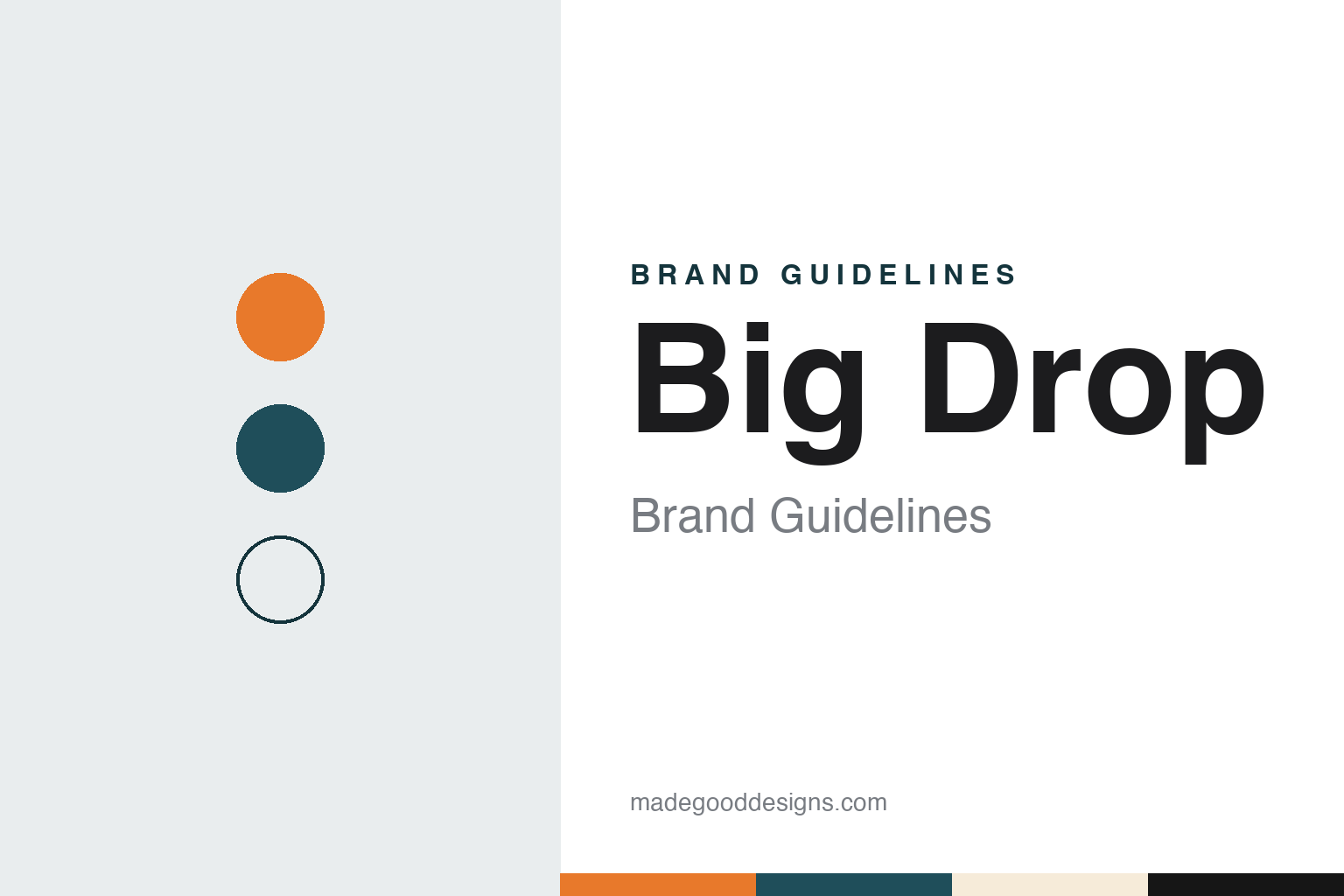
Big Drop Brand Guidelines
The alcohol-free craft brewer founded by Rob Fink and James Kindred in 2016.
Aa
Two constants: a deep teal, sunrise orange and malt cream palette and a heavy grotesque sans register. Abstract homage — not a Big Drop product or mark; no can, label or logo is reproduced.
A lawyer, a designer and a stout
Two school friends set out to brew nothing but alcohol-free beer.
Big Drop Brewing Co. was launched in October 2016 by Rob Fink, then a lawyer in the City of London, and James Kindred, a designer and entrepreneur whom the company describes as Fink’s school friend and bandmate. The company says the idea was a brewing business that made only alcohol-free beer, prompted by changes in the founders’ own lives and by frustration that there were no good alcohol-free options. Packaging Scotland named the pair as co-founders in February 2020, and the Morning Advertiser dated the launch to 2016.
It started small. Fink told Global Drinks Intel in June 2024 that Big Drop began as a side project while he was still practising law, that the business pushed harder from 2018, and that the goal had been “to create a category of alcohol-free craft beer because it didn’t seem to exist.” The company says Fink left his law firm the year after the launch to run the business full time, and that the range grew from a single stout into a full line-up of styles.
The brewing method is the other founding idea. Big Drop says that, with the experimental brewer Johnny Clayton, formerly of Wild Beer Co, it worked out how to brew to no more than 0.5% ABV without taking the alcohol out afterwards, using barley, rye, wheat and oats and more than twenty speciality grains across the range. Fink told FoodNavigator in June 2021 that the beer is not dealcoholised but brewed with less grain and a less efficient yeast, so that less alcohol forms in the first place; he argued that dealcoholisation suits lagers better than pale ales and IPAs.
Colour
A beer brand without a brewhouse of its own.
Big Drop has grown without a brewery of its own. Fink told FoodNavigator in 2021 that the beer was contract-brewed to Big Drop’s recipes by partner breweries in Melbourne, Toronto, Chicago and several British sites, and that he had no plans to build one. In May 2023 the company signed a licence agreement with In Good Company, the owner of Fourpure, moving production to its site in Bermondsey, London, where Big Drop had already been contract-brewed for years, the Morning Advertiser reported. Fink explained the difference to Just Drinks in June 2024: a contract brewer is a supplier, while a licensee also takes on parts of the chain such as sales, marketing and logistics. The same report described licence deals agreed in Singapore, as an export hub for South East Asia, and in Australia, with Destihl of Illinois contract-brewing the beer for the United States, and named Fink, the chief executive, as the company’s largest shareholder.
In December 2024 Big Drop moved again. It awarded its licence to Keystone Brewing Group, which took exclusive rights to brew and sell Big Drop in the UK and European export markets and moved production to Black Sheep Brewery in Masham, North Yorkshire, the Morning Advertiser and Just Drinks reported. Fink said Big Drop and In Good Company had “mutually agreed to trigger a break clause in the contract,” and Keystone’s chief executive, Mark Williams, called Big Drop “a well-established pure-play alcohol-free brand.” The American arrangement with Destihl had expired by then, Just Drinks reported. Keystone was itself sold on: in January 2026 its breweries, Black Sheep among them, were sold to the newly formed Great British Drinks Company, Inside Beer reported. Big Drop Brewing Co. remains a separate company, which the UK register of companies listed as active in 2026.
Typography
Design and documentation.
The seven brands in this group are cider and alcohol-free drinks names: Old Mout, Dunkertons, Sheppy’s, Henney’s, Ceder’s, Big Drop and Lucky Saint. Four are ciders, and three were built around drinks without alcohol: an alcohol-free alternative to gin and two alcohol-free beers. Brands like these sit at many different points in the trade, from family cider makers that still carry a founder’s name to labels that now belong to much larger drinks groups, and to young companies started to fill a gap on the shelf.
A cider or an alcohol-free drink is usually recognised less by what is in the glass than by a label, a name and the place or story it promises, because the company behind the name may have changed hands, moved its production or had its drinks made by someone else from the start. That makes the questions behind each name worth asking plainly: who started it, who owns it now, and where its drinks are actually made.
Each guide separates what independent sources record from what the company says about itself — its founding story, its owners over time, where its drinks are made and how its labels and cans have changed — and marks plainly what rests only on the company’s own word.
Aa
A heavy grotesque sans for a brewer that likes to go big. (Specimen set in Archivo Black, a sans-serif STAND-IN; NOT the Big Drop logo.)
Big Drop
Environments, colourways and a back catalogue.
The look has always had a designer among the founders. Big Drop says Kindred, a brand strategist and graphic designer, shaped the brand from the first bottle onwards. In February 2020 the company unveiled new packaging created by the London design agency Foundation working with Kindred, Packaging Scotland reported: each design was based on an environment linked to the beer’s style, and that environment inspired the beer’s name, its illustration and its colourway. The new look was to be rolled out across the whole range, including the Sour, Brown and Golden ales, and Kindred called it a “bold new design direction.”
The voice is just as deliberate. The company lists “Go On. Go Big.” and “Beer So Good … You Won’t Miss The Alcohol.” among its trademarks, and its website, credited to Kindred Studio, opens with the line “Awesome beer. That just happens to be alcohol-free.” In October 2026 the site’s core range carried plain style names, Citrus IPA, Pale Ale, Lager and Milk Stout, while a back-catalogue page kept a record of retired beers, among them collaborations with Fyne Ales and Einstök.
For a design guide, Big Drop shows how an alcohol-free brewer can borrow the codes of craft beer, with a scene, an illustration and a colour for each style, without owning a brewhouse of its own. Compare Athletic Brewing, the American non-alcoholic craft brewer, Clausthaler, Binding’s alcohol-free beer from Frankfurt, and the British alcohol-free lager Lucky Saint. For this guide we use deep teal, sunrise orange and malt cream with a bold sans, an unofficial interpretation; no product or logo is reproduced.
Explore & save
Keep Big Drop’s identity on hand — save it to a board in the Made Good inspiration library.
Big Drop identity set
Pin the Big Drop deep teal, sunrise orange and malt cream palette and the heavy grotesque sans register to your own board.