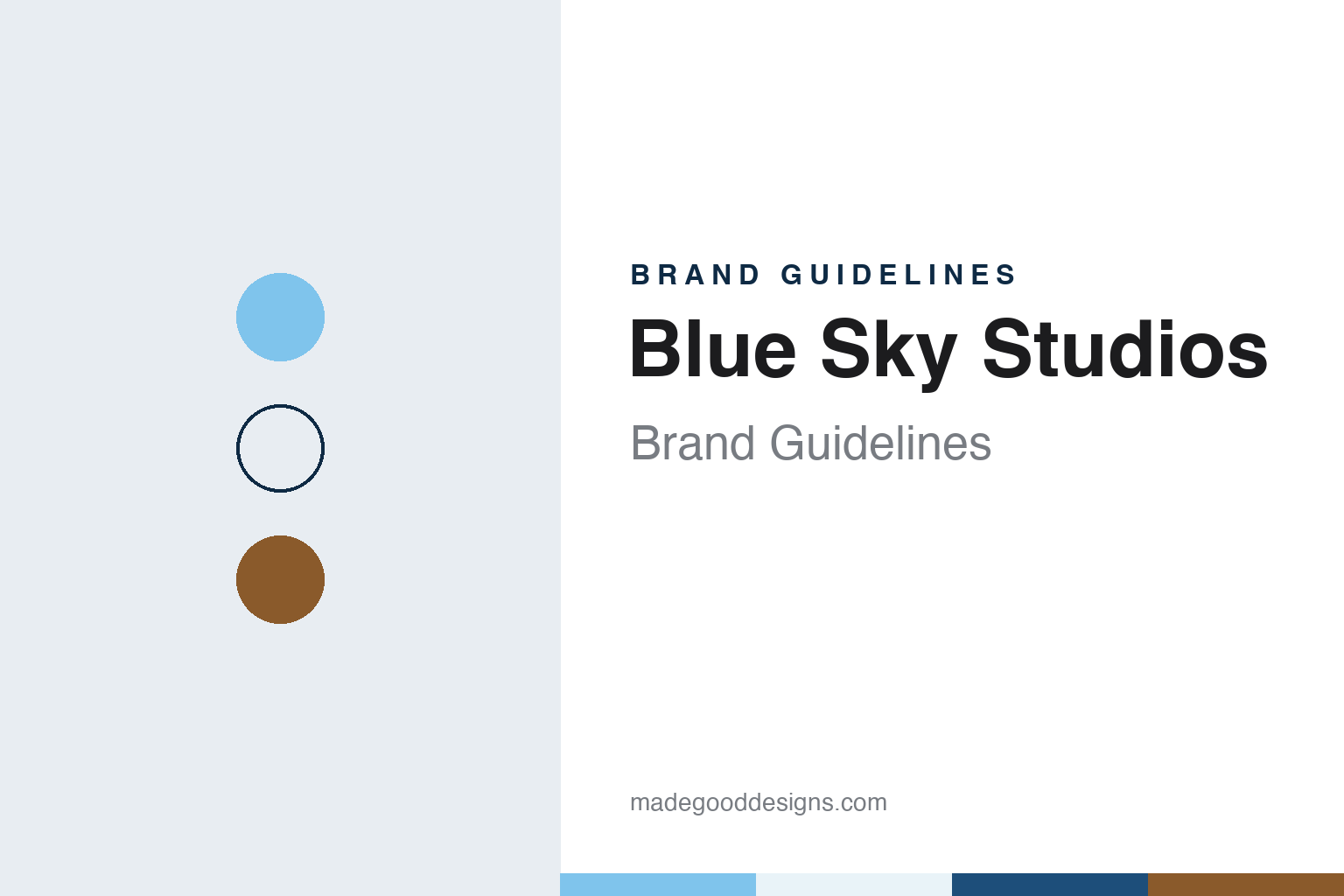
Blue Sky Studios Brand Guidelines
A renderer, a squirrel and a sky that closed in 2021.
Aa
Two constants: an open sky, glacier and acorn palette and a Rounded sans register. Abstract homage — not a Blue Sky Studios asset or mark; no logo, character, film frame or wordmark is reproduced.
Six founders and a renderer
Former MAGI staff, ray tracing and a short called Bunny.
Blue Sky Studios was a computer animation company that worked from 1987 until 2021; it no longer operates. Cartoon Brew reported on 9 February 2021 that the studio was founded in February 1987 by Alison Brown, David Brown, Michael Ferraro, Carl Ludwig, Eugene Troubetzkoy and Chris Wedge, and that it was formed by former crew of MAGI/Synthavision, a visual effects studio. The Hollywood Reporter, writing the same day, said Blue Sky was founded just outside New York City by a small team that included Wedge. English Wikipedia gives the date as 22 February 1987 and says the six set up the company after MAGI was sold to Vidmax Canada.
The company was built around its own software. Wikipedia says Ferraro and Ludwig carried on developing CGI Studio, a programming language they had begun at MAGI, and that Troubetzkoy and Ludwig adapted ray tracing so that lighting effects could be calculated by the computer rather than added by hand. According to the encyclopedia, Ludwig studied how light passes through water, ice and crystal and programmed those properties into the renderer. It adds that, after the stock market crash of 1987, the studio waited about two years for a paying client, and that the commission which arrived was for a company logo animated to fly over the ocean in front of a sunset.
Commercials and effects work filled the next decade. Cartoon Brew listed computer-animated advertising for Bell Atlantic, Rayovac, Gillette and Braun, the animated insects for the 1996 film Joe’s Apartment, and visual effects for films including Alien Resurrection and Fight Club. Wikipedia adds a talking coffee bean for Chock Full o’Nuts and a Nicktoons bumper in which an orange blob shapes itself into a dolphin, a dinosaur and a walking person. The Hollywood Reporter described this period as commercials and other short-film work.
Wedge’s short film Bunny, released in 1998, was made partly to show what the software could do. Wikipedia says it required CGI Studio to render fur, glass and metal lit from several sources, including a swinging light bulb, and that Ludwig modified the program to simulate radiosity, which follows light as it bounces between surfaces. The encyclopedia also records that Wedge had shared storyboard panels for Bunny with Carlos Saldanha, who later joined Blue Sky as an animator.
Colour
Fox in 1997, Greenwich in 2009 and Disney in 2019.
Ownership passed to Fox in stages. Wikipedia says that in August 1997 VIFX, the Los Angeles visual effects company owned by 20th Century Fox, acquired a majority interest in Blue Sky, and that the combined business was renamed Blue Sky/VIFX. In March 1999, it says, Fox sold VIFX to Rhythm & Hues while keeping Blue Sky. The Hollywood Reporter reported in February 2021 that the studio moved into feature animation with Ice Age in 1999 following its acquisition by Fox. Wikipedia says the studio moved to White Plains, New York, to make the film, which 20th Century Fox released on 15 March 2002.
The address changed again in 2009. When an expansion was announced on 26 October 2011, Cartoon Brew carried a statement from Connecticut governor Dannel Malloy that Blue Sky had opened its digital animation production facility in the state in 2009, and reported plans to enlarge the studio’s offices at One American Lane in Greenwich. The report quoted chief operating officer Brian Keane saying the company looked forward to producing new films within the state. Wikipedia dates the move from White Plains to January 2009.
Disney became the owner in 2019. The Hollywood Reporter wrote that Fox owned the studio until the Walt Disney Company acquired 21st Century Fox’s entertainment assets that year, and that former Walt Disney Animation Studios president Andrew Millstein then joined Blue Sky as co-president alongside Robert Baird. Wikipedia dates the completion of that acquisition to 20 March 2019. Cartoon Brew reported that Spies in Disguise, released in December 2019, was the studio’s last feature release.
On 9 February 2021, The Hollywood Reporter and Cartoon Brew reported that Disney would close the studio. A Disney spokesperson said that, given the current economic realities, the company had made the decision to close filmmaking operations at Blue Sky Studios. Cartoon Brew said the last day would come in April; the Reporter said production of Nimona would stop and that Disney would keep the rights to Blue Sky’s titles. Wikipedia dates the last day of operation to 10 April 2021 and says the library and characters are held through 20th Century Animation.
Typography
A name, a character and a library that outlived the studio.
A game studio’s identity usually reaches players before the game does. The company logo appears on a splash screen or a short animated ident in the seconds while software loads, then again on store pages, trailers, packaging and the credits. Because those seconds repeat every time someone opens a game, the ident tends to be short, legible on a phone or a television, and quiet enough that it does not compete with the title that follows. Animation studios use the same device in front of their films, often with a brief piece of motion or a sound cue that returns from release to release.
Much of the visible branding, though, belongs to the work rather than the company. Characters, mascots and title logos carry the recognition, and a studio name may sit underneath them in small type. Some companies let a recurring character stand in for the studio; others keep the studio mark plain so that each new game or film can look different. Ownership changes add another layer: when a studio is bought or becomes independent, the parent’s mark may appear beside its own or drop away. For designers, the practical point is that a studio identity is a set of placements — a splash screen, a store icon, a credit line, a website — and each needs a version of the mark that works at its size and in its moment.
Aa
A rounded sans — after the soft, open shapes associated with the studio’s films and title cards. (Specimen set in Nunito, a sans STAND-IN; NOT the Blue Sky Studios logo or any Blue Sky typeface.)
Blue Sky Studios
Scrat, a logo card and a farewell in 2022.
Blue Sky’s name reached audiences mainly through its films and one recurring character. Wikipedia describes Scrat, a character from the Ice Age films, as the studio’s mascot. Cartoon Brew reported in February 2021 that the studio had produced the Ice Age and Rio series and films including Ferdinand, The Peanuts Movie, Robots, Epic and Horton Hears a Who!, beginning with Ice Age in 2002.
The name continued for a short time after the doors closed. Wikipedia says Blue Sky’s website began redirecting to Disney.com in June 2021, and that Ice Age: Scrat Tales, a series of shorts, was released on Disney+ on 13 April 2022 as the last official Blue Sky production, with its final episode closing on a parting message from the company. Cartoon Brew had reported in February 2021 that a planned Ice Age series for Disney+ would not be made at Blue Sky.
The studio’s record has two strands. Its early work, as Wikipedia records it, was shaped by software written to model how light behaves in water, ice and glass, and by the commercials, effects shots and short film that tested it. Its later work was a run of feature films released by 20th Century Fox from 2002 to 2019. Under the arrangement reported in February 2021, the films and characters now sit in Disney’s library rather than with a working studio, and a guide to the name has to be read in the past tense.
For a design guide, Blue Sky Studios shows how a studio identity can be carried by a renderer, a recurring character and a simple name, and how that identity survives as a catalogue after the company itself has closed. Compare DreamWorks Animation, another feature-animation studio whose ownership changed hands, and Laika, a feature-animation studio on the West Coast. For this guide we use open sky blue, glacier white and acorn brown with a rounded sans, an unofficial interpretation; no product or logo is reproduced.
Explore & save
Keep Blue Sky Studios’s identity on hand — save it to a board in the Made Good inspiration library.
Blue Sky Studios identity set
Pin the Blue Sky Studios open sky, glacier and acorn palette and the Rounded sans register to your own board.