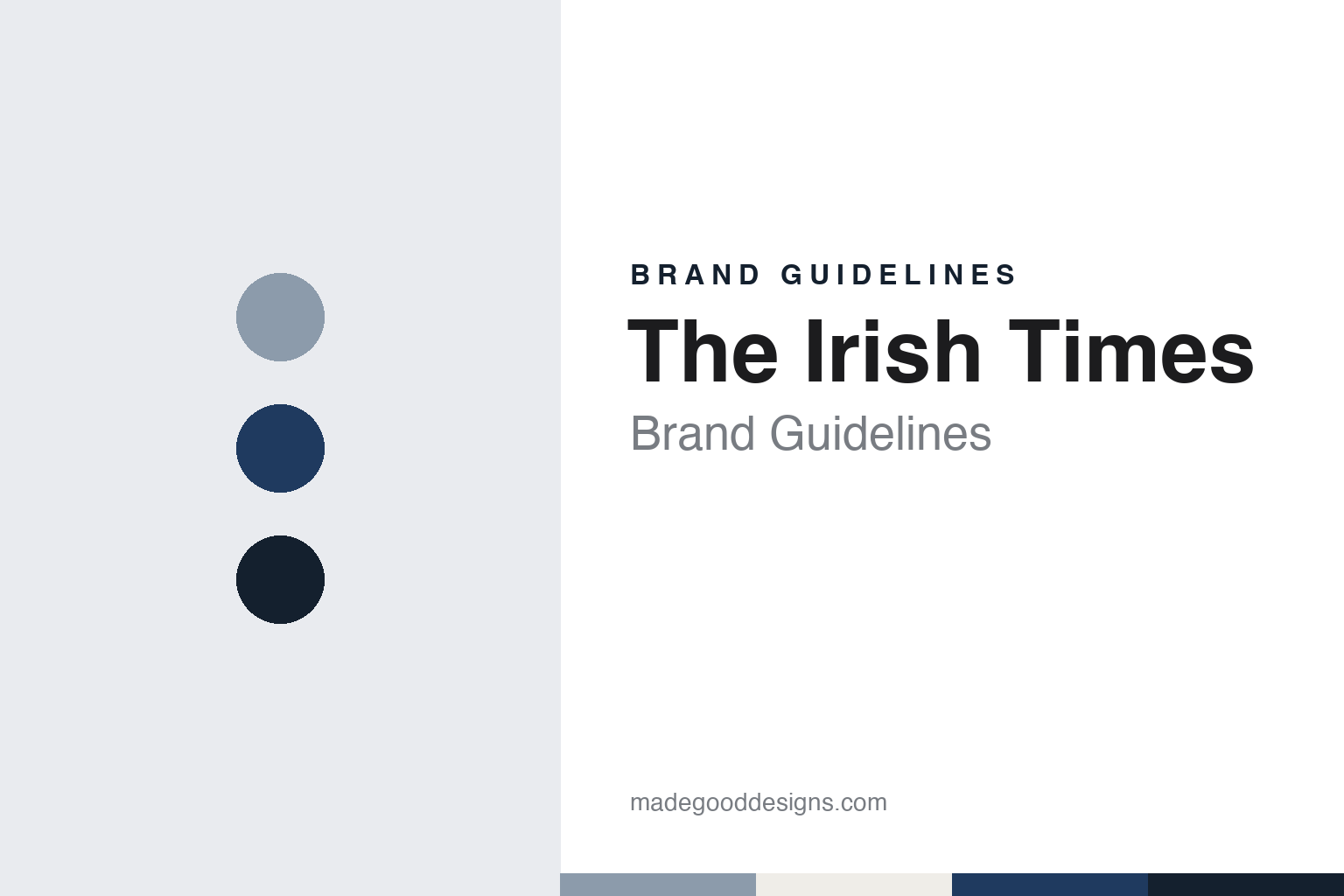
The Irish Times Brand Guidelines
A Dublin broadsheet held in trust.
Aa
Two constants: a grey, blue and ink palette and a bookish serif register. Abstract homage — not an Irish Times asset or mark; no nameplate, page or logo is reproduced.
A Dublin daily from 1859
A revived title, an army officer and a family that held it for a century.
The name had been used before. English Wikipedia says a newspaper called The Irish Times was founded in 1823 and closed in 1825, and that the title was revived decades later by Lawrence E. Knox, an army officer later known as Major Lawrence Knox. He began with a paper that appeared three times a week and soon turned it into a daily. The same article dates the opening daily edition to 29 March 1859 and places the early office at Lower Abbey Street in Dublin, with the Dublin Daily Express as its main competitor in those years.
Ownership passed to a Dublin retail family in 1873. English Wikipedia says the paper was sold that year to the widow of Sir John Arnott, the owner of the Arnotts department store in Dublin, and that the Arnotts moved the paper to 31 Westmoreland Street. The newspaper worked from that part of the city centre until 2005. The same article says the paper became a publicly listed company in 1900, while the Arnott family kept a majority shareholding until the 1960s; the last member of the family to sit on the board was Sir Lauriston Arnott.
The address became a nickname. English Wikipedia says “D’Olier Street”, around the corner from Westmoreland Street, became shorthand for the newspaper, which was personified as “The Old Lady of D’Olier Street”. In October 2006 the paper moved to a new building on nearby Tara Street, according to the same article.
Editors are named with dates. English Wikipedia names R. M. Smyllie as editor during the 1930s and lists Douglas Gageby among the paper’s editors. In 1974, the article says, ownership was transferred to a non-charitable trust, The Irish Times Trust, which still owns the paper. When the Companies Act 2014 came in, the trust registered the group as The Irish Times Designated Activity Company, known as The Irish Times DAC.
The columns gave the paper its voices. English Wikipedia says the long-running column An Irishman’s Diary was credited for decades to the pseudonym “Quidnunc”, used by Patrick Campbell in the 1940s and by Seamus Kelly from 1949 to 1979, and that the satirical column Cruiskeen Lawn, by Myles na gCopaleen, a pen name of Brian O’Nolan, made its debut in October 1940. Its title is an anglicised spelling of the Irish crúiscín lán, “little full jug”. The paper is published every day except Sunday.
Colour
From a website in 1994 to a Cork newspaper group in 2018.
The screen came early. English Wikipedia says The Irish Times launched an online edition in 1994, added a digital edition that could be read in the same layout as the printed paper in 2004, and launched an application for iPhone and Android smartphones in 2010. In May 2005, the same article says, the paper began an international edition printed in Great Britain, so that copies were on sale in London and the south-east of England at the same time as other morning papers, instead of being flown from Dublin. The company also bought the property website MyHome.ie, according to the same article.
The next change in ownership came from Cork. Fora, the business site, reported on 6 December 2017 that the Irish Times had agreed to buy the publishing and media interests of Landmark Media, the Cork-based group behind the Irish Examiner, for an undisclosed sum. The report said the deal would need clearance from the Competition and Consumer Protection Commission, the government and the Broadcasting Authority of Ireland. It listed the group’s other titles as Cork’s daily Evening Echo, the Waterford News & Star, the Western People, four Nationalist titles and the Roscommon Herald, along with radio interests and websites such as Breakingnews.ie. Fora quoted the Irish Times managing director, Liam Kavanagh, on building a digital platform with reach across the country and abroad.
The purchase closed the following summer. The Irish Examiner reported on 10 July 2018 that The Irish Times had completed the acquisition of all of Landmark Media’s publishing and media interests by buying Sappho Limited. After the deal, the report said, The Irish Times owned the Irish Examiner, the Evening Echo, the group’s regional titles, its websites and its radio station interests. The same report said the sale ended the Crosbie family’s ownership of the Cork titles, and quoted Landmark’s outgoing chief executive, Tom Murphy, calling it the end of an era. The Irish Examiner kept its own name and masthead under the new owner.
The group kept adding names. English Wikipedia says the Irish Times Group bought the death-notice website RIP.ie, a deal announced on 2 May 2024. The same article names Ruadhán Mac Cormaic as editor and describes the paper as a daily broadsheet that also runs as an online digital publication, owned by The Irish Times Trust rather than by a private commercial company.
Typography
A revived 1859 title, a Dublin street nickname and a trust.
A newspaper can change its typefaces without touching its name. English Wikipedia says the South China Morning Post, a Hong Kong broadsheet founded in 1903, was given new fonts in a facelift on 26 March 2007, and that a redesign in 2011 set its headlines in Farnham and Amplitude, its body text in Utopia and its section headers in Freight. The title on the front page stayed the same through both changes.
The name itself can also change. English Wikipedia says The Straits Times, founded in Singapore on 15 July 1845 as The Straits Times and Singapore Journal of Commerce, was renamed The Shonan Times on 20 February 1942, and then appeared as The Syonan Times, the Syonan Sinbun from 8 December 1942 and the Syonan Shimbun from 8 December 1943, before the earlier title returned. When reading a newspaper’s identity, look at how long its title has stayed fixed, which typefaces set its headlines and text, and when those faces were last changed.
Aa
A bookish serif — the register of a Dublin broadsheet. (Specimen set in Libre Caslon Text, a serif STAND-IN; NOT The Irish Times nameplate or any Irish Times typeface.)
The Irish Times
Three words that have outlasted four addresses.
The title is the constant. The Irish Times has kept the name Lawrence E. Knox revived in 1859 through a sale to the Arnott family in 1873, a stock-market listing in 1900, the move into a trust in 1974, and moves from Lower Abbey Street to Westmoreland Street and, in 2006, to Tara Street. Its nickname, “The Old Lady of D’Olier Street”, outlived the move away from that street.
The page has grown into a group. Since July 2018 the same owner has published the Irish Examiner and the Cork Evening Echo under their own names, alongside regional titles, websites and radio interests, as the Irish Examiner reported at the time. That makes the Dublin title one masthead among several in one company, each kept distinct on the newsstand.
The columns are part of the identity too. Names such as An Irishman’s Diary, credited for decades to “Quidnunc”, and Cruiskeen Lawn, from October 1940, gave the paper recurring furniture that readers could find on the page day after day, much as the nameplate does on the front.
For a design guide, The Irish Times shows how a newspaper can keep one plain three-word title across more than a century and a half of owners, addresses and formats, from a thrice-weekly sheet to a daily broadsheet, an international edition and a phone app. Compare The New York Times, another daily known by its title and nameplate, and The Globe and Mail. For this guide we use Liffey grey, Westmoreland blue and Tara Street ink with a serif, an unofficial interpretation; no product or logo is reproduced.
Explore & save
Keep The Irish Times’s identity on hand — save it to a board in the Made Good inspiration library.
The Irish Times identity set
Pin The Irish Times grey, blue and ink palette and the bookish serif register to your own board.