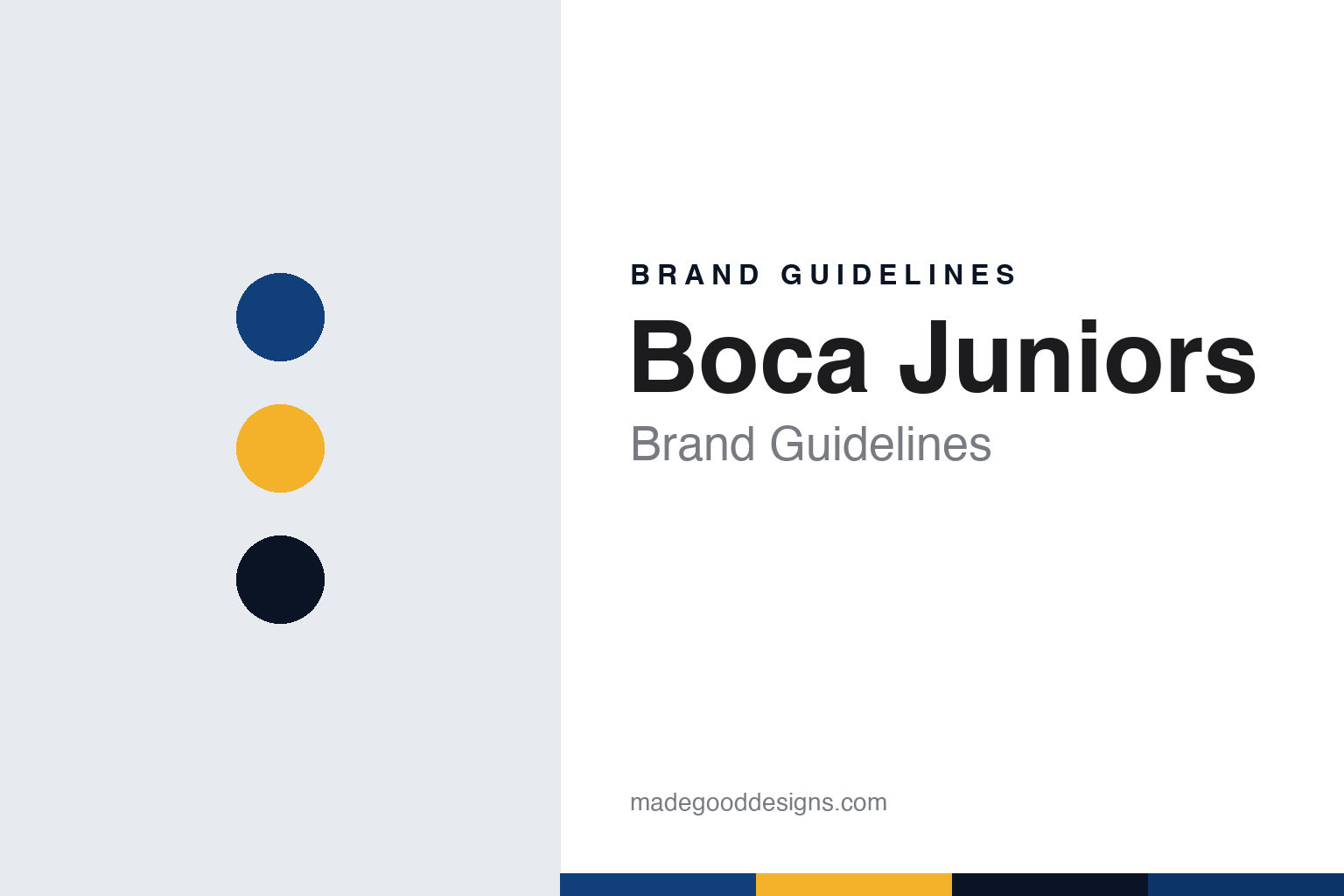
Boca Juniors Brand Guidelines
Blue and gold from a ship’s flag, a port neighbourhood and a stadium called the chocolate box.
Aa
Two constants: a Xeneize blue, port gold and dock ink palette and a condensed terrace sans register. Abstract homage — not a Boca Juniors product or mark; no crest, shirt or logo is reproduced.
Club Atlético Boca Juniors
A port neighbourhood, Genoese families and an Irish coach.
Boca Juniors takes its name and its character from La Boca, the port neighbourhood of Buenos Aires where the Riachuelo meets the River Plate. English Wikipedia says the club was formed on 3 April 1905, when a group of boys who were the sons of Italian immigrants from Genoa met at the house of Esteban Baglietto. The others present were Alfredo Scarpatti, Santiago Sana and the brothers Juan and Teodoro Farenga. Wikipedia lists further founding members, including Arturo Penney, Marcelino Vergara, Luis Cerezo and Adolfo Taggio.
The founders had learned the game from an immigrant of another nationality. Wikipedia says Patrick McCarthy, an Irishman from Cashel in County Tipperary, had taught the rules and basics of football to young people in the district, Baglietto among them, and that when the boys founded the club they asked him to be its first manager.
The Genoese roots gave the club and its supporters a nickname. Wikipedia says Boca fans are called Los Xeneizes, “the Genoese”, after the immigrants who founded the team and lived in La Boca in the early twentieth century. A second name came from the ground itself: rival supporters began calling Boca fans Los Bosteros, a reference to the horse manure used by the brick works that once stood where the stadium is now, and Wikipedia says the supporters later took the insult as their own. The shirt has its own name, la azul y oro, “the blue and gold”.
The supporters’ name “La 12”, the twelfth player, dates from the club’s tour of Europe in 1925. Wikipedia says the team was accompanied by a supporter, Victoriano Caffarena, who travelled as a newspaper correspondent but also acted as kit man and helper, so the players called him “player number 12”. The phrase now names the club’s main body of supporters.
The club is still governed by elected officials. Wikipedia says that Juan Román Riquelme, a former Boca player, has been president of the club since December 2023, when he won the election against Andrés Ibarra, with Jorge Amor Ameal, president from 2019 to 2023, elected as vice-president.
Colour
From stripes to a ship’s flag.
The colours come with an origin story that the club repeats. According to the club’s official site, as summarised by English Wikipedia, Boca’s first shirt was white with thin black vertical stripes, followed by a light blue shirt and another striped design before the club settled on blue and gold.
The change is usually tied to a match in 1906. Wikipedia tells the story this way: when Boca played Nottingham de Almagro, the two teams wore such similar shirts that the game was played to decide which side would keep its colours. Boca lost, and decided to adopt the colours of the flag of the first boat to sail into the port at La Boca. That boat was Swedish, so the blue and yellow of the Swedish flag became the team colours. Wikipedia adds that it was a dockworker, Juan Bricchetto, who saw the ship, and gives its name as the Drottning Sophia.
The story has been retold in the British press. The Guardian’s “The Knowledge” column, on 23 November 2005, printed a reader’s explanation that the team wore black and white stripes until another club with a similar kit challenged it to a play-off in 1906, with the winner keeping its colours. Boca lost and, having no alternative planned, chose the colours of the next ship to enter the Buenos Aires harbour. The ship, the column said, was Swedish.
The pattern changed after the colours arrived. Wikipedia says the first blue and gold shirt had a yellow diagonal band, which was later changed to the horizontal gold stripe across the chest that the club still wears.
The colours reach well beyond the pitch. The BBC News correspondent Daniel Schweimler reported from Buenos Aires on 6 May 2006 that coffins decorated for Boca supporters came in only two colours, blue and yellow, the club colours, and that buyers could have the team’s logo engraved on them.
The badge has kept the same outline for long periods of its history. English Wikipedia says the earliest known emblem dates from 1911, when it appeared on the club’s letterhead. In October 1932 the club said it would add a star to the badge for each first-division title, although the stars did not appear until 1943, in a report and balance sheet, and have appeared regularly on the shirts since 1993. A version with laurel leaves was printed in a magazine in 1955 for the club’s 50th anniversary but never used officially. In 1996, Wikipedia says, the Ronald Shakespear studio introduced a new badge, without the horizontal band, as part of a wider visual identity for the club that also brought new typography and style.
Typography
Design and documentation.
South American club identities often grew out of a small, fixed set of visual devices that later designers inherit rather than invent. Colours tend to come first: a pair of shades chosen in a club’s early years becomes the base layer for crests, shirts, stadium seating and printed matter, and later redesigns usually work within that pair instead of replacing it. Shirt patterns carry much of the recognition. A diagonal sash cuts across a plain shirt from shoulder to hip and reads clearly at a distance; horizontal hoops wrap the body in alternating bands; vertical stripes divide it into columns. Each pattern behaves differently when reduced to a badge, a scarf or a social-media avatar, so club graphics often simplify the shirt into a few flat shapes. Stadiums add a second vocabulary. Many grounds are known by affectionate nicknames rather than their official names, and those nicknames appear on signage, merchandise and broadcast graphics. Animal mascots form a third layer, often adopted from supporters’ chants or newspaper cartoons before clubs formalised them. For a designer, the useful lesson is how a few durable elements — two colours, one pattern, a nickname and a creature — can carry an identity across generations of kits and media.
Aa
A condensed terrace sans — the register of a shirt number and a stand sign. (Specimen set in Oswald, a sans-serif STAND-IN; NOT the Boca Juniors logo.)
Boca Juniors
Kits, kit makers and the chocolate box.
The blue and gold shirt has been reworked many times by its makers. Wikipedia says that when Nike became the club’s kit supplier in 1996, its first design added two thin white stripes around the gold band, which caused some controversy. Nike also produced a silver shirt for the 1998 Copa Mercosur and, for the club’s centenary, commemorative versions of earlier shirts, including the 1907 design with a diagonal sash, worn in two summer matches in 2005. Later alternative shirts included black and white stripes, purple, a pink away shirt for 2013–14 and a fluorescent yellow replacement. In 2016 the club wore a black shirt, launched as a third kit. Adidas has supplied the kit since January 2020.
The ground took some time to settle. Wikipedia says Boca’s first pitch was at Dársena Sur in the old port, which it left in 1907, and that the club then used three grounds on the Isla Demarchi between 1908 and 1912, and moved to Wilde, in Greater Buenos Aires, in 1914 and 1915 before returning to La Boca.
The present stadium stands on Brandsen street. Wikipedia says construction began in 1938 under the supervision of the engineer José L. Delpini, and that the ground was completed on 25 May 1940, with the team playing at Ferro Carril Oeste’s stadium in the meantime. A third tier added in 1953 gave the stadium the nickname La Bombonera, “the chocolate box”. Its official name is the Estadio Alberto J. Armando. Three sides have conventional sloping stands, but the fourth was built vertically, with seating areas stacked one above another, because the site left no room for a slope. Wikipedia says the stands are known for moving when supporters jump in rhythm, which led to the phrase “La Bombonera no tiembla. Late” — “the Bombonera does not tremble, it beats”.
The colours also extend to the club’s other ventures. Wikipedia says that in 2012 Boca opened a themed hotel in Buenos Aires designed by the Uruguayan architect Carlos Ott, with rooms decorated in the club colours.
For a design guide, Boca Juniors shows how two colours borrowed from a passing ship can become a full identity: a band across the chest, a badge that keeps one outline and a stadium named for its shape. Compare it with Adidas, the club’s current kit supplier, and River Plate, the other club founded in La Boca. For this guide we use Xeneize blue, port gold and dock ink with a sans, an unofficial interpretation; no product or logo is reproduced.
Explore & save
Keep Boca Juniors’s identity on hand — save it to a board in the Made Good inspiration library.
Boca Juniors identity set
Pin the Boca Juniors Xeneize blue, port gold and dock ink palette and the condensed terrace sans register to your own board.