River Plate Brand Guidelines
A white shirt crossed by a red band, a club named after an estuary and a stadium in Núñez.
Aa
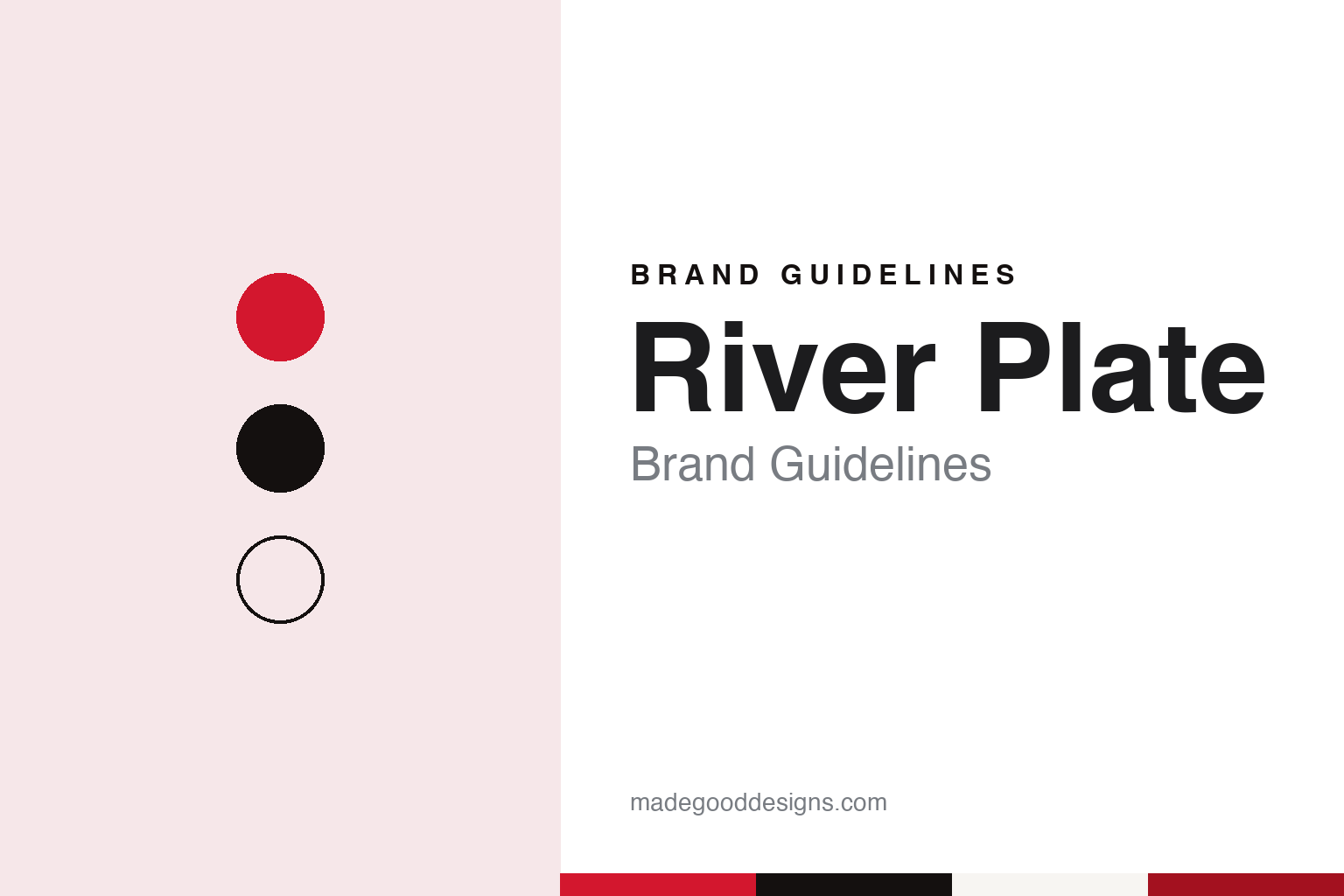
Two constants: a Banda red, monogram black and shirt white palette and a narrow grandstand sans register. Abstract homage — not a River Plate product or mark; no crest, shirt or logo is reproduced.
Club Atlético River Plate
Two neighbourhood clubs and a word on a crate.
River Plate began beside the water that gave it its name. English Wikipedia says that, according to the club’s official history, Club Atlético River Plate was founded on 25 May 1901 close to the La Boca neighbourhood of Buenos Aires, through the merger of two local clubs, Santa Rosa and La Rosales. Leopoldo Bard was elected the first president. Spanish Wikipedia adds that the two teams had kept up a friendly rivalry in La Boca, that the founding act was signed on the same day and that Bard was also the team’s first captain.
The name came from the docks. Wikipedia says that during the construction of the port of Buenos Aires, one of the members, Pedro Martínez, saw workers at Dique nº 3 stop to play football and noticed the words “The River Plate” on the boxes they were handling. That was the English name for the Río de la Plata, the estuary on which the city stands, and the members adopted it. Other proposals, Wikipedia says, including “Club Atlético Forward”, “Juventud Boquense” and “La Rosales”, were rejected.
The club did not stay in La Boca. Wikipedia lists its grounds as Dársena Sur in La Boca (1901–05 and 1907–15), a spell in Sarandí (1906–07), a stadium on Pinzón and Gaboto streets in La Boca (1915–23) and Alvear y Tagle in Recoleta (1923–37), before the move north to the present site. The move away from the port shaped how the club is seen. The BBC Sport Academy described both River and Boca Juniors as clubs formed in La Boca, with River becoming associated with the more affluent Núñez district after 1938.
Another nickname is about money rather than place. Wikipedia says River are commonly called Los Millonarios, “the Millionaires”, a name that dates from the 1930s, when the club paid large sums to sign the forwards Carlos Peucelle in 1931 and Bernabé Ferreyra in 1932. Spanish Wikipedia credits those purchases to Antonio Vespucio Liberti, who first became president in 1933 and served for twenty non-consecutive years.
The club is run by elected presidents. Spanish Wikipedia says the current president is Stéfano Di Carlo, elected in November 2025, who had held several posts at the club under his predecessors Rodolfo D’Onofrio and Jorge Brito.
Colour
A carnival ribbon becomes a sash.
The red band is the club’s signature. Spanish Wikipedia says River’s first shirt was plain white with black buttons, and that the red band was first crossed over it at the end of 1905, when Catalina Salvarezza, the mother of two of the players, sewed it on diagonally. The story attached to the band, as Wikipedia tells it, is that on a carnival night players and officials took a red silk ribbon hanging from an old float called “Los habitantes del Infierno” and pinned it diagonally across their white shirts to give them some colour. Wikipedia also records another version, that the red and white came from the cross of Saint George, the emblem of Genoa, home city of many La Boca families.
The sash took some time to become the first-choice shirt. Infobae reported in March 2013, marking the anniversary, that the red band made its debut as the main shirt on 13 March 1932, in the club’s first match of the professional era, against Chacarita at the old Alvear y Tagle ground. The paper said the band had been used in 1905 in the amateur era, that it came from carnival ribbons added to the white shirt, and that Liberti decided it should be the main shirt.
The sash also names the team. Wikipedia says that because of the red band River are often called El Equipo de la Banda, “the team with the band”, or simply La Banda, a word that can mean a stripe, a gang or a musical group. Rival supporters call River Gallinas, “hens”; Spanish Wikipedia traces the name to a match in May 1966, when Banfield supporters released a white hen with a red band painted on it.
The badge repeats the shirt. English Wikipedia describes it as a white field crossed by a red stripe, with the club’s initials CARP in black, in a stylised design embroidered on the shirt in three colours. Spanish Wikipedia says the first emblem, the initials CARP in a circle, appeared in the 1930s and changed from black to red over the years, and that the structure around the initials took shape in the late 1950s.
For a few years the club tried something else. English Wikipedia says that when Hugo Santilli became chairman in 1984, he called a competition for a new emblem, hoping to shake off the Gallinas taunt. The winning design showed a lion in a River shirt rising from the Monumental. English Wikipedia credits it to Claudio Loiseau, brother of the cartoonist Caloi, while Spanish Wikipedia credits Caloi himself. The lion appeared on the shirts from 1985 and was dropped in 1989, when Santilli left the club.
Typography
Design and documentation.
South American club identities often grew out of a small, fixed set of visual devices that later designers inherit rather than invent. Colours tend to come first: a pair of shades chosen in a club’s early years becomes the base layer for crests, shirts, stadium seating and printed matter, and later redesigns usually work within that pair instead of replacing it. Shirt patterns carry much of the recognition. A diagonal sash cuts across a plain shirt from shoulder to hip and reads clearly at a distance; horizontal hoops wrap the body in alternating bands; vertical stripes divide it into columns. Each pattern behaves differently when reduced to a badge, a scarf or a social-media avatar, so club graphics often simplify the shirt into a few flat shapes. Stadiums add a second vocabulary. Many grounds are known by affectionate nicknames rather than their official names, and those nicknames appear on signage, merchandise and broadcast graphics. Animal mascots form a third layer, often adopted from supporters’ chants or newspaper cartoons before clubs formalised them. For a designer, the useful lesson is how a few durable elements — two colours, one pattern, a nickname and a creature — can carry an identity across generations of kits and media.
Aa
A narrow grandstand sans — the register of a shirt number and a gate sign. (Specimen set in Archivo Narrow, a sans-serif STAND-IN; NOT the River Plate logo or club typeface.)
River Plate
Adidas, a new corporate image and the Monumental.
One kit maker has dressed the club for decades. English Wikipedia says Adidas has supplied River’s uniforms since 1982. Spanish Wikipedia records a small accident in that partnership: for the 1993–94 season the kit maker produced a badge in which the red band ran straight through the CARP initials.
The sash itself has been treated as a design surface. Spanish Wikipedia lists the few seasons in which something was printed inside it: miniature grey crests in 1996, a raised image of the Monumental in 2013, and fine lines in 2018. Infobae reported on 16 August 2018 that Adidas and River had presented the new shirt with fine lines on the traditional red band, echoing the red and white paper ribbons that supporters throw down from the stands of the Monumental, and that it would be worn for the first time two days later against Belgrano. Spanish Wikipedia also lists a gradient of reds in 2016, a pixel pattern in 2019 and multi-tone gradients in 2022.
The club refreshed its whole identity in 2022. English Wikipedia says that in February 2022 River launched a new corporate image, including an update to the logo and a typeface designed exclusively for the club, created by the branding and design studio Grupo Berro, which had worked on it for more than two years.
The stadium carries the club’s identity on a building scale. Spanish Wikipedia says Liberti promoted the move to a new site, that land in Núñez was bought on 31 October 1934, and that work began on 27 September 1936 under the architects Aslan y Ezcurra. English Wikipedia says the Estadio Monumental opened on 25 May 1938 on land once occupied by the Bajo Belgrano racecourse; Spanish Wikipedia gives 26 May. The stands were added in stages, and Spanish Wikipedia says the upper tier was completed in 1977 ahead of the 1978 FIFA World Cup. Since 1986 the ground has officially carried Liberti’s name, as the Estadio Antonio Vespucio Liberti, though it is still widely called the Monumental.
For a design guide, River Plate shows how a single diagonal line can carry a whole identity, from a ribbon pinned to a white shirt to a badge, a nickname and a club typeface. Compare it with Adidas, the club’s kit supplier since 1982, and Boca Juniors, the other club founded in La Boca. For this guide we use Banda red, monogram black and shirt white with a sans, an unofficial interpretation; no product or logo is reproduced.
Explore & save
Keep River Plate’s identity on hand — save it to a board in the Made Good inspiration library.
River Plate identity set
Pin the River Plate Banda red, monogram black and shirt white palette and the narrow grandstand sans register to your own board.