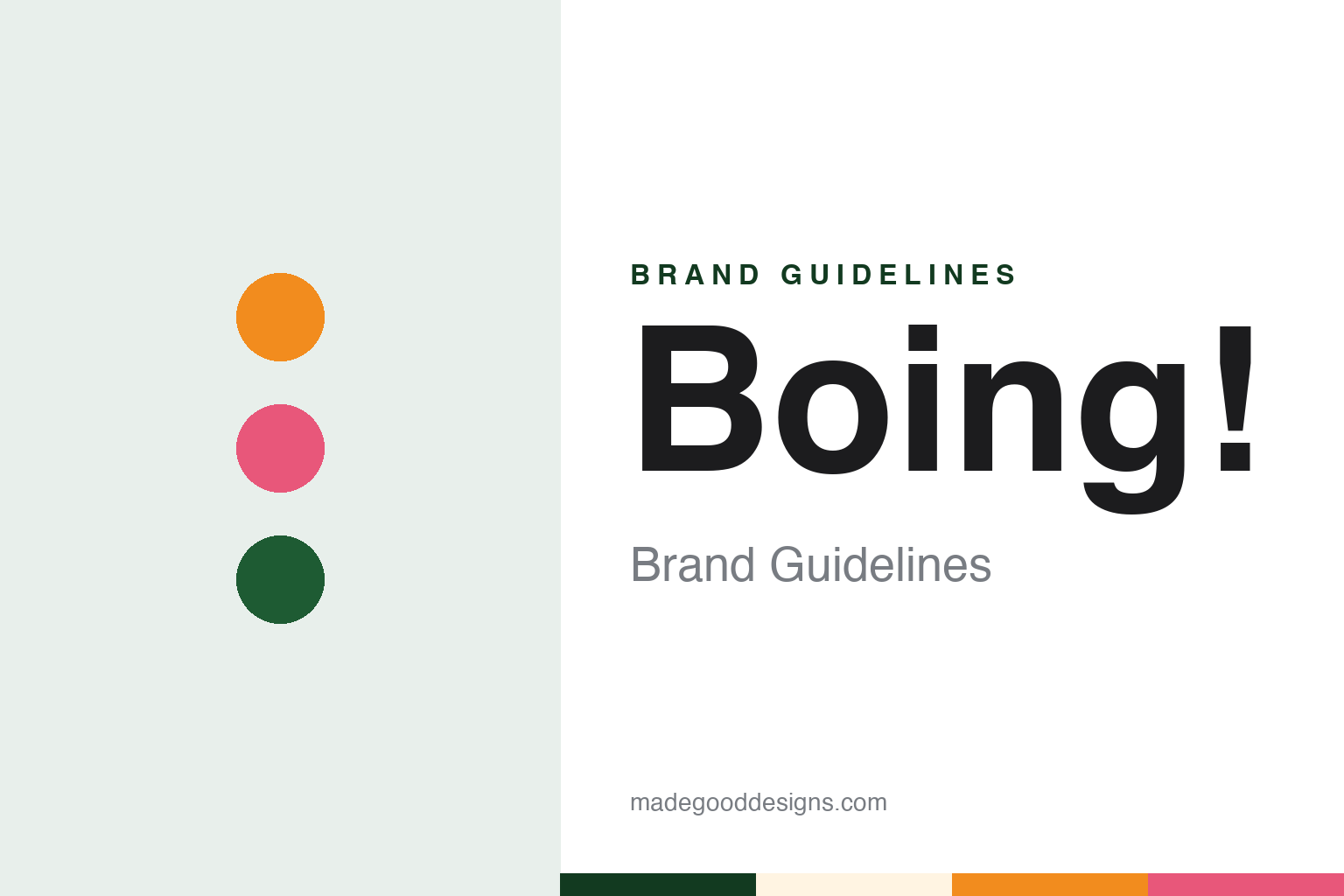
Boing! Brand Guidelines
The worker-owned Mexican fruit drink in a carton.
Aa
Two constants: a mango orange, guava pink and leaf green palette and a rounded friendly sans register. Abstract homage — not a Boing! product or mark; no pack, logo or mascot is reproduced.
Pascual and the carton
Ice lollies, water jugs, a duck and a still fruit drink.
Boing! is the fruit-drink brand of Cooperativa Pascual, the Mexico City drinks maker whose legal name is the Sociedad Cooperativa Trabajadores de Pascual. The company it grew from, Pascual S.A., was founded at the end of the 1930s or the start of the 1940s by Rafael Víctor Jiménez Zamudio, the cooperative says; English Wikipedia gives the year as 1940. Its first products were ice lollies, then drinking water sold in large garrafón jugs, and finally the Pascual sodas.
The business moved from colonia Anáhuac to colonia San Rafael and then, in the early 1950s, to colonia Tránsito, in central Mexico City, where the cooperative still has its head office. In that decade, the company says, it promoted its Pato Pascual soda with the slogan “Fruta en tu refresco” (fruit in your soda) and launched Lulú, a soda represented by a doll character.
Boing! came next. In the early 1960s, the cooperative’s history says, the company launched the fruit drink Boing!, which, unlike Pascual and Lulú, was not carbonated, and Jiménez secured exclusive rights to pack it in cartons from the Swedish packaging company Tetra Pak. English Wikipedia, citing a history of the cooperative published by the University of Minnesota Morris, also dates the company’s first Tetra Pak cartons to the 1960s. By the end of that decade the company had bought a northern plant from Canada Dry, together with a franchise to make that brand’s drinks, and English Wikipedia, citing a 2007 presentation by the cooperative, says Pascual was fourth in the Mexican soft-drink market by 1980. The cooperative says the company lost both the Tetra Pak exclusivity for Boing! and the Canada Dry franchise in 1982.
Colour
Worker-owned since 1985.
Boing! has been made by a workers’ cooperative since the mid-1980s. After a strike over wages that began on 18 May 1982, the assets of Refrescos Pascual were awarded in 1984 to its workers on condition that they run the business as a cooperative, and the Sociedad Cooperativa Trabajadores de Pascual began work on 27 May 1985, the cooperative says. Its history adds that it restarted with what it calls the “Proyecto Aguascalientes”: eight trucks drove to Aguascalientes, where Boing! was still being produced, to collect stock to sell in the capital.
Since then the cooperative has grown beyond its two historic plants in Mexico City. English Wikipedia, citing the cooperative’s 2007 presentation, lists processing plants opened in San Juan del Río, Querétaro, in 1992, in Tizayuca, Hidalgo, in 2003 and in Culiacán, Sinaloa, in 2006, and the newspapers Reforma and El Norte reported in January 2011 that it was building a plant in Anáhuac, Nuevo León, in the north of the country. English Wikipedia, citing the same presentation and El Universal (2002), says the Mexico City area accounts for about sixty percent of the cooperative’s sales, and that the cooperative was looking to markets in the United States, Central America and the Caribbean, as the trade site just-drinks reported in July 2011.
The cooperative describes the making of Boing! on its product page. Fruit is chosen in different regions of Mexico, washed and milled; the skins, seeds and fibre are separated to leave the pulp; and the pulp is sterilised and pasteurised to form the base of the drinks, which the company says are checked by its own quality-control department. English Wikipedia, citing La Jornada (2010) and the Minnesota history, adds that the cooperative has used mangoes from Veracruz and Guerrero, strawberries from Guanajuato and apples from Puebla.
Typography
Design and documentation.
The seven brands in this group are all drink names from France and Mexico: Orangina, Vittel, Teisseire, Peñafiel, Boing!, Sidral Mundet and Tecate. French and Mexican drink brands in general sit at many different points in the trade, from family firms that still carry a founder’s name to names that now belong to much larger food and drink groups, and a single brand can be sold everywhere from a corner shop to a supermarket shelf.
A drink brand’s identity is usually carried less by a single product than by a bottle, a can, a name and the moment of drinking it promises, because the company behind the name may have changed hands, moved its production or grown far beyond the place where it started. That makes the questions behind each name worth asking plainly: who started it, who owns it now, and where its drinks are actually made and packed.
Each guide separates what independent sources record from what the company says about itself — its founding story, its owners over time, where its drinks are made and how its packaging has changed — and marks plainly what rests only on the company’s own word.
Aa
A rounded friendly sans for a fruit drink with an exclamation mark in its name. (Specimen set in Baloo 2, a sans STAND-IN; NOT the Boing! logo.)
Boing!
Cartons, cans, a duck and an art collection.
Boing! is sold in several formats, according to the cooperative’s product page: a one-litre carton it calls Gemina, a 340 ml can and a 200 ml Tetra Brick. Flavours listed there include mango, guava, strawberry and grape, and the company says the range runs to more than ten flavours; English Wikipedia names tamarind and soursop among the cooperative’s fruit flavours. Alongside Boing!, the cooperative sells Pato Pascual, Lulú and Mexicola sodas, Leche Pascual milk and Agua Pascual water, its website shows.
The company’s best-known mascot belongs to Pascual rather than Boing!: the Pato Pascual duck, adopted in the 1940s. English Wikipedia, citing La Jornada and Reuters (May 2007), says the duck, originally a sailor-capped figure resembling Donald Duck, was modified after a Disney lawsuit in the 1980s and redrawn in 2007 with ruffled feathers and a backwards baseball cap. The cooperative also owns an art collection: in 1991 it set up the Fundación Cultural Trabajadores de Pascual to look after works donated by Mexican and Latin American artists, among them Rufino Tamayo, David Alfaro Siqueiros and Francisco Toledo, English Wikipedia says, citing La Jornada (2010) and Mural (2002).
For a design guide, Boing! shows how a still fruit drink in a carton became a household name for a company better known for a cartoon duck. Compare Jumex, another Mexican juice maker, and Sidral Mundet, Mexico’s apple soda. For this guide we use a mango orange, a guava pink and a leaf green with a rounded sans, an unofficial interpretation; no product or logo is reproduced.
Explore & save
Keep Boing!’s identity on hand — save it to a board in the Made Good inspiration library.
Boing! identity set
Pin the Boing! mango orange, guava pink and leaf green palette and the rounded friendly sans register to your own board.