Sidral Mundet Brand Guidelines
Arturo Mundet’s Mexican apple soda since 1902.
Aa
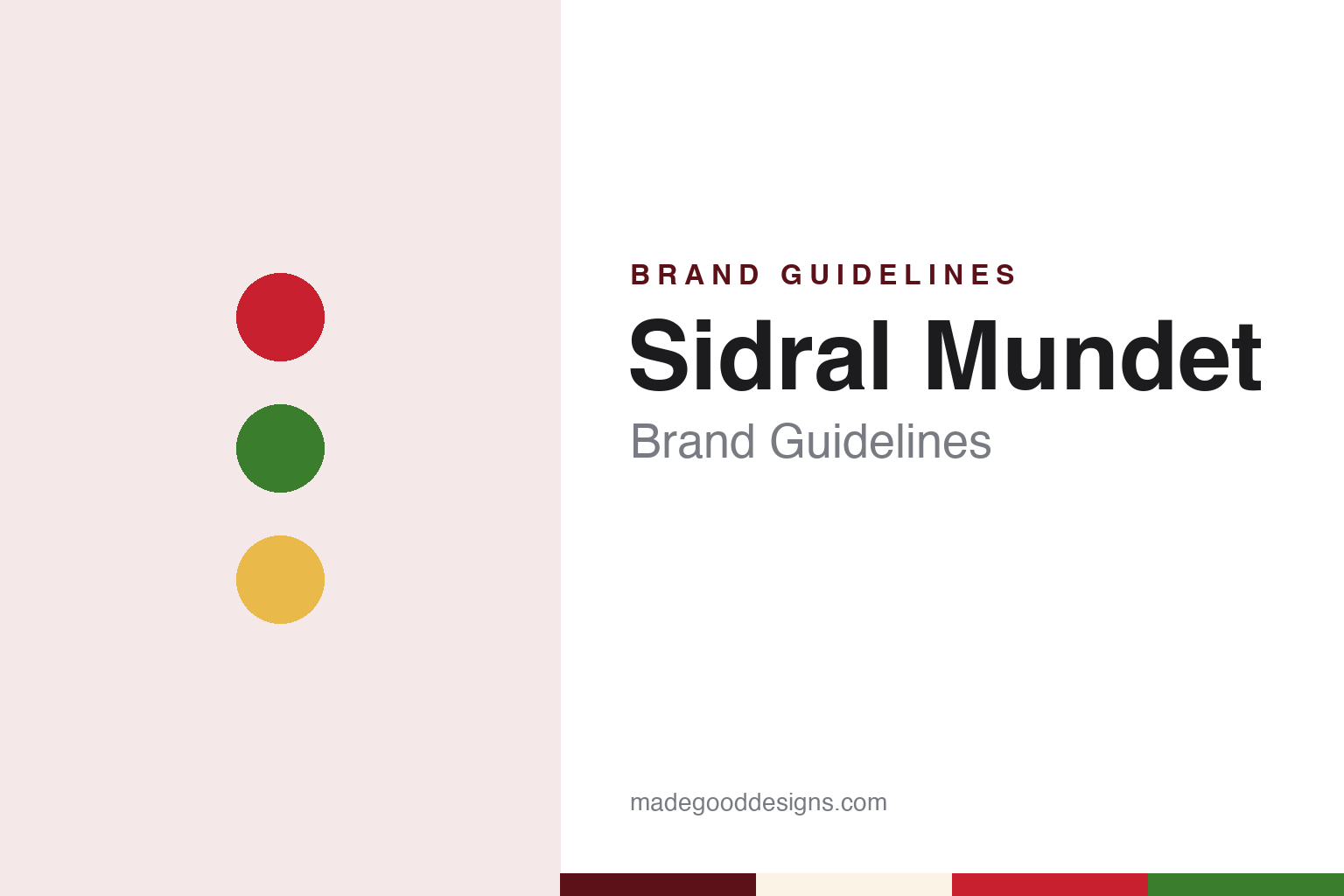
Two constants: an apple red, leaf green and golden apple palette and an old-style serif register. Abstract homage — not a Sidral Mundet product or mark; no bottle, label or logo is reproduced.
Cork and cider
A Catalan stopper maker in Mexico.
Sidral Mundet is an apple-flavoured soda from Mexico. It was first bottled in 1902 by Arturo Mundet, a cork manufacturer from Catalonia, the brand’s US website says, and English Wikipedia gives the same year. In a 2010 press release its then owner, FEMSA, described Mundet as “a 100-plus year old brand.” Spanish Wikipedia names Mundet’s birthplace as Sant Antoni de Calonge, on the coast of Girona province, and says his family had made cork stoppers for generations.
Mundet reached Mexico through the cork trade. Spanish Wikipedia, citing a biographical profile, says the family firm opened a New York office in 1895, that the young Arturo travelled the Americas selling its stoppers, and that a first cork factory opened in Mexico in 1902; the family went on to build cork works at Seixal, in Portugal, in 1905 and at Palamós, on the Catalan coast, the following year. He married Anna Gironella in Barcelona in 1906 and the couple settled in Mexico City, where he built up a business of his own, Artículos Mundet para Embotelladoras, which supplied bottlers; Spanish Wikipedia says it became known for crown caps lined with a disc of cork, called the corcholata in Mexico.
The drink grew out of that trade. The brand’s US website says Sidral Mundet was inspired by Mexico’s traditional aguas frescas and calls it the first soft drink in Mexico. Spanish Wikipedia says it was conceived as a kind of sparkling cider, and that it was pasteurised to stop it fermenting, keeping it a sweet soda; English Wikipedia also credits Mundet with using pasteurisation to keep the drink stable in the bottle.
Colour
From mule carts to FEMSA and Coca-Cola.
Spanish Wikipedia sketches how production grew. At first the apple concentrate was imported from Canada, and the soda was delivered around the Valley of Mexico in mule-drawn carts. By 1936 three automatic lines were filling 120 bottles a minute; in the 1950s there were nine lines, producing 600,000 bottles a day. In 1970 a new plant, Jugos de Frutas Mundet, was built and the company stopped importing concentrate, and in 1971 it began offering franchises that took production across Mexico.
The brand has since changed hands twice, according to filings with the US Securities and Exchange Commission. FEMSA, the Mexican group that also controls the bottler Coca-Cola FEMSA, acquired Mundet in 2001; its annual report for 2002 called Mundet and Mundet light its “proprietary” soft-drink brands. Coca-Cola FEMSA signed two franchise agreements with a FEMSA subsidiary on 2 November 2001 that made it the sole bottler of Mundet brands in the Valley of Mexico and most of its south-east Mexico territory, and its annual report for 2002 listed Sidral Mundet, Sidral Mundet light and Prisco in its range. The concentrate for Mundet and Mundet light came from Perfil Corporativo, a FEMSA company, FEMSA’s report says, and in the third quarter of 2002 Coca-Cola FEMSA told investors that Mundet made up 3.2 percent of the product mix in its Mexican territories.
In 2010 the brand passed to The Coca-Cola Company. FEMSA said in a press release dated 22 October 2010 that it had sold the Mundet brand to Coca-Cola during the third quarter of that year, describing Sidral Mundet as the brand’s flagship. English Wikipedia names Coca-Cola FEMSA as the drink’s producer today, and Spanish Wikipedia lists it among the brands of The Coca-Cola Company, made by Coca-Cola’s Mexican bottling system.
Typography
Design and documentation.
The seven brands in this group are all drink names from France and Mexico: Orangina, Vittel, Teisseire, Peñafiel, Boing!, Sidral Mundet and Tecate. French and Mexican drink brands in general sit at many different points in the trade, from family firms that still carry a founder’s name to names that now belong to much larger food and drink groups, and a single brand can be sold everywhere from a corner shop to a supermarket shelf.
A drink brand’s identity is usually carried less by a single product than by a bottle, a can, a name and the moment of drinking it promises, because the company behind the name may have changed hands, moved its production or grown far beyond the place where it started. That makes the questions behind each name worth asking plainly: who started it, who owns it now, and where its drinks are actually made and packed.
Each guide separates what independent sources record from what the company says about itself — its founding story, its owners over time, where its drinks are made and how its packaging has changed — and marks plainly what rests only on the company’s own word.
Aa
An old-style serif for a soda that dates itself to 1902. (Specimen set in Fraunces, a serif STAND-IN; NOT the Sidral Mundet logo.)
Sidral Mundet
North of the border, and a name in Barcelona.
Sidral Mundet reached the United States in 1988, when it was introduced by Novamex, a distributor of Mexican brands, the brand’s US website and English Wikipedia say. Novamex also handles the Mexican sodas Jarritos and Sangría Señorial in the United States, English Wikipedia says, and Spanish Wikipedia adds that from 1988 the drink was also exported to Central and South America. The website says Sidral Mundet is now sold in restaurants, bodegas, supermarkets and food trucks across the country. English Wikipedia lists red apple, green apple, golden apple, plum, peach and pear flavours; Spanish Wikipedia counts ten, including strawberry-kiwi and apricot.
The Mundet name also survives in Barcelona. Spanish Wikipedia, citing the Gran Enciclopèdia Catalana, says Arturo Mundet and Anna Gironella funded new homes for orphans, the elderly and the sick in the city’s Vall d’Hebron district, designed by the architect Manuel Baldrich and opened in 1957 as the Llars Anna Gironella de Mundet; since 1996 the site has housed faculties of the University of Barcelona as the Campus Mundet. In Mexico City, Spanish Wikipedia says, Mundet funded a home for the elderly that opened in 1940 and a public sports park, the Club Mundet, completed in 1956.
For a design guide, Sidral Mundet shows how a soda can carry its founder’s surname for well over a century and through three owners. Compare Postobón, the Medellín soda maker behind Manzana Postobón, and Boing!, the Mexico City cooperative’s fruit drink. For this guide we use an apple red, a leaf green and a golden apple yellow with a serif, an unofficial interpretation; no product or logo is reproduced.
Explore & save
Keep Sidral Mundet’s identity on hand — save it to a board in the Made Good inspiration library.
Sidral Mundet identity set
Pin the Sidral Mundet apple red, leaf green and golden apple palette and the old-style serif register to your own board.