Booking.com Brand Guidelines
The Dutch accommodation site that kept the .com in its name.
Aa
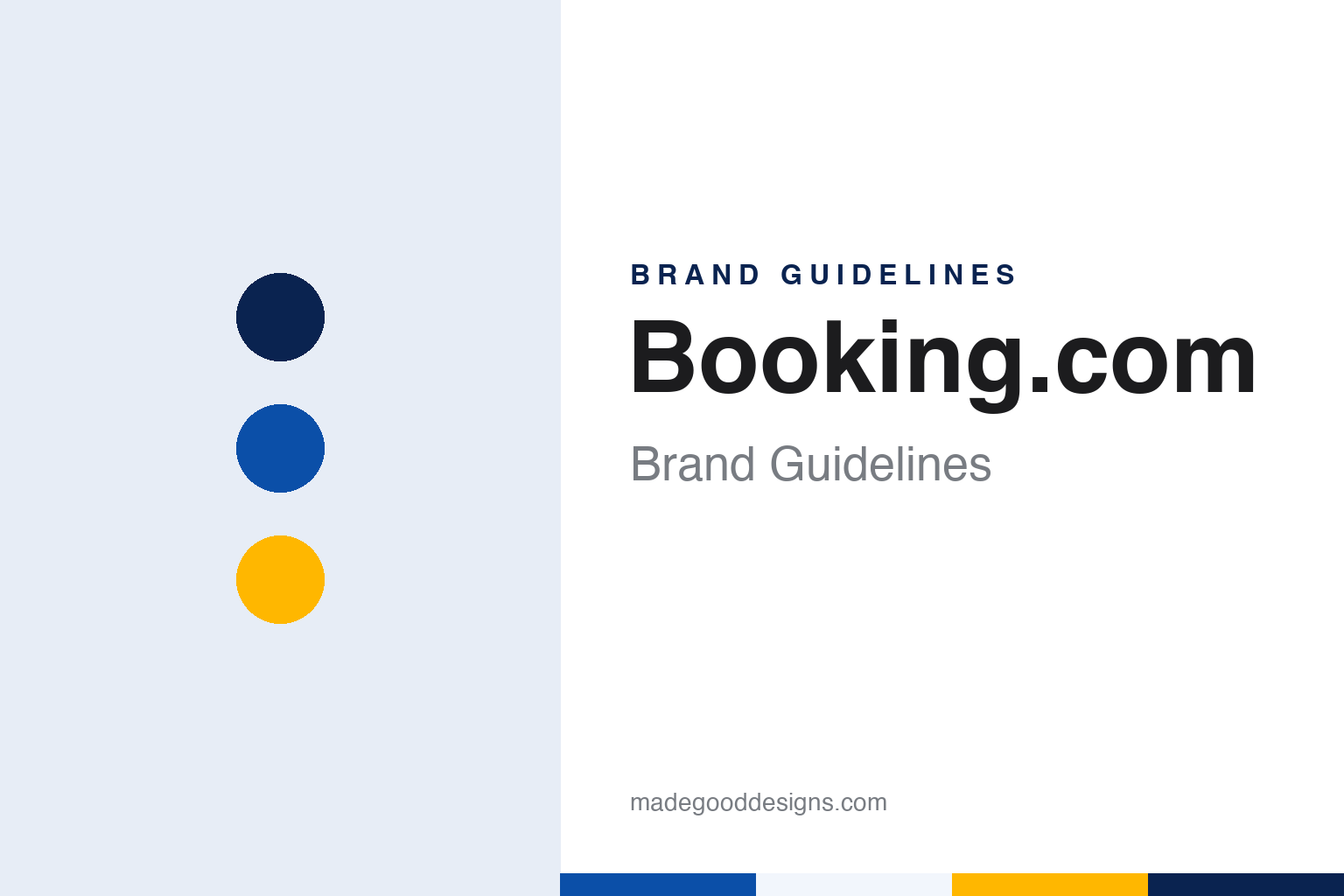
Two constants: a harbour blue, navy and yellow palette and a rounded humanist sans register. Abstract homage — not a Booking.com asset; no logo, icon or screen is reproduced.
From Bookings.nl
A Twente student, a hotel site and a refused newspaper ad.
Booking.com began in the Netherlands in 1996 as Bookings.nl. English Wikipedia says it was founded by Geert-Jan Bruinsma, then a student at the University of Twente, and gives Enschede as the place of founding. Skift, in a long oral history of the business published on 6 July 2018, described Bruinsma as a recent graduate who had always wanted to start a company, discovered the internet and decided to build a hotel-booking website. The site, Skift reported, borrowed some of its code from the young US website of Hilton.
Bruinsma did not come from the hotel business. Skift noted that his only experience was a short spell as a hotel night porter during his studies at Twente, and one of the people it interviewed recalled that he had to learn the industry’s terms from scratch, visiting hotels in Amsterdam to ask questions. Bruinsma told Skift that in 1997 he tried to place an advertisement for Bookings in De Telegraaf, and that the newspaper refused it because it gave an internet address rather than a phone number. He turned instead to search engines, and to a deal with two Amsterdam hotel-guide websites that put his hotels behind their pages in return for a share of the commission.
The name went through several versions before it settled. According to Wikipedia, Bookings.nl merged in 2000 with Bookings Online, a business founded by Sicco and Alec Behrens, Marijn Muyser and Bas Lemmens, and the combined company traded as Bookings.org; the name and web address later became Booking.com, with Stef Noorden as chief executive. One of the people Skift interviewed remembered that the company was still Bookings.org when its sale was agreed in 2005, and that customers often got the name wrong, calling it Booking or Bookings. The company’s own releases give 1996 as its year of establishment.
Colour
Priceline, Active Hotels and a move to Amsterdam.
The business that carries the name today was formed from two companies. The other was Active Hotels, started in Cambridge, England, by the cousins Andy Phillipps and Adrian Critchlow. Skift reported that it launched as Activebooking.com and changed its name to Active Hotels in early 2001, and that it focused on independent hotels.
Both caught the attention of Glenn Fogel, who was then in charge of mergers and acquisitions at Priceline.com. Skift says Fogel led the purchase of Active Hotels in 2004 and of Bookings in 2005; it dates the purchase of Bookings B.V. to July 2005. He has since become chief executive of the parent company. Fogel’s own recollection, published in the same oral history, was of visiting a little-known company called Bookings.nl in Amsterdam in late 2004, meeting Stef Noorden and asking if he could come back the following day.
In 2006, Skift reports, Priceline merged Active Hotels and Bookings to create Booking.com; Wikipedia adds that Active Hotels Limited changed its name to Booking.com Limited that year. A former Active Hotels executive told Skift that the business soon moved its centre of gravity to Amsterdam, partly because expansion was to be in continental Europe and partly because Bookings’ rebuilt systems were easier to scale. Wikipedia gives the headquarters as Amsterdam. The parent company has also changed its name: the Priceline Group became Booking Holdings, which has owned Booking.com since 2005 and also owns Priceline and Kayak.
The name itself was tested in court. On 30 June 2020 the US Supreme Court decided United States Patent and Trademark Office v. Booking.com B.V., holding that because consumers do not perceive “Booking.com” as a generic name for a class of services, it is not generic and may be registered as a trademark.
Typography
Design and documentation.
Travel sites live on small screens as much as large ones, so their identities are tested at very different sizes. A wordmark that reads well across the top of a desktop search page has to survive as a home-screen app icon, a favicon in a browser tab and a tiny badge on a booking confirmation email. Many travel brands answer that problem with a compact symbol or a single letter that can stand alone when the full name will not fit, and keep the wordmark for larger placements.
Colour does a lot of work in this category. A consistent brand colour helps a user spot the right app among dozens on a phone and recognise the brand inside a crowded comparison results page. Mascots and characters play a similar role: an animal, a figure or a costumed spokesperson can carry a brand across television, social video and outdoor advertising without relying on the name alone.
Television spokespeople and recurring advertising characters have long been part of the travel-site playbook, giving a web service a face and a voice. When a company refreshes its identity, these elements are often redrawn, retired or brought back, so it is worth checking the date of any logo, icon or campaign before treating it as current.
Aa
A rounded humanist sans — the register of a search form and a confirmation page. (Specimen set in Nunito Sans, a sans-serif STAND-IN; NOT the Booking.com typeface and NOT the Booking.com logo.)
Booking.com
A web address as a brand name, and a campaign that made it an adjective.
Since its early years the brand has been its web address. The name moved from Bookings.nl to Bookings.org to Booking.com, and the final version keeps the domain suffix as part of the name. That suffix sat at the heart of the 2020 trademark case, in which the question was whether a common word joined to “.com” could still work as a brand.
Advertising later played on the name. In a release dated 22 January 2013 from Amsterdam, Booking.com announced a brand campaign called Booking.yeah, created for the US market with the agency Wieden+Kennedy Amsterdam. The company said the work would run online, in cinemas and on television networks across the country, opening with a 60-second film of the same title, followed by shorter 30- and 15-second films, all directed by the filmmaking collective Traktor. Media buying was handled by Wieden+Kennedy New York. Booking.com said the campaign turned the word “booking” from a simple transaction and a company name into an adjective for the satisfaction of opening the door to the right room. Mark Bernath, executive creative director at Wieden+Kennedy, put the idea in the voice of the traveller who chose well: “You are a booking genius.” Wikipedia notes that the advertisements have used the “booking.yeah” line since January 2013.
The brand’s influence also shows in the interface. Skift argued in 2018 that rival travel sites had adopted Booking.com’s on-page messages, such as notes on how many people were looking at a hotel at that moment and how recently it had been booked. The same oral history recalled the Bookings team reading books on persuasion and consumer psychology to understand the signals that help a customer decide, and an Active Hotels partnerships manager remembered that, after the merger, partners could no longer restyle the booking pages themselves but had to ask the team in Amsterdam to change colours and text.
For a design guide, Booking.com shows a domain name carried all the way into a brand, defended as a trademark and then played with in advertising. Compare it with Priceline, whose parent company bought it in 2005 and later renamed itself Booking Holdings, and Airbnb, another accommodation brand built on the web. For this guide we use harbour blue, navy and yellow with a sans, an unofficial interpretation; no product or logo is reproduced.
Explore & save
Keep Booking.com’s identity on hand — save it to a board in the Made Good inspiration library.
Booking.com identity set
Pin the Booking.com harbour blue, navy and yellow palette and the rounded humanist sans register to your own board.