Borders Brand Guidelines
The Ann Arbor bookshop that became a national chain, then a trademark at auction.
Aa
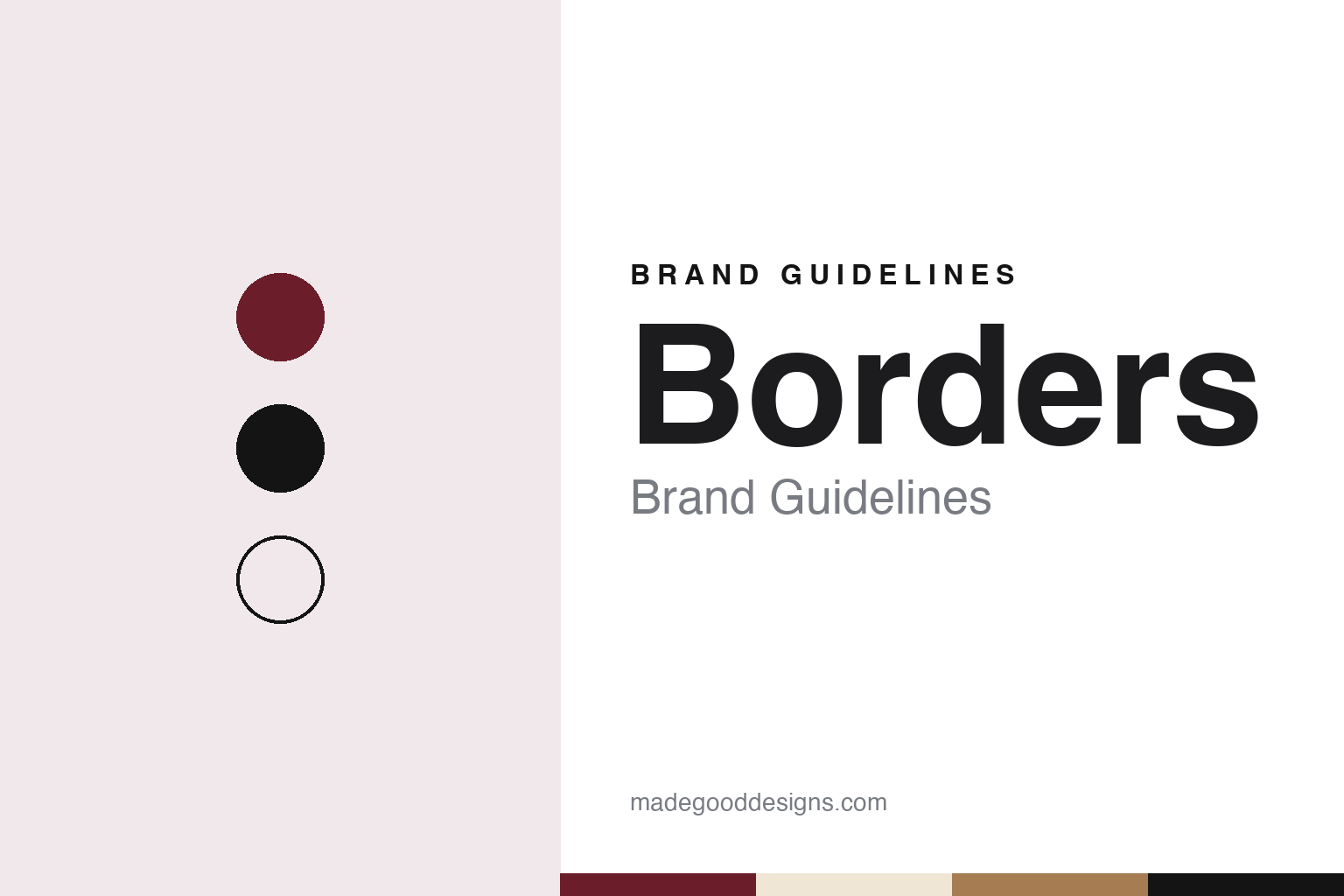
Two constants: a maroon, cream and ink palette and a bookish serif register. Abstract homage — not a Borders asset; no logo, sign or bag is reproduced.
Ann Arbor, 1971
Two brothers and a bookshop near the university.
Borders began in Ann Arbor, Michigan, in 1971, founded by the brothers Tom and Louis Borders. The International Directory of Company Histories, in a company profile reproduced by FundingUniverse, describes the start as a single used bookstore serving the University of Michigan and the town’s smaller colleges, and says the shop became a popular neighbourhood hangout. English Wikipedia says the brothers set it up while they were studying at the university, in a shop on South State Street, close to the campus.
The business stayed close to its home town for years. English Wikipedia says that in 1975 the brothers bought the stock of Wahr’s, an old Ann Arbor bookstore that was closing, and moved their own shop to larger premises on the same street, and that a second Borders location opened in 1985 in Beverly Hills, Michigan. The company profile adds further stores in Michigan, one in Atlanta and one in Indianapolis, and says the brothers also started a wholesaling business called Book Inventory Systems. In 1989, English Wikipedia says, the company hired Robert F. DiRomualdo, formerly president of Hickory Farms, to expand it.
The flagship moved within downtown Ann Arbor in 1994, to the corner of Liberty and State Streets, into a building once occupied by the department store Jacobson’s, according to English Wikipedia. That store, which the company treated as its original shop, closed in September 2011, CNN reported on 12 September 2011. The report described the building in its final weeks, with posters announcing that nothing was held back, and quoted a longtime employee who said staff had prided themselves on knowing their own sections and everybody else’s; a University of Michigan historian told CNN that the store had once been chockablock with books.
Colour
From Kmart to Borders Group.
The name changed hands in 1992. On 3 October 1992 The New York Times reported that the Kmart Corporation would buy Borders Inc., described as a Michigan-based chain of large bookstores in the Midwest and Northeast, and that Borders would join Kmart’s specialty retail group. Kmart already owned the Waldenbooks chain, the paper noted, and had not yet decided how Borders would fit with its other book operations, which also included the Basset Book Shops superstores. English Wikipedia says Kmart hoped experienced Borders managers could help the Waldenbooks business, but that many of them left.
Kmart let the book business go three years later. Publishers Weekly, in a February 2011 history of the chain by Jim Milliot, says Kmart merged Waldenbooks and Borders and spun them off as a separate company in 1995; English Wikipedia says the new company was initially called Borders-Walden Group and took the name Borders Group by the end of that year, with its headquarters in Ann Arbor. The Publishers Weekly account says the two businesses never fully combined their computer and inventory systems, a problem it follows through the rest of the company’s history.
The Borders name also travelled abroad. English Wikipedia lists stores opened in Singapore from 1997, in the United Kingdom from 1998 and later in Ireland, Australia, New Zealand and Malaysia, with a franchised store in Dubai from October 2006. It says the UK and Irish stores were sold to Risk Capital Partners in 2007 together with a licence to use the Borders name, and that the Singapore, Australian and New Zealand stores were sold in 2008 to REDgroup Retail, also with a licence to the name. The UK and Irish business went into administration in November 2009 and closed its stores by the end of that year, English Wikipedia says.
Inside the American stores the brand was dressed with partners. English Wikipedia says Borders arranged in 2004 for Seattle’s Best Coffee, then a Starbucks subsidiary, to run cafés in its domestic superstores under the Seattle’s Best name, and that the company later launched Borders Rewards, a free loyalty programme built on coupons and store credit. In 2008, it says, Borders opened concept stores with a Digital Center selling devices such as e-readers and digital photo frames.
Typography
Bookshops as brands.
A store chain that has closed leaves its identity behind in a scattered set of objects: the lettering that once ran along a shopfront, the cover of a mail-order catalogue, a printed shopping bag, a receipt, a gift card or a television advertisement recorded off the air. None of these was made to last. Signs were taken down when leases ended, catalogues went out with the recycling, and bags were reused until they wore through, so what survives tends to be whatever someone chose to keep.
That makes the visual record of a defunct retailer patchy and uneven. Photographs of storefronts, archived web pages and library or museum holdings can show how a name was set and coloured at particular moments, but they rarely show the whole sequence of changes, and they almost never explain who designed a mark or why it was redrawn. A name may also outlive its stores, passing to new owners who use it online or on a different kind of business.
Each guide in this group therefore keeps to what dated sources record about the chain, its owners and what became of its name, and treats the palette and typeface here as an interpretation rather than a reconstruction.
Aa
A bookish serif for a bookseller’s name. (Specimen set in Libre Baskerville, a serif STAND-IN; NOT the Borders logo.)
Borders
A name bought at auction.
Online, the brand was handed to a partner. Publishers Weekly says Borders gave up control of its website to Amazon in a partnership deal in 2001, and that after George Jones became chief executive in 2006 the company announced it would take its online business back; English Wikipedia dates the end of the Amazon marketing alliance to March 2007. In 2010, Publishers Weekly adds, Borders formed a partnership with, and invested in, the e-book company Kobo.
Borders Group filed for Chapter 11 protection in February 2011 and, with no buyer found, began liquidating its remaining stores in July, with the last U.S. stores closing in September 2011, English Wikipedia says. At an auction of the company’s intellectual property that month, Barnes & Noble appears to have acquired the domestic assets, including the Borders.com website and the Borders, Waldenbooks and Brentano’s trademarks, Publishers Weekly reported on 16 September 2011. The same report said Borders trademarks for Australia and New Zealand, Singapore, Malaysia and certain Gulf countries went to businesses that had run Borders stores there, including Al Maya International for the Gulf. English Wikipedia says the bankruptcy court approved the sale to Barnes & Noble on 26 September 2011, and that Borders customers were told by e-mail that Barnes & Noble had acquired the trademarks and customer list.
Outside the United States the name carried on. English Wikipedia says a Borders store reopened in Singapore in 2013 on a trial basis before being converted to a Popular bookstore; that Al Maya Group bought the regional Borders trademark rights outright from Barnes & Noble in 2015 and widened the range to books, toys and stationery; that the Malaysian franchise stores closed in August 2023; and that as of 2025 Borders stores operated in Middle Eastern countries including the United Arab Emirates, Oman, Qatar and Kuwait.
For a design guide, Borders shows how a college-town shop name became a national chain, a corporate parent’s division and finally a set of trademarks sold country by country. Compare Barnes & Noble, the rival that bought its U.S. name, and Amazon, which ran its website from 2001. For this guide we use maroon, cream and ink with a serif, an unofficial interpretation; no product or logo is reproduced.
Explore & save
Keep Borders’s identity on hand — save it to a board in the Made Good inspiration library.
Borders identity set
Pin the Borders maroon, cream and ink palette and the bookish serif register to your own board.