Burma-Shave Brand Guidelines
The Minneapolis shaving cream that rhymed its way along the highway.
Aa
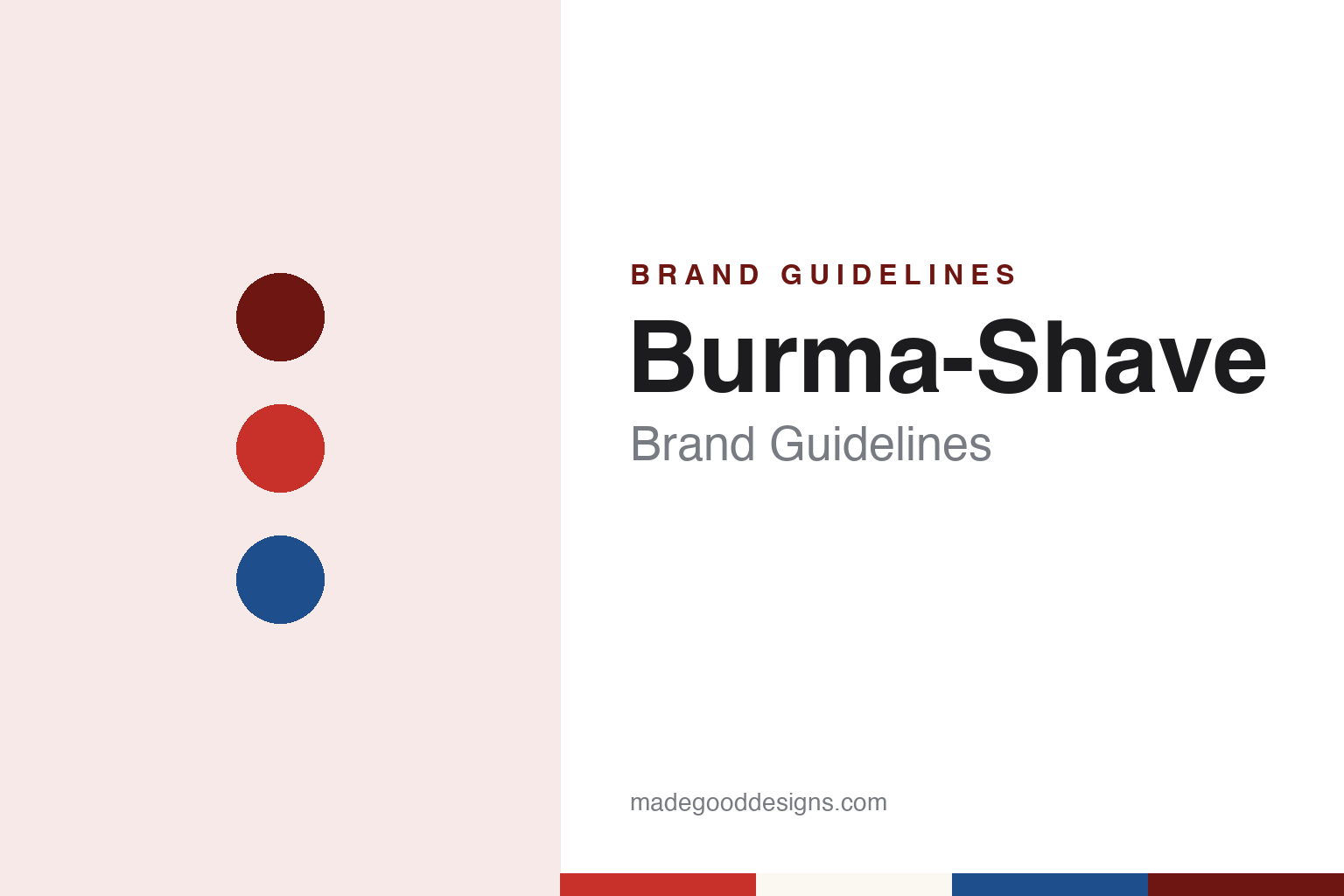
Two constants: a sign red, sign white and prairie blue palette and a capital slab register. Abstract homage — not a Burma-Shave product or mark; no sign, jar or logo is reproduced.
Burma-Vita
A liniment, a chemist and a brushless cream.
Burma-Shave was a brushless shaving cream made in Minneapolis, Minnesota, by the Burma-Vita Company, a business run by the Odell family. MNopedia, the online encyclopedia of the Minnesota Historical Society, says it grew out of an aromatic liniment made in the early 1900s by Robert Odell, a Minneapolis attorney looking for a second source of income. He called the liniment Burma-Vita: “Burma” for the place its ingredients — cassia, camphor and cajeput — came from, and “vita”, the Latin word for life.
By 1925, MNopedia says, the Burma-Vita company was in dire financial straits. Robert’s son Clinton Odell had the idea of turning the liniment business towards a brushless shaving product for men, one that would do away with the shaving brush in a traveller’s kit. The cream itself came after months of experimentation by Carl Noren, a Minneapolis chemist, and English Wikipedia also names Noren as the chemist Clinton Odell hired. A newspaper advertisement in 1926, MNopedia says, pitched Burma-Shave to young men as a way to spend less time shaving, and offered it in a half-pound jar and a big tube.
The business moved as it grew. MNopedia, drawing on the Minneapolis Sunday Tribune of 1926, says the company leased a four-storey building on East Lake Street in Minneapolis that year, fitted with machinery to mix the cream and to fill and label jars and tubes, and moved again in 1940 to West Chestnut Avenue. Its staff worked either on the shaving cream or on the signs that made the name known.
Those signs were the idea of the next generation. MNopedia credits Allan Odell, Clinton’s son, with persuading his father to advertise along the roadside as car ownership and travel grew. NPR’s Morning Edition, in a report by Lars Hoel broadcast on 21 January 2002, said that according to the historian Bill Vossler, Allan got the idea after spotting a run of roadside signs for a gas station, and that Allan and his younger brother Leonard put up the early Burma-Shave signs on highways in southern Minnesota using scrap lumber. MNopedia dates the opening signs to the fall of 1925, on highway 65 from Minneapolis to Albert Lea and highway 61 to Red Wing; Wikipedia dates them to 1926, on U.S. Highway 65 near Lakeville.
Colour
Philip Morris, the end of the signs and a revived name.
The roadside campaign ran for decades, and its decline came with the roads themselves. MNopedia says that during the Second World War, shortages of gasoline and tyres limited sign maintenance and there were fewer cars on the road. With the start of the interstate highway system in the 1950s, signs had to stand farther from the road while driving speeds rose, making them harder to read, and new laws on highway billboards added to the pressure.
In 1963 the Odells sold the Burma-Vita company to Philip Morris. MNopedia says the new owner began removing the signs, and NPR’s 2002 report said the signs began to come down after Philip Morris bought Burma-Vita from the family. Wikipedia gives 1963 as the last year of the signs and says many of the final sets were repeats of earlier jingles. MNopedia adds that in 1966 manufacturing moved to New Jersey and that production was discontinued soon afterwards. The roadside campaign has not run since 1963.
The name did not disappear entirely. NPR reported in 2002 that the American Safety Razor Company had brought back the Burma-Shave name and logo in 1996, on a shaving brush and mug set, and noted at the time that Burma-Shave was a registered trademark of American Safety Razor. Wikipedia dates the revival to 1997 and describes it as a shaving soap and brush kit. Wikipedia notes that the original product was brushless and that the old signs had often ridiculed the shaving brush.
The signs themselves have become museum pieces and roadside reproductions. Wikipedia lists examples at The Henry Ford in Dearborn, Michigan, and at other museums, as well as re-created sets along old stretches of U.S. Route 66 in Arizona and the Lincoln Highway route in Iowa that were not put up by the company during its own campaigns. The Minnesota Historical Society’s collection includes a later aluminium tube of the cream with its box, which MNopedia says was made in St. Paul by the Waldorf Paper Products Company between 1954 and 1957.
The campaign also produced a story that outlived it. The Los Angeles Times reported in July 1997 that the comedian Fred Allen had parodied the signs on radio with an offer of a free trip to Mars for a pile of empty jars; a supermarket manager in Appleton, Wisconsin, took the offer up, and a Hollywood publicist arranged a trip instead to Moers, a German town near Düsseldorf whose name sounds like Mars, according to Frank Rowsome Jr.’s company history.
Typography
Design and documentation.
The brands in this group all sell soap, body wash or shampoo, and they sit at very different points in the trade. Some still belong to the company that first registered the name; others have passed through several owners, been licensed out, or been revived years after their original makers stopped using them. A single name can move from one parent group to another without the product on the shelf changing much at all.
In this category a brand’s identity is carried by a small set of surfaces: the paper or film wrapper around a bar, the printed label on a pump bottle or a squeeze tube, and the advertising that surrounds them. Those surfaces are redrawn often, and a wordmark, a colour or a slogan may outlast several owners, factories and formulas.
Each guide separates what independent sources record from what the company says about itself — who started the brand, who has owned it and since when, where the product is made and how its packaging and advertising have changed — and marks plainly what rests only on the company’s own word.
Aa
A capital slab — the register of a painted roadside board read from a moving car. (Specimen set in Roboto Slab, a slab-serif STAND-IN; NOT the Burma-Shave logo.)
Burma-Shave
An identity built one board at a time.
The Burma-Shave identity was a sequence rather than a single mark. MNopedia describes one line of a jingle painted on each board, with the boards spaced along the roadside so a passing driver read them in order, and Wikipedia says the final board usually carried the product’s name. Wikipedia adds that the signs were generally printed in capital letters.
According to Wikipedia, the signs were originally produced in two combinations, red-and-white and orange-and-black, and the orange-and-black version was dropped after a few years. South Dakota, which reserved red on roadside signs for official warnings, received a special white-on-blue set.
The early wording was plain. NPR quoted a 1927 set that did not rhyme at all, opening “Shave the modern way / No brush / No lather / No rub-in” and closing on the product name, and MNopedia says shorter, rhyming jingles followed so drivers could read them more easily. One it quotes runs “Your shaving brush / has had its day, / so why not / shave the modern way / with Burma-Shave”. Many later sets carried road-safety lines, such as “Drive / with care. / Be alive / when you / arrive. / Burma-Shave.”
Customers helped write the copy. MNopedia says Allan and Clinton Odell wrote many of the early jingles and, from 1930, ran a yearly national jingle-writing contest. Entries had to rhyme, fit on a series of signs and end with the words “Burma-Shave”, and each had to arrive with the top or bottom flap of a Burma-Shave carton. The Odells, it says, were careful to avoid jingles that might offend.
For a design guide, Burma-Shave shows how an identity can live in rhythm, spacing and a closing signature — a joke told one board at a time and signed with the brand name — and how that identity stopped when the boards came down in 1963. Compare it with Barbasol, the Indianapolis brushless cream, and Gillette, the Boston razor company owned by Procter & Gamble since 2005. For this guide we use sign red, sign white and prairie blue with a slab serif, an unofficial interpretation; no product or logo is reproduced.
Explore & save
Keep Burma-Shave’s identity on hand — save it to a board in the Made Good inspiration library.
Burma-Shave identity set
Pin the Burma-Shave sign red, sign white and prairie blue palette and the capital slab register to your own board.