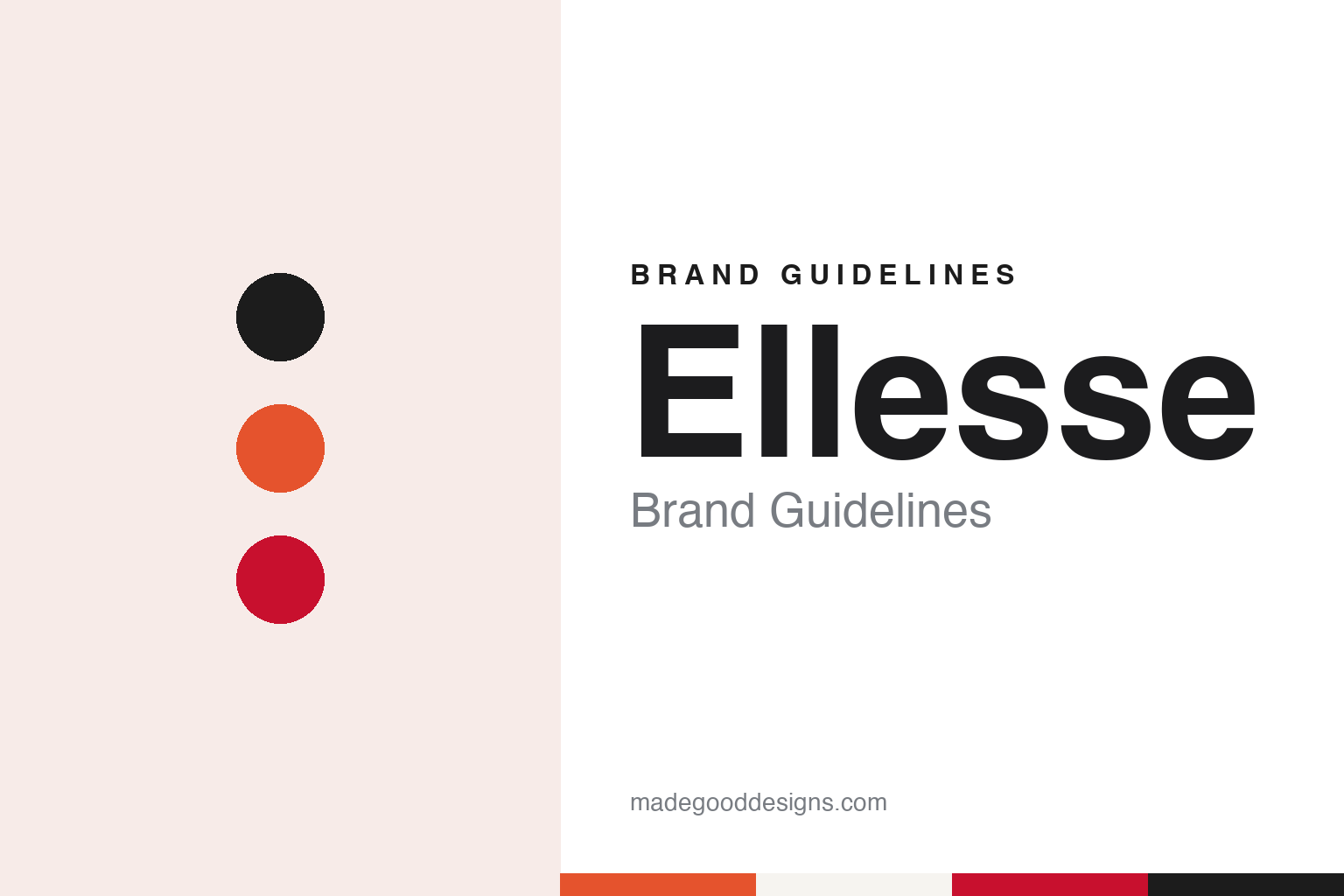
Ellesse Brand Guidelines
The Perugia skiwear maker named for its founder’s initials.
Aa
Two constants: a half-ball orange, court red and snow white palette and a geometric sport sans register. Abstract homage — not an Ellesse product or mark; no half-ball, wordmark or logo is reproduced.
Servadio
A trouser workshop in Perugia and two spoken letters.
Ellesse began in Perugia, in Umbria, in 1959. English Wikipedia says it was founded by Leonardo Servadio on 19 June that year; Italian Wikipedia gives 7 July 1959 and says the business started under the name SE.GI, as a small workshop making trousers in the city’s Pallotta district. In 1960, Italian Wikipedia says, Servadio’s brother-in-law Franco D’Attoma joined as a partner and took charge of administration and staff.
The name is the founder’s signature. Ellesse is the Italian pronunciation of Servadio’s initials, L.S. — “elle” and “esse” — and English Wikipedia and the German trade paper TextilWirtschaft both trace the brand name to those two letters. Italian Wikipedia says the company adopted it formally in 1966, when it moved its offices and production to a new plant at Ellera di Corciano, outside Perugia, and became Ellesse S.p.A.
The brand made its name on the slopes. Italian Wikipedia says Ellesse specialised in sportswear, especially ski trousers, which from 1967 carried a plasticised logo showing a penguin. In 1969, it says, the company sponsored Italy’s alpine ski team, and that sponsorship brought the brand recognition and buyers abroad. In 1971, Italian Wikipedia says, Ellesse introduced a ski trouser fastened outside the boot, with protective knee padding and elastic joints at the waist. English Wikipedia describes the brand’s quilted jackets and ski pants of the 1970s, and says its Jet Pant, with padded knees and a wide lower leg to fit around a ski boot, was included in an event on Italian design at the Pompidou Centre in Paris in 1979.
Tennis followed. Italian Wikipedia says that in 1975 the company changed its logo and entered tennis, and TextilWirtschaft reported in 2005 that Servadio created the brand’s tennis collection in Perugia that year. Through the late 1970s and 1980s, Italian Wikipedia says, Ellesse sponsored tennis players including Chris Evert and Boris Becker, and English Wikipedia says the brand made kits for the New York Cosmos football club in the 1980s.
Colour
Licensing, Reebok and Pentland.
Expansion in the 1980s brought new factories and markets. Italian Wikipedia says the company opened production sites and sales branches abroad, entered footwear in 1981 and sponsored the national alpine ski teams of several countries besides Italy. It then ran into difficulty, and to restore its finances, Italian Wikipedia says, Ellesse sold its United States business to Reebok in 1987, and in 1990 licensed its brand in Japan to Goldwin for clothing and to Toyo Tire for footwear.
The brand’s British owner had been its distributor first. Pentland Group’s own timeline says it was appointed UK distributor for ellesse in the 1980s, and English Wikipedia dates that appointment to 1981. Pentland’s timeline then records the purchase of a majority share of the Ellesse International business in the 1990s, followed later by the remaining shares. Italian Wikipedia dates the majority purchase to 1993 and says the old company was wound up and replaced by a new one, Ellesse International S.p.A., with Servadio as a minority shareholder and chairman; English Wikipedia dates the purchase to 1994, and its introduction says Ellesse has been part of Pentland since 1987. Italian Wikipedia adds that in 1997 Pentland bought back the North American rights to the brand that had gone to Reebok.
Today Ellesse sits in Pentland Brands, which Pentland Group says owns Speedo, Berghaus, Canterbury, Endura, ellesse, SeaVees, Red Or Dead and Mitre. English Wikipedia says Pentland licenses the brand to partners around the world, who make and distribute Ellesse products in their own territories. TextilWirtschaft reported in June 2005 that the brand was turning back to its Italian roots with a line named Perugia for summer 2006. English Wikipedia says Ellesse marked an anniversary with a party in Rome in July 2009, and that in October 2021 it worked with the YouTube group the Sidemen on a collaboration with their clothing label, SDMN. Italian Wikipedia says the old plant at Ellera di Corciano was sold to a retail chain in 2019.
Typography
Design and documentation.
A sportswear mark has to work at very small sizes and at a distance. On a shirt it usually sits on the chest, opposite a club crest or a national badge, and it has to read on a pitch, in a photograph and on a television screen as clearly as it does on a swing tag or a shoebox. That is why so many sportswear identities pair a compact symbol with a wordmark that can be dropped when space runs out.
Many brands also repeat the mark beyond the chest: as a tape running down the sleeve or the side seam, as a band of stripes or shapes on a cuff, or as a pattern woven into the fabric itself. On a team kit those placements share the shirt with the club’s own crest and with a sponsor’s name across the front, so the sportswear brand’s marks have to sit alongside other people’s identities without competing with them.
Each guide below looks at how one brand’s symbol, wordmark and repeated details have changed over time, who has owned the name, and what the documented record says about its history.
Aa
A geometric sans — the register of a chest badge and a racket bag. (Specimen set in Montserrat, a sans-serif STAND-IN; NOT the Ellesse logo.)
Ellesse
Two letters, a penguin and a half-ball.
Ellesse’s identity rests on a name that is also a pair of letters. Because Ellesse is simply “L.S.” spoken aloud in Italian, the wordmark carries the founder’s initials in every use, and Pentland Group writes it in lower case, as ellesse, in its list of brands.
The symbol changed with the sport. Italian Wikipedia says the ski trousers of the late 1960s carried a penguin and that in 1975, as the company moved into tennis, it replaced the penguin with the mark it has used since: a red-orange half-ball. Italian Wikipedia describes it as half a basketball; English Wikipedia says the logo references the form of a tennis ball together with the shape of the tips of a pair of skis.
English Wikipedia says Ellesse built a reputation in the 1970s and 1980s for pairing sportswear function with street-level fashion, that the French designer Jean-Charles de Castelbajac worked with the brand in the mid-1980s, and that the UK casuals adopted it in the same decade. TextilWirtschaft described the Perugia line of 2005 as a return to the brand’s Italian origins under British ownership.
For a design guide, Ellesse shows how a founder’s initials, spoken as a word, and a single half-circle can carry a brand from ski slopes to tennis courts and through several owners. Compare it with Fila, another Italian sportswear brand with tennis roots, and Reebok, which held Ellesse’s United States business from 1987. For this guide we use half-ball orange, court red and snow white with a geometric sans, an unofficial interpretation; no product or logo is reproduced.
Explore & save
Keep Ellesse’s identity on hand — save it to a board in the Made Good inspiration library.
Ellesse identity set
Pin the Ellesse half-ball orange, court red and snow white palette and the geometric sport sans register to your own board.