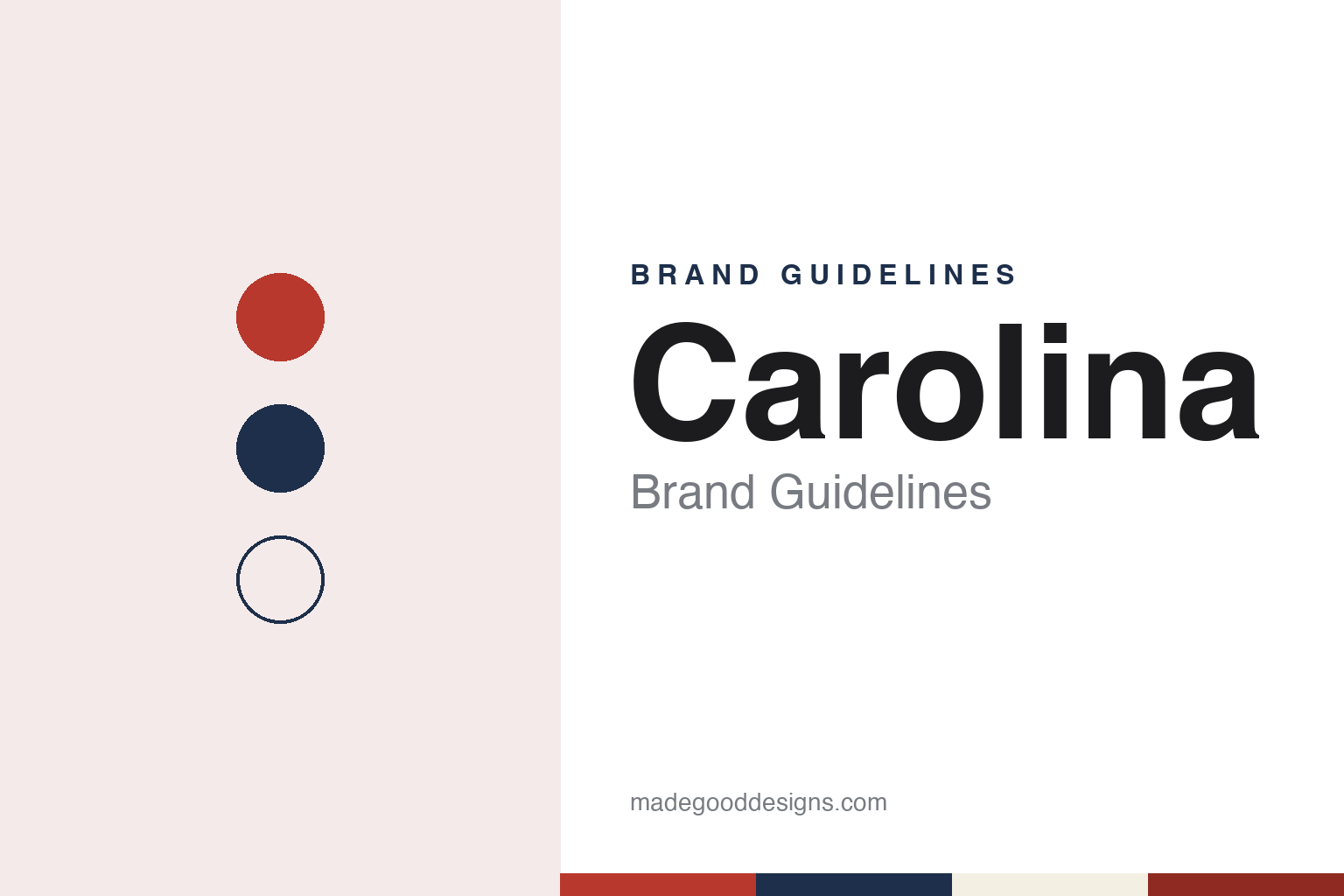
Carolina Brand Guidelines
A New York sales company’s long-grain rice, kept in the Northeast for a century.
Aa
Two constants: a brick red, harbour navy and grain cream palette and a bookish serif register. Abstract homage — not a Carolina product or mark; no bag, label or logo is reproduced.
Southern Rice Sales
A sales company, a regional name and a Louisiana rival.
Carolina is a rice brand sold mainly in the northeastern United States. It is owned by Riviana Foods of Houston, Texas, and through Riviana by the Spanish group Ebro Foods. Its story begins with a sales company rather than a mill. The entry on Riviana Foods in the International Directory of Company Histories, reproduced by FundingUniverse, says the Southern Rice Sales Company was founded in 1911 by Julius R. Ross. Eat This, Not That!, in a July 2018 article by Olivia Tarantino, describes Southern as based in New York, with a branch in New Orleans.
Riviana’s own history places it in 1920, saying that Southern Rice Sales, later absorbed by River Brand Rice Mills, began packaging and selling rice in the Northeast under two brands: Carolina for long-grain rice and River for short-grain rice. The International Directory history and Eat This, Not That! both say Southern began selling rice under the Carolina name in the late 1920s, and English Wikipedia’s article on Ebro Foods gives 1927.
Carolina’s early competitor later became its stablemate. The International Directory history says Southern proved a troublesome marketing rival to the Louisiana State Rice Milling Company, the miller that, according to Riviana, a consortium led by Frank A. Godchaux Sr. formed in 1911 by buying rice mills in southwest Louisiana. That company launched Mahatma, its long-grain rice, in 1932, during the Great Depression, and sold a short-grain rice under the Water Maid name.
The decisive change for Carolina came after the Second World War. Riviana says the Champion Rice Milling Company was incorporated in 1946, later changed its name to River Brand Rice Mills, Inc., and acquired rice milling facilities in Houston and Memphis. The International Directory history says the new company bought Southern Rice Sales and several other businesses, and that combining Southern’s marketing ability with the capacity of four mills soon made River a serious competitor to the Louisiana miller. Eat This, Not That! also dates Champion’s acquisition of Southern to 1946.
Colour
A 1965 merger, Colgate, a family buy-back and Ebro.
The two rivals cooperated on research. The International Directory history says Louisiana State Rice Milling and River Brand formed a jointly owned research company, Food Engineering International, in 1964. On 2 September 1965, it says, the two companies merged through an exchange of stock, at first under the River name and later as Riviana Foods Inc., with Frank A. Godchaux III as chairman. Riviana’s own history also gives 1965 for the merger. Eat This, Not That! wrote in 2018 that Riviana appears to have kept the regional brands in the areas where each had first been sold.
The merged company then grew well beyond rice. Riviana says it was listed on the New York Stock Exchange in 1968, that its headquarters moved to Houston in 1973, after the Riviana Building was put up near downtown, and that between 1965 and 1975 it bought businesses including Hill’s pet foods and Hebrew National franks. In 1976, Riviana says, Colgate-Palmolive entered food manufacturing by merging with Riviana.
The rice business returned to its founding family a decade later. Riviana says that in 1986 a group of its managers and outside investors bought the Colgate-Palmolive/Riviana rice operations in the United States and Belgium, together with other food businesses. The International Directory history says that group traded as Lastarmco, was controlled by the Godchaux family and took all of Riviana’s holdings except Hill’s. Riviana says it was listed again, on NASDAQ, in 1995.
The Spanish connection came next. Riviana says its European operations formed a joint venture in 1991 with Arrocerías Herba, a subsidiary of Ebro, and that Ebro Foods acquired Riviana in 2004; English Wikipedia says that purchase marked Ebro’s entry into the US market. Ebro Foods has owned Carolina, through Riviana, since 2004. Riviana later added Minute Rice, which it bought from Kraft in 2006, and a Riviana press release of September 2025 lists Carolina alongside Minute, Success, Mahatma, RiceSelect and Tilda.
Typography
Design and documentation.
The brands in this group sell nuts, rice and chilled side dishes, three kinds of food that reach the shelf in very different packages. A nut brand may speak through a tin, a jar or a resealable bag; a rice brand through a printed sack or a box that sits in the cupboard for months; and a side-dish brand through a tray or tub in the refrigerated case, where it is seen for a few seconds beside its neighbours.
In each case the pack carries most of the identity: a name, a colour that can be spotted from the end of an aisle, and often a picture of a place, a farm or a person. Behind that name, the company may have changed owners, moved its kitchens or plants, or grown from a single shop or farm into part of a much larger food group.
Each guide separates what independent sources record from what the company says about itself — its founding story, its owners over time, where its food is made and how its packs and labels have changed — and marks plainly what rests only on the company’s own word.
Aa
A bookish, open serif — the steady, kitchen-shelf register of a long-established regional grocery name. (Specimen set in Libre Baskerville, a serif STAND-IN; NOT the Carolina logo.)
A regional twin
The Northeast counterpart, its rice sources and a 2025 campaign.
Carolina and Mahatma divide the country between them. English Wikipedia’s article on Ebro Foods describes Mahatma as a national rice brand serving the whole of the United States, while its sister brand Carolina covers distribution in the Northeast, from Maine to Washington, D.C. Eat This, Not That! listed Carolina as the East Coast name and Mahatma as the West Coast name in its 2018 survey of foods sold under different regional names, adding that the two packs are very similar and that the brands are often promoted together. Carolina’s website, published in English and Spanish, calls it “the brand the Northeast can call family”.
The range runs from plain grains to quick meals. Carolina’s products page lists white, parboiled and whole grain brown rice, jasmine and basmati rice, organic rice, seasoned yellow rice, rice and grain blends and a line of Ready to Heat microwaveable pouches. On sourcing, Carolina’s FAQ says the company buys its rice from farmers in Arkansas, California, Florida, Louisiana, Missouri, Mississippi and Texas, imports its jasmine rice from Thailand, and imports its basmati rice from India and Pakistan. Riviana’s locations page lists its manufacturing facilities by town, in Texas, Arkansas, Louisiana, Tennessee, California and Minnesota, and two sites in Canada.
The brand’s recent marketing leans on home cooking. In a press release dated 23 September 2025, Riviana announced two new Carolina Ready to Heat pouches, Red Beans & Rice, which it described as New Orleans–style, and Basmati Rice. The release said the launches were part of Carolina’s “Feels Like Home” campaign, running on radio, connected TV, e-commerce and social media, and that the new products were sold through Instacart and at grocery stores in the Northeast. It quoted Rodrigo de la Fuente, a marketing manager at Riviana, as saying that consumers had always relied on Carolina for comfort and connection around the kitchen table.
For a design guide, Carolina shows how a regional grocery name can outlast the company that created it: a long-grain label from a New York sales company, absorbed by a Texas miller in 1946, merged with its Louisiana rival in 1965 and owned from Spain since 2004, yet still sold mainly where it began. Compare it with Mahatma, its national counterpart, and Success, another Riviana brand. For this guide we use brick red, harbour navy and grain cream with a serif, an unofficial interpretation; no product or logo is reproduced.
Explore & save
Keep Carolina’s identity on hand — save it to a board in the Made Good inspiration library.
Carolina identity set
Pin the Carolina brick red, harbour navy and grain cream palette and the bookish serif register to your own board.