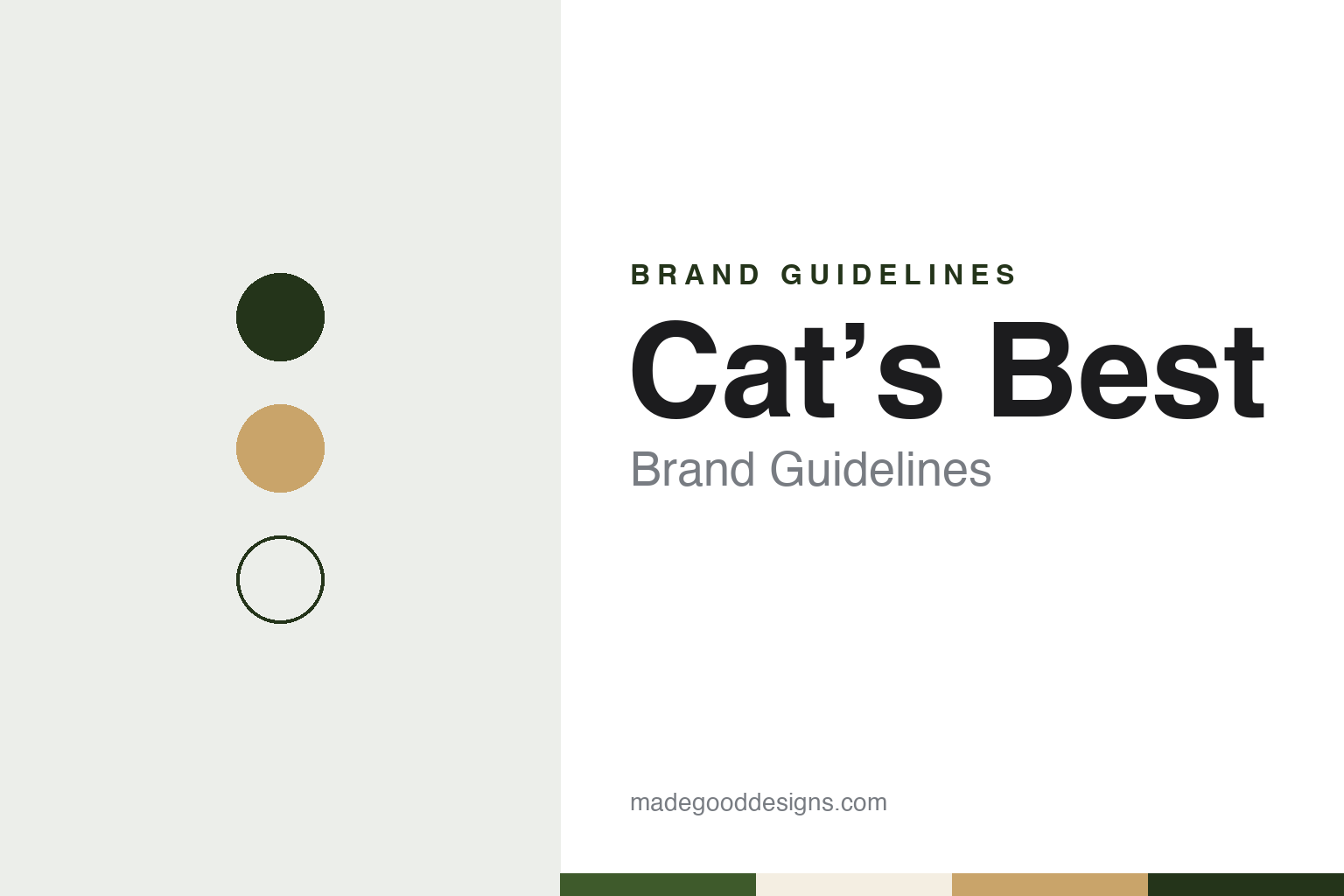
Cat’s Best Brand Guidelines
JRS’s wood-fibre cat litter from Rosenberg, Germany.
Aa
Two constants: a Cat’s Best forest green and wood-fibre palette and a bookish serif register. Abstract homage — not a Cat’s Best product or mark; no bag, logo or label is reproduced.
From a mill in Rosenberg
A family fibre company in the Ostalb.
Cat’s Best is a cat litter made from plant fibres by JRS — J. Rettenmaier & Söhne — a fibre company based at Holzmühle in Rosenberg, in the Ostalbkreis district of Baden-Württemberg in south-west Germany. The brand is marketed by the group’s petcare business, JRS Petcare GmbH & Co. KG, also of Rosenberg, according to the imprint of catsbest.de, whose product copy credits the plant-fibre technology to JRS.
The company is older than its litter by a long way. German Wikipedia dates JRS to 1878, when Jakob Rettenmaier acquired an oil and grain mill in Rosenberg. When the closure of small rural mills put pressure on that business, the Schwäbische Zeitung reported in March 2020, the company turned to a new field, and in 1938 it began producing wood fibres. German Wikipedia lists the steps that followed: a first branch plant at Heilbronn in 1949, the name J. Rettenmaier & Söhne OHG in 1953, cellulose powder from 1956 and, from 1977, cellulose fibres offered as an alternative to asbestos.
JRS has stayed in the family. The Schwäbische Zeitung reported that its head, Josef Rettenmaier, is the great-grandson of the founder, that a family council accompanies the company’s decisions, and that the fifth generation is meant to take over in time. JRS Petcare describes the group as a family business in its fourth generation; German Wikipedia lists its management as Josef Otto Rettenmaier, Michael Hempe and Elmar Schmid.
Colour
Wood fibre, not clay.
Most of what JRS makes never reaches a shop shelf under its own name. The Schwäbische Zeitung described fibres from the company going into tablets, baking mixes, film snow and plant-based cosmetics, and into the dietary fibre added to Leberkäse. The same report said that the company is known above all for its Cat’s Best litter, made entirely of wood fibres.
The brand describes its product in technical language. Its German website, run from Rosenberg, speaks of “Pflanzenfaser-Technologie” — plant-fibre technology — and of “Aktiv-Holzfasern”, active wood fibres, and says the litter is made from PEFC-certified wood raw materials from certified supply chains. JRS Petcare says it prefers regional plant raw materials sourced near its production sites, though its manufacturing page does not name the plants that make the litter. German Wikipedia lists JRS plants at Rosenberg, Heilbronn, Ettenheim, Herbrechtingen, Stuhr, Calenberg and Pirna in Germany, and further sites in Finland, France, the United States, Mexico, India, China and the United Kingdom.
The current range on catsbest.de includes Original, Smart Pellets, Sensitive and Active for cats, plus a non-clumping Universal litter for small animals. JRS Petcare’s other brands include Chipsi small-animal bedding, Dogs Best and Pets Dream, and the company also offers private-label products for retailers. The naming pattern is plain and English across two of those brands: Cat’s Best for cats, Dogs Best for dogs.
Typography
Litter as a brand.
The seven brands in this group are all cat-litter names: World’s Best Cat Litter, Tidy Cats, Fresh Step, Cat’s Best, Catit, PrettyLitter and Dr. Elsey’s. Cat-litter brands in general sit at many different points in the pet trade, from names that still carry a founder’s story to labels that now belong to much larger consumer-goods or pet-care groups, and a single brand can be sold everywhere from a supermarket aisle to a pet shop or an online subscription.
A litter brand’s identity is usually carried less by the product itself than by a bag or box, a name and the material it promises, because the company behind the name may have changed hands, moved its production or grown far beyond the place where it started. That makes the questions behind each name worth asking plainly: who started it, who owns it now, and where its litter is actually made.
Each guide separates what independent sources record from what the company says about itself — its founding story, its owners over time, where its litter is made and how its packaging has changed — and marks plainly what rests only on the company’s own word.
Aa
A calm, bookish serif for a plant-fibre brand. (Specimen set in Lora, a serif STAND-IN; NOT the Cat’s Best logo.)
Cat’s Best
Nature and technology, in one line.
Cat’s Best has a long web history. The earliest capture of catsbest.de in the Internet Archive, from January 2001, carries the title “CAT’S BEST – natürlich, wie Katzen es mögen” — natural, the way cats like it. The present site opens on “Katzenhygiene für eine neue Zeit”, cat hygiene for a new era, and JRS Petcare describes Cat’s Best as an innovative litter that combines nature and “Hi-Tech”. Another line on the site, “Eine saubere Sache für Mensch und Tier”, plays on the German idiom for a clean, straightforward affair: a clean thing for people and animals. The petcare company’s own motto, “Tierliebe bis in die kleinste Faser”, promises a love of animals down to the smallest fibre — a pun that ties the brand’s warmth back to the group’s raw material.
The brand has also been reworked for the trade. In May 2018 the trade magazine Pet Worldwide reported that a new Cat’s Best brand presentation was the focal point of JRS’s stand at that year’s Interzoo, the international pet-trade fair, describing the product as a plant-based litter made from raw plant materials. The same report said JRS aimed to offer the right hygiene solution “for every pet and its environment”. The two brands have shared a home for years: the Internet Archive’s captures of catsbest.de from early 2001 already include a page for Chipsi alongside pages on cat care and hygiene.
The brand also sits inside a company whose main customers are other manufacturers. JRS’s fibres, the Schwäbische Zeitung noted, end up in tablets and food as well as in the litter tray, and the paper singled out the litter as the product the company is best known for.
For a design guide, Cat’s Best shows how an industrial fibre maker can carry a consumer brand without hiding its engineering. Compare World’s Best Cat Litter, another plant-based litter, and Catit, a cat-products brand. For this guide we use a forest green, a wood-fibre tan and cream with a serif, an unofficial interpretation; no product or logo is reproduced.
Explore & save
Keep Cat’s Best’s identity on hand — save it to a board in the Made Good inspiration library.
Cat’s Best identity set
Pin the Cat’s Best forest green and wood-fibre palette and the bookish-serif register to your own board.


