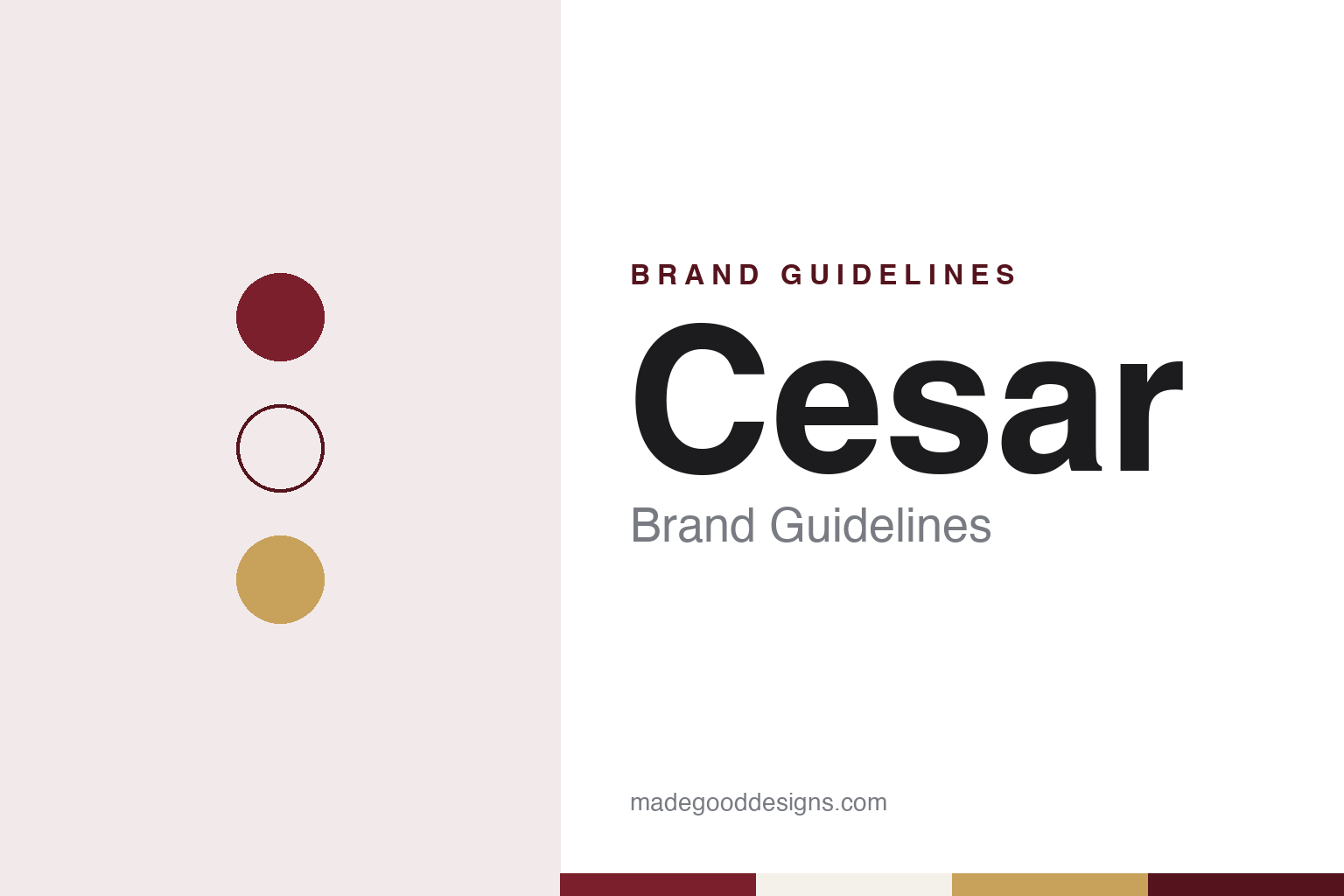
Cesar Brand Guidelines
A small-dog dinner sold like a restaurant dish, with a white terrier at the table.
Aa
Two constants: a burgundy, gold and white palette and a dining-room serif register. Abstract homage — not a Cesar product or mark; no tray, dog or logo is reproduced.
Kal Kan
A European name brought to American shelves.
Cesar is a dog-food brand owned by Mars, the family-owned American company headquartered in McLean, Virginia, and sold today through its Mars Petcare division. On its US website the brand writes its name in capitals, as CESAR, and describes its range as gourmet food for dogs, built around wet meals in small trays alongside pouches, dry food, shelf-stable “Pantry Fresh” meals and treats.
The clearest dated account of the brand’s arrival in the United States comes from Advertising Age. On 15 June 1998 the magazine’s Judann Pollack reported that Kal Kan, the Mars division then responsible for the company’s American pet food, was relaunching its Pedigree Select dog food under the name Cesar. The name, the article said, was already popular in Europe and Asia but new to the US. The relaunched product was called Cesar Select Dinners and was advertised as a superpremium food aimed specifically at small dogs. English Wikipedia’s article on Pedigree Petfoods cites the same report when it describes Pedigree Select becoming Cesar.
Kal Kan itself was an older Los Angeles pet-food company. English Wikipedia’s article on Whiskas says it began making pet food in 1936 from a base near Los Angeles, and its article on Mars records that Mars bought the business and later renamed Kal Kan’s dog food Pedigree and its cat food Whiskas. In 1998 Cesar followed the same route, replacing an American product name with one Mars already used outside the US.
Advertising Age placed the 1998 move in a wider context. The industry had been consolidating, with Nestlé buying Alpo and Heinz buying Quaker Oats’ pet-food lines, and the magazine described Mars as using a global brand name as it competed with both.
Colour
Small trays, small dogs and a fine-dining tone.
From the start, Cesar was presented less as everyday feed than as a meal. The 1998 Advertising Age report described print advertising by BBDO West in Los Angeles showing a tiny dog trying to pull its owner out of bed by the pyjama bottoms, under the line “What do you feed the head of the household? Only the best.” The joke set the tone the brand has kept: a small dog treated as the most important member of the household.
The same article linked Cesar closely to a Mars cat-food brand. BBDO also handled Sheba, and Advertising Age noted that Cesar was packaged almost identically to Sheba, in small oval tins. Tim Phillips, then editor of Petfood Industry, told the magazine that Sheba was a high-price gourmet cat food that fitted a trend of treating pets like children. Cesar carried that approach across to dogs.
The single-serving tray has stayed at the centre of the range. The brand’s US frequently-asked-questions page lists its wet trays in five lines: Classic Loaf in Sauce, which it says was previously called Cesar Classics; Filets in Gravy, previously Filets in Sauce; Loaf & Topper in Sauce, previously Savory Delights; Home Delights; and Simply Crafted, which the company says is meant as a topper or snack.
Around the trays the brand has added other formats. Its site describes a mini-pouch with a peel-and-serve opening, dry food for small dogs, shelf-stable “Pantry Fresh” meals and the Softies treats, which the company says returned after a break in supply. The site also runs a “recipe finder” and a set of articles on dog-friendly dining and travel, extending the restaurant theme beyond the bowl.
Cesar sits in the Mars Petcare stable beside Pedigree and the Dentastix chews. Where Pedigree speaks to dogs of every size, Cesar has kept the narrower focus on small dogs that Advertising Age described in 1998.
Typography
Design and documentation.
The eight brands in this group are all dog and cat food or treat names. Pet-food brands sit at many different points in the trade, from companies that still carry a founder’s name to labels that now belong to much larger food or confectionery groups, and a single brand may be sold under more than one name in different countries.
A pet-food brand’s identity is carried mostly by its bag, can or pouch: the name set large, a photograph or drawing of an animal, a few strong colours that make a range easy to sort on a shelf, and sometimes a mascot or a jingle remembered from television. Because the company behind the name may have changed hands several times, the questions behind each name are worth asking plainly: who started it, who owns it now, and how its packs and advertising have changed.
Each guide separates what independent sources record from what the company says about itself — its origins, its owners over time and its advertising — and marks plainly what rests only on the company’s own word.
Aa
A dining-room serif — the register of a menu card for a small, pampered dog. (Specimen set in Playfair Display, a serif STAND-IN; NOT the Cesar logo.)
Cesar
A terrier, a tray and a new pack for 2026.
The most recognisable element of Cesar’s identity is a dog rather than a letterform. On its US website the company says the West Highland White Terrier, or Westie, has been part of the brand since its beginning, and it introduces the current dog by name as Louna. The Westie appears in the lifestyle photography on the brand’s US website.
The name itself is set in capitals on the brand’s American site, where it is followed by a registered-trademark sign. Files on cesar.com name two web typefaces, Roanne and Westitude Caps, along with a logo file dated 2025.
That date matches a change the company has announced. Its US frequently-asked-questions page says Cesar has a new packaging look, rolling out to stores throughout 2026, and stresses that the recipes inside are unchanged. The company describes the change as an update to the outside of the pack only. The same page records the renaming of the wet-tray lines, so the redesign and the clearer product names arrived together.
The tray remains the brand’s defining object. Advertising Age noted in 1998 how closely Cesar’s small oval tins followed Sheba’s, and the single-serving container has continued to carry the idea of a portioned meal served on its own. The language on the site — “dine like doggy royalty,” recipes, menus and toppers — keeps the same restaurant metaphor that BBDO West used in the first American print advertising.
For a design guide, Cesar shows how a pet-food brand can build its identity on a mascot breed and a serving format, letting a white terrier and a small tray stand for the whole range. Compare it with Pedigree, its larger stablemate at Mars, and Beneful, Nestlé Purina’s dog food. For this guide we use tray burgundy and lid gold on Westie white with a serif, an unofficial interpretation; no product or logo is reproduced.
Explore & save
Keep Cesar’s identity on hand — save it to a board in the Made Good inspiration library.
Cesar identity set
Pin the Cesar burgundy, gold and Westie-white palette and the dining-room serif register to your own board.


