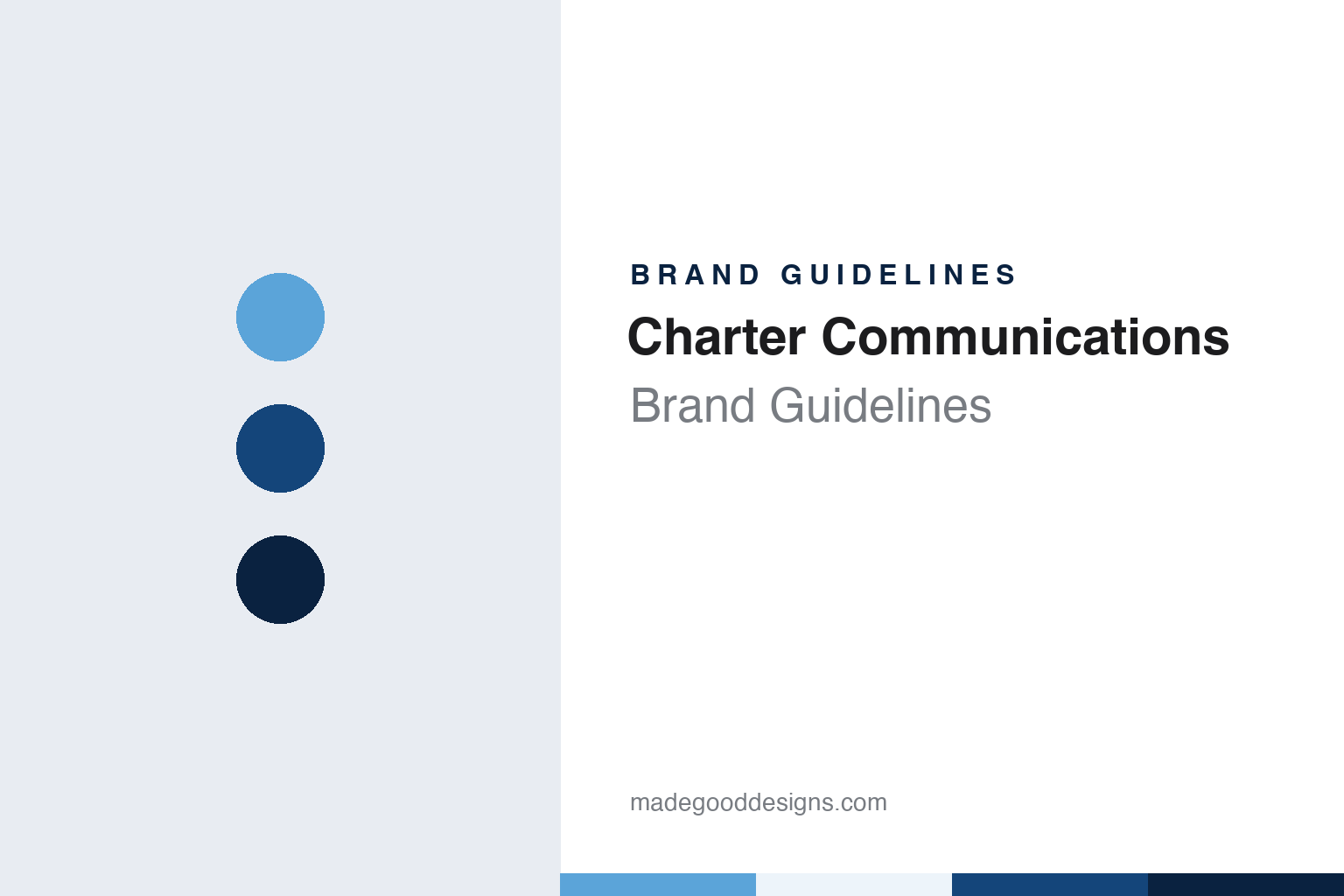
Charter Communications Brand Guidelines
A charter, a spectrum and a name that may change again.
Aa
Two constants: a sky, harbour and deep palette and a Geometric sans register. Abstract homage — not a Charter Communications asset or mark; no logo, icon or wordmark is reproduced.
A Michigan system, a St. Louis company
Charter, 1980 and 1993.
Charter Communications has two starting points, and both are in its own history. Wikipedia says a cable business called Charter Communications CATV was founded in 1980 by Charles H. Leonard in Barry County, Michigan, and that a partnership in the early 1980s merged it with a company called Spectrum Communications.
The company in its present form dates from 1993. Wikipedia says Charter was consolidated that year through mergers and acquisitions by Barry Babcock, Jerald Kent and Howard Wood, three former executives of Cencom Cable Television in St. Louis, Missouri, and that it was incorporated in Missouri in 1993. St. Louis became the home of the corporate name, and the company built up its cable systems through purchases across the country during the 1990s.
Ownership changed hands at the end of that decade. According to Wikipedia, Paul Allen, the Microsoft co-founder, bought a controlling interest in 1998, the year the company also acquired the Dallas-based Marcus Cable, and in 1999 Charter agreed to swap cable systems with AT&T so that its territories would sit closer together. Allen stepped down as chairman in 2011. In between, Charter filed for a prearranged Chapter 11 reorganisation on 28 March 2009 and emerged on 30 November 2009, Wikipedia says.
The next move was geographic. Wikipedia says that in late 2012, with Thomas Rutledge, a long-time Cablevision executive, as chief executive, Charter moved its corporate headquarters from St. Louis to Stamford, Connecticut, while keeping many operations in St. Louis. Until then the word “Charter” did both jobs, naming the company for investors and the service for households, and appearing on vans, bills and set-top boxes alike. A new consumer name was about to take over the second job, and the company’s own name would recede into filings and press releases.
Colour
Charter Spectrum, then Spectrum.
The rebrand was announced in the trade press. Multichannel News reported on 14 November 2013 that Charter would begin marketing its video, telephone and broadband services under the Charter Spectrum brand early the following year. The magazine noted that Charter was following other cable operators that had rebranded their products, naming Comcast’s Xfinity and Cablevision’s Optimum, and tied the new name to the company’s move to all-digital service, with a cloud-based on-screen guide. The magazine added that Rutledge had hinted at a rebranding on the company’s third-quarter conference call on 5 November 2013.
The consumer name grew with the company. Wikipedia says that on 18 May 2016 Charter completed its acquisition of Time Warner Cable and Bright House Networks, and that the Time Warner Cable, Bright House and Charter systems were to move to the Spectrum brand after the merger. Three cable names that households had seen on their bills for years gave way to one, and the corporate word Charter stepped back from the van and the screen.
The arrangement is the same one a designer meets across cable: a parent name for shareholders and regulators, and a consumer name for the house. For Charter the split is unusually clear. Spectrum appears on the truck, the remote, the router and the monthly bill; Charter appears on the stock listing, the annual report and the newsroom. Neither name points to a city or a founding family.
That leaves the corporate name with a smaller role than the consumer one. Charter is a name people meet when they read about the company, while Spectrum is the name they meet when they call it. The balance between the two was about to shift again, through a combination with a company whose name is older than Charter’s.
Typography
Parents, consumer names and the van.
Cable and broadband identities usually run on two levels at once. There is the corporate parent name, the one that appears on stock listings, regulatory filings and press releases, and there is the consumer brand name that a household actually sees. The two are often different words, and a parent can introduce, retire or merge consumer names while its own name stays the same. For a designer, the useful habit is to ask which layer a mark belongs to before borrowing anything from it.
The consumer layer travels on physical surfaces as much as on screens. Service trucks and vans carry the mark through neighbourhoods every day, so livery has to read at a distance, at speed and in bad light, usually with a short name, a strong single colour and a lot of white or dark ground. Technician uniforms, door hangers and installation boxes repeat the same few elements.
Inside the home, the brand lives on quieter surfaces: the boot screen of a set-top box, the on-screen programme guide, the router label, the remote control and the monthly bill. These are read up close and often, so typography, spacing and a restrained palette tend to matter more there than any large logo.
Aa
A geometric sans — after a parent that hands the household to its consumer name. (Specimen set in Inter, a sans STAND-IN; NOT the Charter or Spectrum logo or any Charter typeface.)
Charter Communications
Charter, Cox and Spectrum.
The latest chapter joins Charter to a family-owned cable company. Wikipedia says that on 16 May 2025 Charter announced an agreement to combine with Cox Communications. The California Public Utilities Commission said on 13 August 2026 that it had approved the merger of Cox’s California telephone company into Charter, subject to settlement agreements and conditions. The commission said the agreements were between the companies and two groups, the California Public Advocates Office and the California Emerging Technology Fund.
Charter said on 20 August 2026 that it had completed the transaction with Cox. In the same announcement the company said that, within a year, it would change its parent company name to Cox Communications while continuing to operate as Spectrum in all markets, and that it would remain headquartered in Stamford, Connecticut, with a significant presence in Atlanta. Charter said the Spectrum brand, pricing and packaging would launch in all Cox markets in mid-September 2026.
That plan turns the usual direction of a merger around. The acquiring company keeps its consumer brand but adopts the acquired company’s name for the parent. For a designer it is a clear example of how loosely the two layers are tied together: Spectrum can stay on every van and bill while the name above it changes, because households rarely meet the parent name at all. The Charter name, chosen in the 1980s and consolidated in 1993, is set to become part of the company’s history rather than its masthead.
Until that change takes effect, the company remains Charter Communications, based in Stamford, with St. Louis and Atlanta in its story.
For a design guide, Charter Communications shows how a consumer brand can outlast the corporate name above it. Compare Cox Communications, the name Charter says its parent company will take, and Optimum, another cable product name that rose above its parent. For this guide we use sky, harbour and deep with a sans, an unofficial interpretation; no product or logo is reproduced.
Explore & save
Keep Charter Communications’s identity on hand — save it to a board in the Made Good inspiration library.
Charter Communications identity set
Pin the Charter Communications sky, harbour and deep palette and the Geometric sans register to your own board.