Chesapeake Bay Candle Brand Guidelines
An Annapolis basement start, owned by Newell since 2017.
Aa
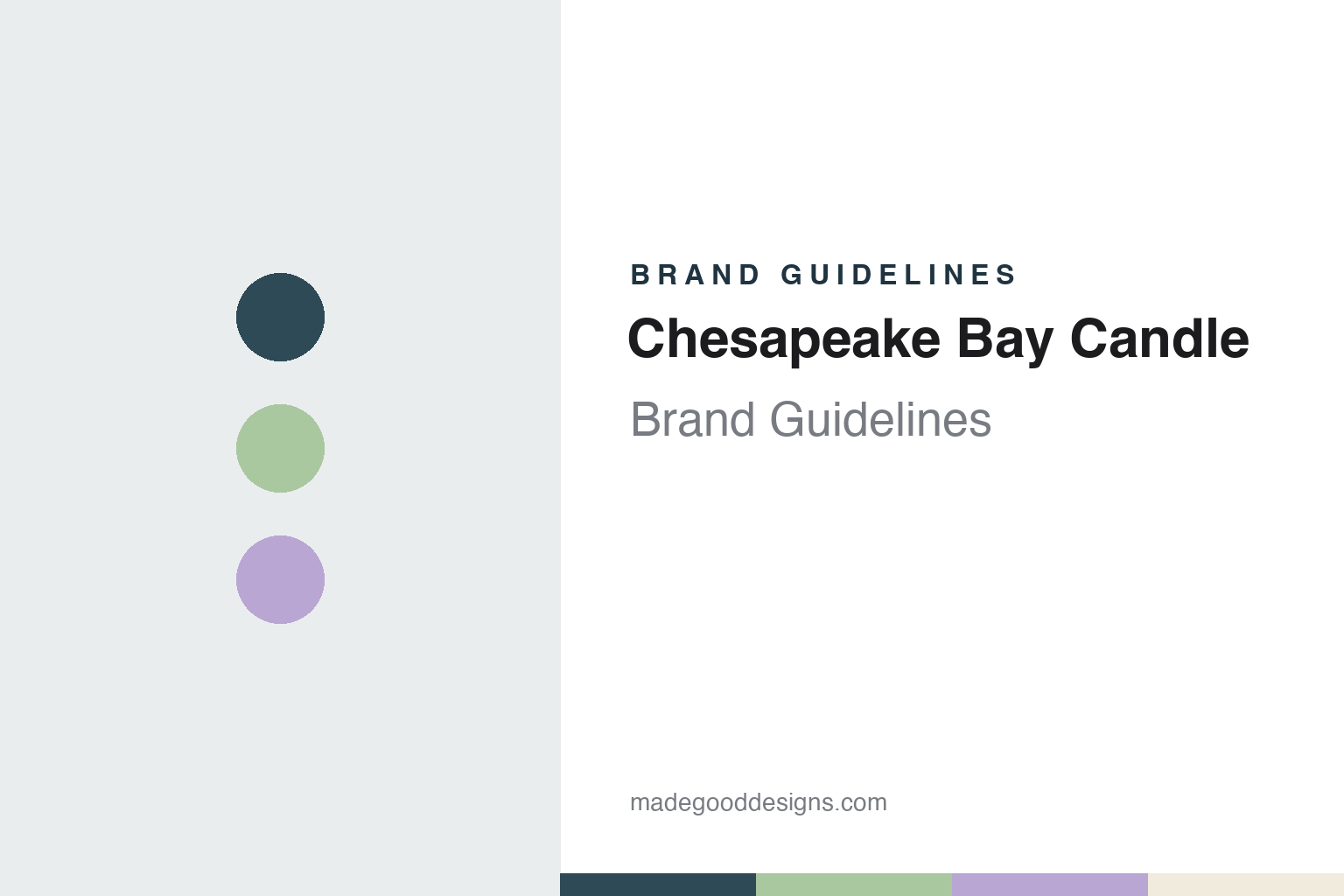
Two constants: a bay slate, melon green and lavender palette and a minimal geometric sans register. Abstract homage — not a Chesapeake Bay Candle product or mark; no jar, label or logo is reproduced.
Soup cans in Annapolis
A gift-show test, then a candle company.
Chesapeake Bay Candle began in 1994 in Annapolis, Maryland. Its founders were Mei Xu and her then-husband David Wang; a University of Maryland profile from 2019 says they started the business in the basement of their Annapolis home, and its current owner, Newell Brands, gives the same year, place and founders on its brand page. The Daily Hampshire Gazette dated the founding to early 1994. The University of Maryland profile named the operating company as Pacific Trade International, with Chesapeake Bay Candle as its brand.
The story of how it started has been told several times. Before the business, Xu worked in New York for a firm that exported medical equipment to China, and she has described the cosmetics and fashion floors of Bloomingdale’s as the place her interest in scent began. A Washington Post column, syndicated by Gulf News in October 2016, said the company began “as an experiment in an Annapolis basement with wax poured into soup cans.” Baltimore Magazine, in a July 2018 profile by Martha Thomas, said the couple first asked friends to bring home goods from China — silk flowers, decorative pillows and candles with a stained-glass motif — and rented a table at a gift show in Charlotte, North Carolina, to see what would sell. Candles drew the most orders.
The Post column followed the early steps: a warehouse in Laurel, Maryland, a toll-free number and, after a trip to a housewares fair in Germany, two decisions — to treat fragrance as the heart of the product, and to keep the design minimal so the scent could sell the candle. The couple worked with Xu’s sister in China to start their first factory in 1995, and the column said the company made and sold its candles from China until 2008.
Colour
Melon green and lavender instead of hunter green.
Colour was part of the pitch from the start. Xu told Baltimore Magazine that the candles on sale in the mid-1990s were “boring,” mostly hunter green, cranberry and off-white, yet they sold because they carried fragrance. Her answer was to skip the expected pine, cinnamon and vanilla in favour of what the magazine called more sophisticated aromas, and to use a palette of melon green, lavender and yellow. That account is the clearest documented statement of the brand’s visual direction, and the tones on this page take their cue from it.
The later ranges were framed around mood. The University of Maryland profile dated the Mind & Body collection to 2015, describing it as made to support a balanced lifestyle. In the 2018 Baltimore Magazine piece, Xu described a soy candle in chartreuse frosted glass under a faux-wood lid, with a label naming the feeling the scent was meant to evoke, and said the Mind & Body line was sold at Target. Often, she said, a new product begins with an idea or an emotion, and the scent follows once the mood is set.
Newell’s own description keeps that register. Its brand page speaks of the “beauty of the Chesapeake Bay shoreline,” of “beautifully minimalist designs and nature-inspired fragrances,” and of collections that run from everyday classics to scents “inspired by ingredients found in nature.” In its annual report for 2017, Newell described the business as focused on consumer wellness and natural fragrance. No designer, agency or official typeface for the Chesapeake Bay Candle wordmark is documented, so the specimen here is a stand-in.
Typography
Design and documentation.
The seven brands in this group are all candle and home-fragrance names: Glade, Bath & Body Works, Chesapeake Bay Candle, Bolsius, ILLUME, Mrs. Meyer’s Clean Day and Price’s Candles. Candle and home-fragrance brands in general sit at many different points in the trade, from small studios that still pour by hand to names that now belong to much larger household-goods groups, and a single brand can be sold everywhere from a supermarket aisle to a boutique shelf.
A candle brand’s identity is usually carried less by a single candle than by a jar, a label, a scent name and the story printed on the box, because the company behind the name may have changed hands, moved its production or grown far beyond the place where it started. That makes the questions behind each name worth asking plainly: who started it, who owns it now, and where its candles are actually made.
Each guide separates what independent sources record from what the company says about itself — its founding story, its owners over time, where its candles are made and how its packaging has changed — and marks plainly what rests only on the company’s own word.
Aa
A minimal geometric sans for a brand built on quiet jars and named moods. (Specimen set in Jost, a sans-serif STAND-IN; NOT the Chesapeake Bay Candle logo.)
Newell and Yankee Candle
From Glen Burnie to Whately.
The move back to American manufacturing came after 2008. The Washington Post column said that during the financial crisis, retailers asked for shorter lead times, and the company built a domestic factory in a leased building in Glen Burnie, Maryland; in 2016 it described a plant there with a research-and-development department and a quality-control room, and loading docks used by retailers including Target, T.J. Maxx and Kohl’s. Baltimore Magazine reported in 2018 that the company made most of its products in Glen Burnie.
Newell Brands has owned Chesapeake Bay Candle since 2017. Newell’s annual report for that year, filed with the U.S. Securities and Exchange Commission, lists the purchase among its 2017 acquisitions, together with Smith Mountain Industries, maker of WoodWick, and says its home fragrance products were sold under the Chesapeake Bay Candle, WoodWick and Yankee Candle trademarks. Baltimore Magazine said in July 2018 that Xu had stayed on in an executive role after the sale.
Consolidation followed. The Daily Hampshire Gazette reported on 8 July 2019 that Chesapeake Bay Candle’s operations would move from Glen Burnie to the Yankee Candle plant on Christian Lane in Whately, Massachusetts, during September and October 2019, as Newell brought them under one roof in its home fragrance division. English Wikipedia’s Yankee Candle article lists Chesapeake Bay Candle and WoodWick among Yankee Candle’s subsidiaries, and in October 2026 the brand’s own web address forwarded to a Chesapeake section of the Yankee Candle website.
For a design guide, Chesapeake Bay Candle shows how a founder’s colour choices — melon green and lavender against the hunter green of the 1990s shelf — and a minimal jar can carry a brand through a change of owner and factory. Compare Yankee Candle, its sister brand under Newell, and Voluspa, another American candle house that began small. For this guide we use bay slate, melon green and lavender with a geometric sans, an unofficial interpretation; no product or logo is reproduced.
Explore & save
Keep Chesapeake Bay Candle’s identity on hand — save it to a board in the Made Good inspiration library.
Chesapeake Bay Candle identity set
Pin the Chesapeake Bay Candle bay slate, melon green and lavender palette and the minimal geometric sans register to your own board.


