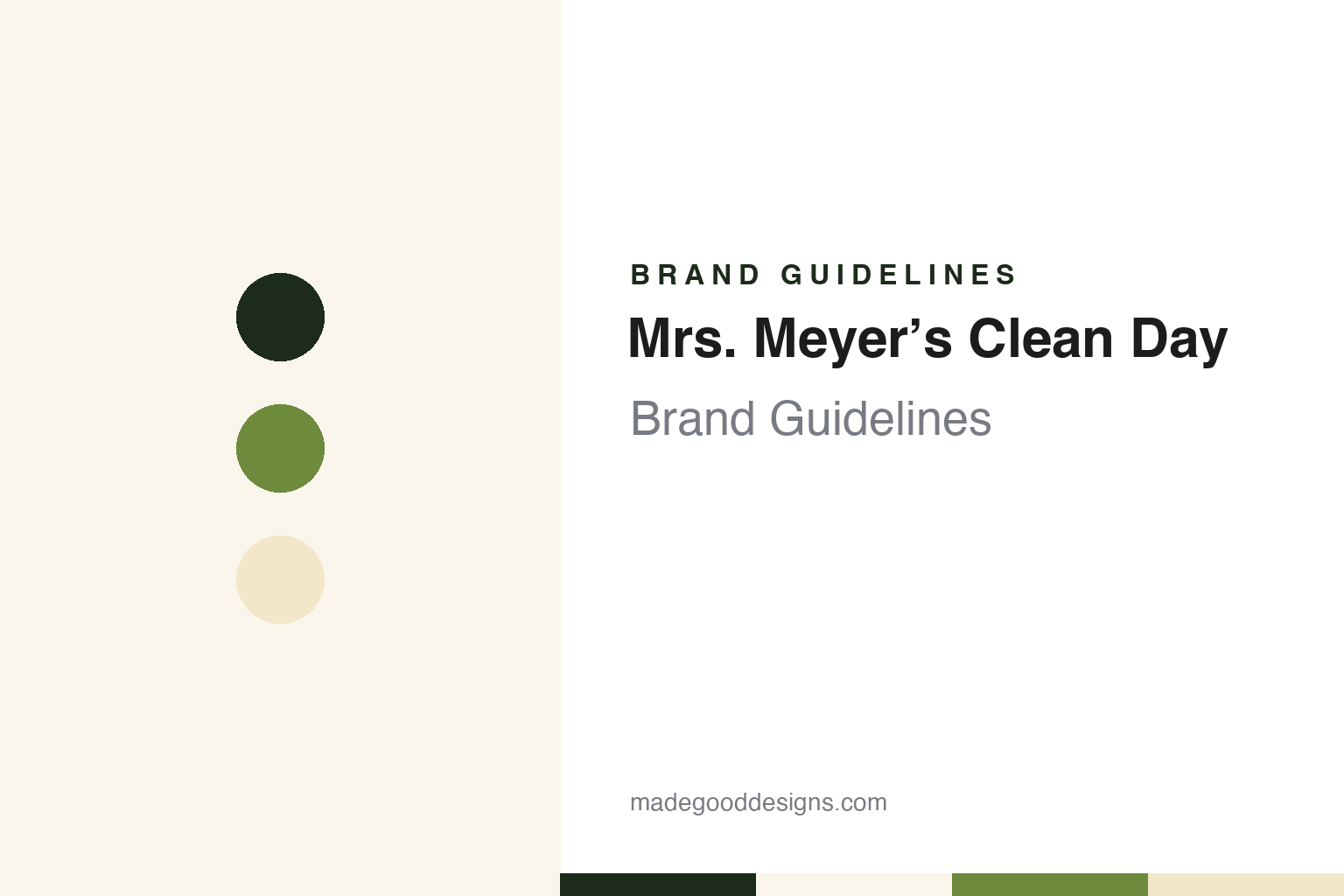
Mrs. Meyer’s Clean Day Brand Guidelines
The cleaners named after an Iowa mother of nine.
Aa
Two constants: a basil green, lemon verbena and lavender palette and a sturdy slab serif register. Abstract homage — not a Mrs. Meyer’s product or mark; no bottle, label or portrait is reproduced.
Monica Nassif’s mother
A marketer, a candle after cleaning and a farm family from Iowa.
Mrs. Meyer’s Clean Day was created in Minneapolis by Monica Nassif, a marketer who had grown up in Granger, Iowa. Twin Cities Business, profiling her in July 2020, says she worked in corporate communications at Dayton Hudson and in 1990 co-founded a marketing design firm, Kilter Inc., with Cynthia Knox. The idea for upscale household cleaners came to her, the magazine says, on a business trip to Atlanta in 1999. In a 2007 “Consumed” column, the writer Rob Walker gave a more domestic version: Nassif had taken to lighting an Aveda candle after cleaning, to cover the smell of the products she had just used.
Sources differ on dates. Twin Cities Business said in February 2014 that Nassif founded both Caldrea and Mrs. Meyer’s Clean Day in 1999. Its 2020 profile gives 2000 for Caldrea, her first, boutique-priced line, which first shipped to retailers in Dallas, and 2002 for Mrs. Meyer’s, whose first products went to Restoration Hardware. Walker’s column put the Mrs. Meyer’s launch at around 2001, with six products. All three accounts agree that Caldrea was named after Nassif’s daughters, Calla and Aundrea, and that Mrs. Meyer’s was the lower-priced line for grocery and hardware stores.
The name is the brand’s central idea. Thelma Meyer, Nassif’s mother, raised nine children in Iowa, and both Twin Cities Business and Walker describe the line as named after her. The company still introduces her on its website as “a real person with a real passion for keeping things tidy,” an avid gardener and mother of nine, and says her no-nonsense view — that cleaning just has to get done, so it might as well be “a little more delightful” — is the brand’s attitude. The 2020 profile says she later travelled to stores as a brand ambassador.
Colour
Copy on the bottle and colour by scent.
The packaging was designed by Sharon Werner, whose small studio, Werner Design Werks, was based in St. Paul. Walker noted in his 2007 column that the labels were unusually text-heavy at a time when most packaging was sleek and sparse, and that the homely name could make a new product look like an old, established one. Werner told him the copy was meant to stand in for the salesperson in a boutique, explaining each scent on the shelf, and that the look echoed the authoritative products “that our parents depended on.” The bottles were colour-coded by scent; as Werner put it, “Mrs. Meyer would color code.”
Scent was the organising principle from the start. Walker described a line built around three fragrances — geranium, lemon verbena and lavender — across detergents, counter-top sprays and dish soap, sold under the line “aromatherapeutic household cleaners.” Twin Cities Business quotes the chemist Pam Helms, who joined full-time in 2001 and later led research and development at S.C. Johnson, as saying people will pick up a cleaning product that smells good and looks good once.
The shelf mattered as much as the bottle. In 2007 Walker found the line in upmarket supermarkets such as Whole Foods and Wild Oats, in Ace Hardware and in some Kroger stores, and Nassif told him that some boutiques found the packaging “kind of hip.” His conclusion was that the brand was aimed less at people like Thelma Meyer than at shoppers who liked the idea of her. By 2014, Twin Cities Business reported, the cleaners were sold across the United States at retailers including Target and True Value.
Ownership changed in 2008, when S.C. Johnson & Son of Racine, Wisconsin, bought Minneapolis-based Caldrea Co., the company behind both lines; the price was not disclosed. In February 2014 Twin Cities Business reported that S.C. Johnson would fold Caldrea into its Home Cleaning business in Racine, closing the Minneapolis office in June 2014. Maggie Carey, Caldrea’s general manager, said the brands had roughly doubled in size in the five years since the purchase. S.C. Johnson, the magazine noted, is privately held and dates from 1886.
Typography
Design and documentation.
The seven brands in this group are all candle and home-fragrance names: Glade, Bath & Body Works, Chesapeake Bay Candle, Bolsius, ILLUME, Mrs. Meyer’s Clean Day and Price’s Candles. Candle and home-fragrance brands in general sit at many different points in the trade, from small studios that still pour by hand to names that now belong to much larger household-goods groups, and a single brand can be sold everywhere from a supermarket aisle to a boutique shelf.
A candle brand’s identity is usually carried less by a single candle than by a jar, a label, a scent name and the story printed on the box, because the company behind the name may have changed hands, moved its production or grown far beyond the place where it started. That makes the questions behind each name worth asking plainly: who started it, who owns it now, and where its candles are actually made.
Each guide separates what independent sources record from what the company says about itself — its founding story, its owners over time, where its candles are made and how its packaging has changed — and marks plainly what rests only on the company’s own word.
Aa
A sturdy slab serif for a label that talks like a neighbour. (Specimen set in Zilla Slab, a serif STAND-IN; NOT the Mrs. Meyer’s logo.)
Mrs. Meyer’s Clean Day
From the kitchen sink to the candle jar.
The garden scents have since moved beyond cleaning. The brand’s website today sells its household cleaners alongside a range of soy candles — large jar candles in scents such as Lavender, Basil and Iowa Pine, and smaller tin candles such as Daisy — which the company describes as made with soy wax and sold in recyclable glass jars or tins. The company says its products are cruelty-free and Leaping Bunny certified, and that its scents are inspired by a Midwestern backyard garden. Seasonal candle scents on the website include Peppermint and Gingerbread.
For a design guide, Mrs. Meyer’s Clean Day shows how a real person’s name, chatty label copy and colour coding by scent can make a household product feel personal on a crowded shelf, and how that system can stretch from a spray bottle to a candle. Compare Glade, its stablemate at S.C. Johnson, and Thymes, another Minneapolis fragrance house. For this guide we use basil green, lemon verbena and lavender with a slab serif, an unofficial interpretation; no product or logo is reproduced.
Explore & save
Keep Mrs. Meyer’s Clean Day’s identity on hand — save it to a board in the Made Good inspiration library.
Mrs. Meyer’s Clean Day identity set
Pin the Mrs. Meyer’s Clean Day basil green, lemon verbena and lavender palette and the sturdy slab serif register to your own board.


