Fowers Games Brand Guidelines
Tim Fowers’s self-published heists, word games and chases.
Aa
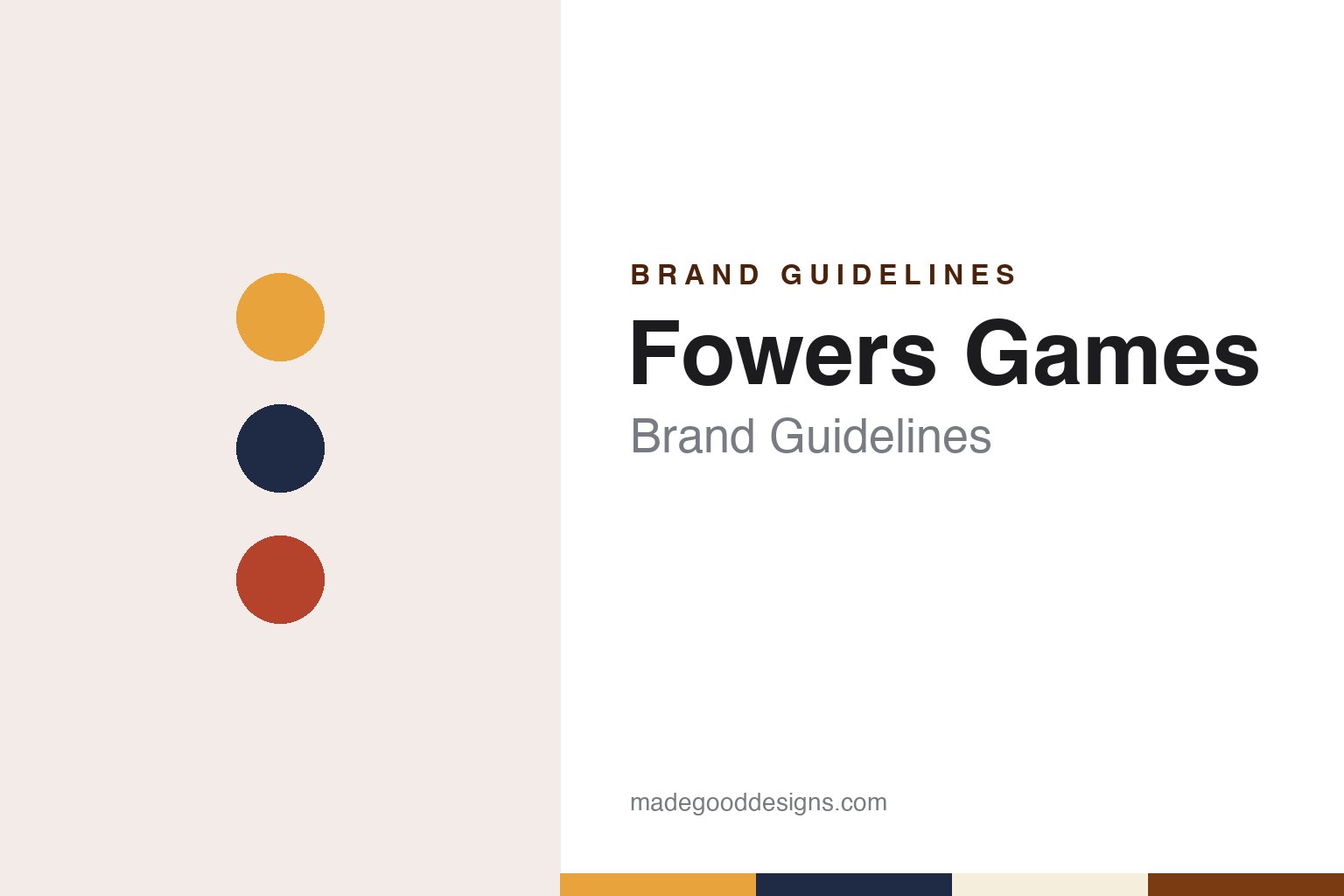
Two constants: a paperback mustard, burnt sienna and heist navy palette and a cartoon slab serif register. Abstract homage — not a Fowers Games product or mark; no box, card or logo is reproduced.
One designer, one label
A games maker who publishes his own work.
Fowers Games is the label of the American game designer Tim Fowers. Its web store introduces the business in his own voice — “Hello! My name is Tim Fowers and I make unique boardgames” — and adds that it also carries games from his friend Jeff Beck. English Wikipedia describes Fowers’s best-known series, Burgle Bros, as cooperative heist games that he “designed and self-published,” with Fowers Games as the publisher, and self-publishing is the thread that runs through the whole catalogue.
Fowers came to publishing from both sides of the screen. In an interview with Theology of Games in March 2015 he said he had been making board games and video games for about ten years, that he had been drawn into the hobby by Settlers, and that Puerto Rico and Power Grid had impressed him with their elegant systems; at the time he described himself as living in Southern California with his family. In a 2021 interview with Dice Tower Dish, he recalled an earlier move to Olive Hill, Kentucky, where he and a friend had taken their families when they went independent to make video games. Today the company’s contact address is a post-office box in Centerville, Utah.
The early catalogue is the one the company still leads with. ICv2, reporting in June 2016 on the Kickstarter for the two-player chase game Fugitive, introduced Fowers as the designer of Burgle Bros and Wok Star, and noted that retailers could order the new game directly from him once backers had been served. English Wikipedia dates the first Burgle Bros to 2015, followed by Burgle Bros 2: Casino Capers in 2021 — a legacy game whose box becomes a two-layer board — and Burgle Bros 3: Future Flip, scheduled for 2025 after a Kickstarter campaign that April. A digital Burgle Bros was released on Steam.
Alongside the heists sit the word games. Paperback crosses a word game with deck-building, and its sequel Hardback, announced on Facebook by Fowers in 2017, was described by Stately Play in March 2017 as a “pre-quill” to the original, ahead of its own Kickstarter launch. Paperback also exists as an app, and the store now sells a tenth-anniversary edition of the game.
Colour
A cartoonist’s world, built game by game.
The look of Fowers Games is largely the work of one artist. The company’s “About Us” page lists Ryan Goldsberry as its artist, and the trade press has credited him across the catalogue: ICv2 wrote in 2016 that Goldsberry illustrated the numbered hideout cards of Fugitive and had also worked on Burgle Bros and Wok Star, and Stately Play noted in 2017 that Hardback’s art came from the same artist as Paperback, in a similar playful style.
Fowers has described how that partnership works. Speaking to Dice Tower Dish in September 2021, he said he hands Goldsberry character concepts and Goldsberry builds the look and the world around them — from the cards of Fugitive to the novel covers of Paperback. In the same interview Fowers said every new game has to stand apart in three ways: new gameplay, a solid theme and a distinct art style. That rule shows in the catalogue’s spread, from a cooperative bank job and a card chase to deck-building word games themed on writing novels.
The rest of the team is listed by role on the company site: Fowers as designer, Goldsberry on art, Jeff Krause on programming and design, Skye Larsen on rulebooks, layout and design, and a customer-support lead. Larsen also co-designed Paperback Adventures, a solo deck-building spin-off; Fowers told Dice Tower Dish that it began as a mash-up of the video game Slay the Spire and Paperback built with Krause, before Larsen created the physical prototype. The store’s current list adds later titles such as RUN and Typewriter.
Typography
Design and documentation.
The seven brands in this group are all board-game publishers: Fowers Games, Alley Cat Games, Dire Wolf, Rebel, Ludonaute, Catch Up Games and Next Move Games. Board-game publishers in general sit at many different points in the trade, from small studios still run by the people who started them to labels that now belong to much larger games groups, and a single name can appear everywhere from a hobby-shop shelf to a department-store toy aisle.
A publisher’s identity is usually carried less by a single box than by a logo on many boxes, a house style of art and graphic design, and the games it becomes known for, because the company behind the name may have changed hands, merged its studios or moved its production far from where it started. That makes the questions behind each name worth asking plainly: who started it, who owns it now, and where its games are designed and made.
Each guide separates what independent sources record from what the company says about itself — its founding story, its owners over time, where its games are made and how its look has changed — and marks plainly what rests only on the company’s own word.
Aa
A cartoon slab serif with a pulp-paperback feel. (Specimen set in Bitter, a slab-serif STAND-IN; NOT the Fowers Games logo.)
Fowers Games
A small studio run as a network of collaborators.
Fowers has described a business organised around projects rather than a payroll. In his 2021 Dice Tower Dish interview, Fowers said he usually has one video game and two board games in progress at any time — one in Kickstarter production or shipping, another earlier in development. He described splitting the revenue of each project among the people who made it rather than keeping a salaried staff, with designers such as Jeff Beck and Rob Cramer releasing games under his umbrella while he runs the systems for production, shipping and the web store.
That approach extends to the wider hobby. Fowers told the same interview that he co-founded Tabletop Network, a conference for game makers, with Jeff Beck and Jeff Krause, later linked to BGGCon, and that he works with Tabletop Mentorship, which pairs new designers with experienced mentors. The store itself sells directly to players, advertises free shipping on larger orders to the United States, the United Kingdom and Germany, and it keeps a separate menu for the label’s video games.
The name needs a little care online: the store lives at fowers.games, while Tim Fowers’s personal site is fowers.net; the similar-looking fowersgames.com domain is not the company’s.
For a design guide, Fowers Games shows how one illustrator’s cartoon world and a designer’s rule of a distinct look for every game can hold together a self-published catalogue of heists, chases and word games. Compare Stonemaier Games, another American publisher built on Kickstarter, and Alley Cat Games, the Cambridge publisher of Dice Hospital. For this guide we use paperback mustard, burnt sienna and heist navy with a slab serif, an unofficial interpretation; no product or logo is reproduced.
Explore & save
Keep Fowers Games’s identity on hand — save it to a board in the Made Good inspiration library.
Fowers Games identity set
Pin the Fowers Games paperback mustard, burnt sienna and heist navy palette and the cartoon slab serif register to your own board.