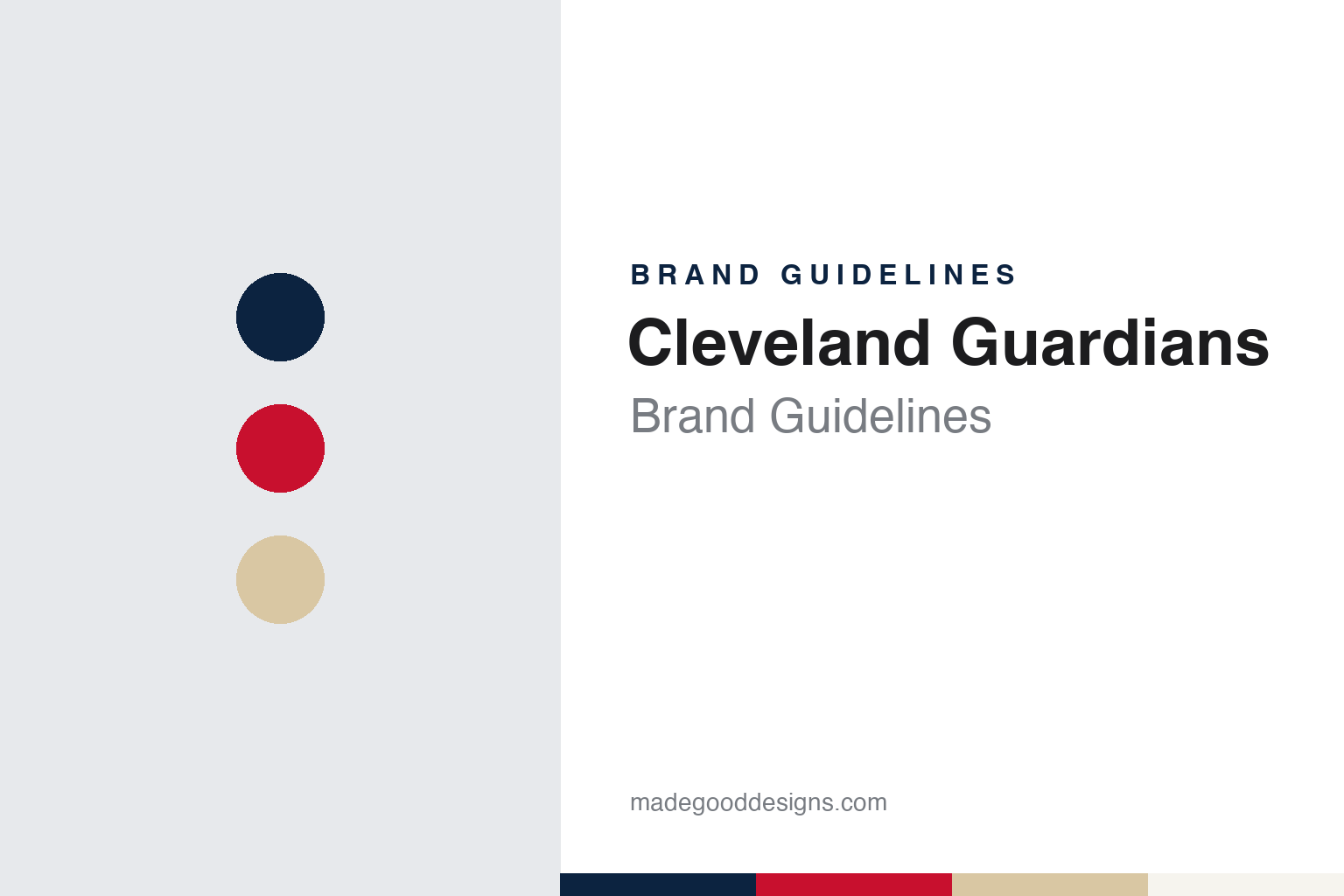
Cleveland Guardians Brand Guidelines
Eight stone figures on a bridge, a tall C and a G with wings.
Aa
Two constants: a Guardian navy, Cleveland red and bridge sandstone palette and a Diamond C and red script register. Abstract homage — not a Cleveland Guardians mark; no cap logo, winged G or wordmark is reproduced.
Six names, one city
Lake Shores, Blues, Naps and Indians, mostly chosen by the newspapers.
The club’s name has changed more often than its city. In an ownership history written for the Society for American Baseball Research and published in January 2017, David Bohmer writes that the American League franchise was moved to Cleveland from Grand Rapids in 1900, backed by the coal businessman Charles Somers and his partner Jack Kilfoyl. English Wikipedia says Cleveland was one of the eight charter members when the American League declared itself a major league in 1901, and that the club has stayed in its original city ever since.
Sportswriters, rather than owners, supplied most of the early names. Bohmer writes that the newspapers first called the team the Lake Shores, then the Bluebirds in 1901 for its blue uniforms, a name quickly shortened to the Blues. A change in 1902 brought a name Bohmer spells Broncos, and the writers then turned to the Naps, after the club’s star second baseman, Napoleon Lajoie. After Somers sold Lajoie, Bohmer writes, the writers came up with Indians. ESPN, reporting on 23 July 2021 with the Associated Press, gave the official sequence as Blues in 1901, Bronchos in 1902, Naps from 1903 to 1914 and Indians from 1915 to 2021, with Guardians as the fifth name.
The ballparks have changed with the owners. Bohmer writes that Somers rebuilt League Park in concrete and steel between the 1909 and 1910 seasons, replacing the wooden structure that had been built for the National League Spiders, and that later owners moved more and more games to Municipal Stadium. Wikipedia records that the club’s downtown ballpark opened in 1994 as Jacobs Field, named for its then owner, Richard Jacobs; Bohmer writes that the surname stayed attached until the naming rights expired in 2008, and the ballpark has since been Progressive Field.
The current ownership dates from the turn of the century. Bohmer writes that Jacobs agreed in 1999 to sell the club to Larry Dolan, a Cleveland-area lawyer, who took control before the 2000 season; his source is a report in The New York Times of 5 November 1999. The Dolan family has owned the club since 2000, and Wikipedia lists Paul Dolan as owner, chairman and chief executive. In June 2022 Cleveland.com reported that a group led by the investor David Blitzer had agreed to buy a minority stake in the club, with a path to majority ownership, after approval by Major League Baseball’s owners on 16 June.
Colour
From a block C to a name taken from a bridge.
The change came in steps. English Wikipedia records that Major League Baseball announced on 29 January 2018 that the Chief Wahoo logo, used in various forms since 1949, would be removed from the club’s uniforms for the 2019 season, and that the block “C” was promoted to primary logo for the final three seasons under the old name. On 18 December 2020, Wikipedia says, the club announced that the Indians name would be dropped after the 2021 season.
The new name was revealed on 23 July 2021. ESPN reported that the club announced it on Twitter in a video narrated by the actor Tom Hanks, and Cleveland.com added that the music came from The Black Keys, a band from the Akron area, and that a press conference followed that afternoon at Progressive Field. In a statement quoted by both outlets, Paul Dolan said the club wanted a name that represented “the pride, resiliency and loyalty of Clevelanders,” and that Guardians drew on the Guardians of Traffic just outside the ballpark on the Hope Memorial Bridge. Wikipedia describes those as eight large Art Deco statues on the bridge.
The club also described how it got there. Cleveland.com reported that, according to Dolan, two themes came through in surveys and focus groups with fans: the name Guardians was well received, and fans wanted to keep the club’s colours of red, white and blue. Brian Barren, the club’s president of business operations, said the research had identified three priorities, which were to connect to the city of Cleveland, to honour the club’s baseball history and to unite the community, and that the club believed the new name met all three.
The switch took the rest of the year. The team finished the 2021 season as the Indians. Wikipedia records that a roller derby team that had used the name Cleveland Guardians since 2016 filed a lawsuit over the name on 27 October 2021, that the two sides settled on 16 November with both allowed to keep it, and that the baseball club’s name change became official three days later, on 19 November 2021. Cleveland.com reported that after the season the club would begin the physical changes at Progressive Field and at its spring-training home in Goodyear, Arizona.
Typography
Design and documentation.
Professional clubs carry names that can outlast the cities, owners and ballparks attached to them. When a club changes its name, the new identity usually arrives as a complete set rather than a single swap: a wordmark, a cap or helmet insignia, a primary logo, home and road uniforms and a colour palette, all launched together so that signage, merchandise and broadcast graphics can switch on the same date. Leagues often supply design support, and clubs commonly test options with supporters before an announcement.
Relocation works differently. A club that moves may keep its nickname, colours and lettering while the city name on the road jersey changes, so the visual system becomes the thread that links one home to the next. Some clubs play for a period in an interim home, such as a smaller ballpark or a shared stadium, before a permanent building is ready, and their identity then has to read clearly in surroundings designed for another team.
Many clubs also keep a single element through every change: a script wordmark, a letter monogram or an animal mascot. Such elements are often redrawn rather than replaced, with thicker strokes, revised serifs or a simplified outline, so that supporters can recognise them on a cap, a sleeve patch or a scoreboard across several decades.
Cc
A tall, condensed sans — the register of a navy Diamond C on a red cap. (Specimen set in Oswald, a sans STAND-IN; NOT the Cleveland Guardians logo, script or Diamond C.)
Cleveland Guardians
A tall C, a winged G and a sandstone City Connect.
The new marks were presented as continuity rather than a clean break. Cleveland.com reported in July 2021 that the team colours would stay the same, that the script on the uniforms would be similar to the style the club had used for the previous 75 years, and that the road uniforms would still read “Cleveland,” with the Guardians script on the home set. The cap mark, the “Diamond C,” was described by the club as an evolution of the block C: a letter that “stands tall,” drawn from the ascending diamond motifs at the top of each Guardian pylon, with a bold weight and a tapered shape the club said was inspired by letterforms used by its 1920 and 1948 teams.
The second new mark, which the club called the “Guardian’s Fastball,” is a winged “G” that wraps around a baseball. The club said it was inspired by the helmets and wings of the statues on the bridge, and that the split-finger grip is a tribute to the club’s pitching history. Wikipedia describes how the set is worn today. The official colours are navy blue, red and white. The white home jersey carries “Guardians” in a red script outlined in navy; a red alternate spells the name in navy Diamond C lettering trimmed in white. The grey road jersey reads “Cleveland” in navy Diamond C letters trimmed in red, and a navy road alternate uses red letters. The home cap is red with a navy bill and a navy Diamond C, the road and alternate cap navy with a red bill, and the batting helmet navy with a red Diamond C. The winged G sits on one sleeve of every regular jersey.
A further layer arrived in 2024. Wikipedia says that year’s City Connect uniform is blue, with red and white stripes down the sleeve, “CLE” across the chest and names and numbers in a white Art Deco lettering, worn with sandstone-coloured trousers and red socks; its logo shows one of the Guardians of Traffic holding a baseball bat.
For a design guide, Cleveland Guardians shows how a club can change its name while keeping the colours, the script style and the city name on the road jersey, and take its new imagery from a landmark a short walk from the ballpark. Compare the city’s football club in our Cleveland Browns guide, its basketball club in the Cleveland Cavaliers guide, and the league-wide marks in the MLB guide. For this guide we use Guardian navy, Cleveland red and bridge sandstone with a condensed sans, an unofficial interpretation; no product or logo is reproduced.
Explore & save
Keep Cleveland Guardians’s identity on hand — save it to a board in the Made Good inspiration library.
Cleveland Guardians identity set
Pin the Cleveland Guardians navy, red and bridge sandstone palette and the Diamond C and red script register to your own board.