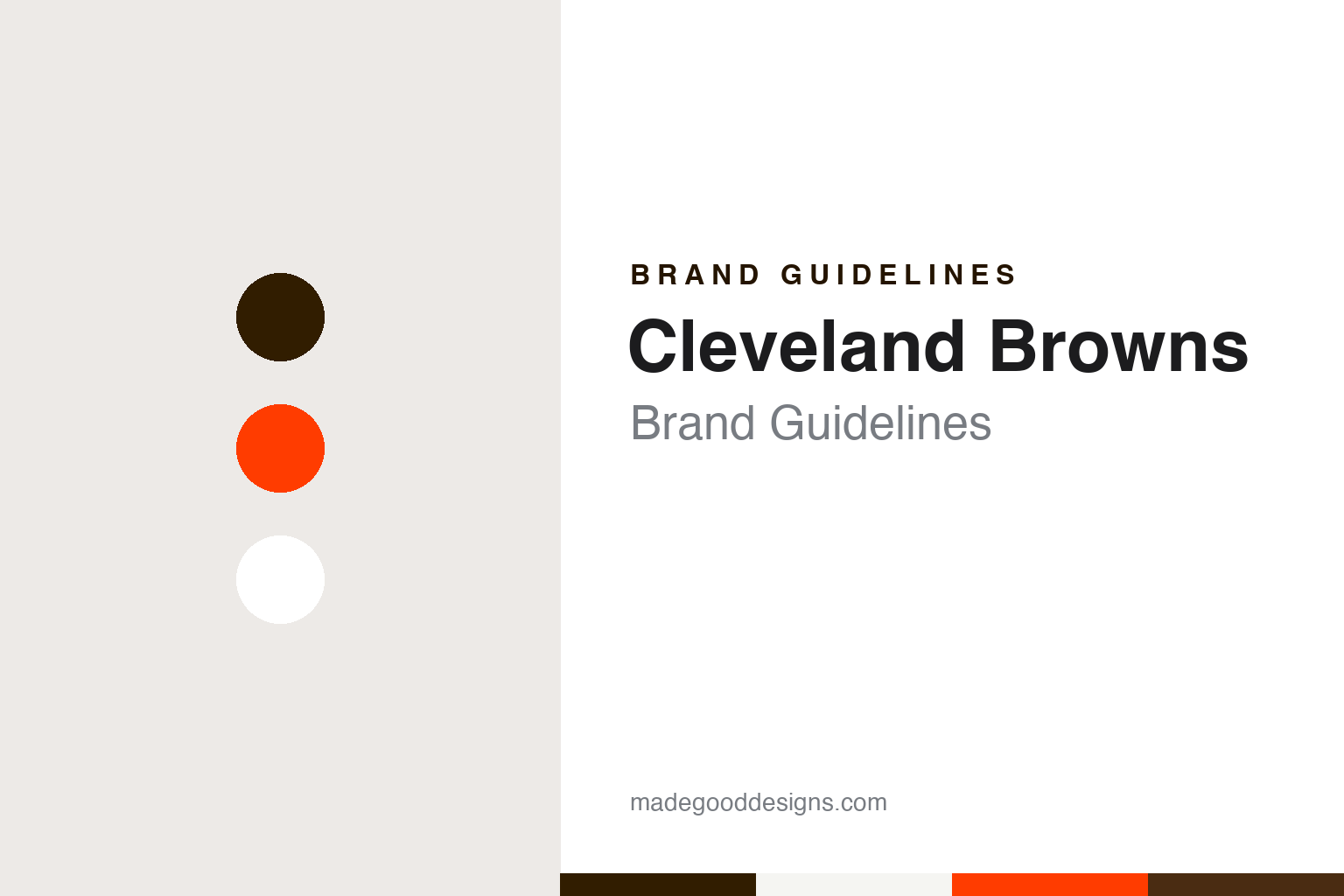
Cleveland Browns Brand Guidelines
A coach’s surname, a helmet with nothing on it, and an elf that keeps coming back.
Aa
Two constants: a seal brown, helmet orange and white palette and a narrow block sans register. Abstract homage — not a Cleveland Browns product or mark; no helmet, uniform or logo is reproduced.
Named for the coach
A taxicab owner, a coach and a fan contest that nearly produced the Panthers.
The Cleveland Browns are named after a person. English Wikipedia says the franchise was founded in 1944 by the coach Paul Brown and the taxicab businessman Arthur B. “Mickey” McBride, who secured a Cleveland franchise in the newly formed All-America Football Conference, and that the team began play in 1946. When the AAFC folded after the 1949 season, the Browns moved into the National Football League.
The name came from the public, and the coach was not keen. In ESPN’s NFL Nation guide to the origins of every league team name, published on 2 February 2022, the Browns reporter Jake Trotter wrote that the franchise held a fan contest in 1945 to choose its nickname and that “Browns”, in honour of Paul Brown, was the winning submission. Brown initially vetoed it, Trotter wrote, and the team was going to pick “Panthers” from the contest instead, until a local businessman said he owned the rights to the Cleveland Panthers name; Brown then relented.
The colours have stayed close to the original idea. Wikipedia says the official club colours are brown, orange and white, and that the dark brown on the helmet stripe is officially called “seal brown”. The helmet itself took a few seasons to settle. Wikipedia’s chronology runs from solid white helmets between 1946 and 1949, to white for day games and orange for night games in 1950 and 1951, to orange with a single white stripe from 1952, brown numerals on the sides from 1957 to 1960, and from 1961 the orange shell with a brown-white-brown stripe that the team still wears.
That helmet carries no logo. Wikipedia says the logoless helmet serves as the Browns’ official logo, that a “CB” mark was created in 1965 and never used, and that the organisation has instead relied on promotional marks, among them the elf mascot, a brown “B” in a white football and, more recently, a dog.
Colour
McBride to Modell, a three-year pause, and the Lerners to the Haslams.
McBride and his partners sold the club to a group of Cleveland businessmen in 1953, Wikipedia says, and Art Modell bought the Browns in 1961. In 1995 Modell announced plans to move the team to Baltimore. After the city of Cleveland and fans threatened legal action, Wikipedia says, a compromise reached in early 1996 let Modell establish the Baltimore Ravens as a new franchise while keeping the contracts of the Browns’ personnel. The Browns’ name, logos, training facility and history were held in trust, and the league treated the franchise as suspended, guaranteed to return no later than 1999.
The team came back on schedule. Wikipedia says the Browns resumed play in 1999 under the new owner Al Lerner, after three seasons in which the old Cleveland Stadium was demolished and a new stadium built on its site, the ground now called Huntington Bank Field. The club is not counted as an expansion franchise, Wikipedia notes, even though its 1999 roster was restocked through an expansion draft. The Lerner family kept the team until 2012; Wikipedia says the initials “AL”, added to the uniform in Al Lerner’s honour, were removed in 2013 when the new owner took over.
That owner is Jimmy Haslam. ESPN reported from Chicago on 16 October 2012 that NFL owners had unanimously approved the sale of the Cleveland Browns to Jimmy Haslam III, who had bought the team from Randy Lerner. ESPN said Haslam had built his fortune with the Pilot Flying J truck stop chain, had held a minority stake in the Pittsburgh Steelers and sold it to buy the Browns, and had agreed the deal with Lerner in August of that year. Haslam has owned the club since 2012. The team’s administrative offices and training facilities are in Berea, Ohio, Wikipedia says.
The uniform has changed little around the helmet. Wikipedia says the club redesigned everything except the helmet for 1984, but the set proved unpopular and the team returned to a look close to the original in 1985. Orange trousers with a brown-white-brown stripe, worn from 1975 to 1983, became associated with the “Kardiac Kids” teams of that era.
Typography
Design and documentation.
A professional football identity is built from a small set of parts that have to work together at very different sizes. The helmet decal is a compressed version of the identity: a mark that sits on a curved shell, is seen from the side at a distance and has to read in a single colour against a painted surface. Many clubs keep the helmet mark separate from the primary logo used on print and screens, and the two are often redrawn on different schedules.
Colour names are part of the system. Clubs and their uniform suppliers give their tones proper names, and those names travel from style guides onto merchandise labels and broadcast graphics, which helps keep a shade consistent across fabric, paint and pixels.
Throwback uniforms let a club revisit an earlier set without retiring the current one, so an older wordmark, numeral style or helmet colour can return for a single season or a few games. Stadium naming adds another layer: when naming rights change, the building’s signage, tickets and wayfinding are rebranded while the team’s own marks stay the same.
Aa
A narrow block sans — the register of a trouser stripe wordmark and a stadium banner. (Specimen set in Archivo Narrow, a sans-serif STAND-IN; NOT the Cleveland Browns logo or wordmark.)
An elf, a helmet and a dog
Brownie from folklore, Modell’s retreat, and a fan-voted mastiff.
The Browns’ elf mascot is older than the team. Writing in Cleveland Scene on 18 November 2009, in a reprint of a piece he originally wrote for Uni Watch in December 2006, Vince Grzegorek explained that “brownies” come from folklore, where they were elf-like creatures who helped with household chores, and that the illustrator Palmer Cox drew them regularly, including in advertising for Kodak. Grzegorek wrote that the elf’s link to the football team began in the late 1940s with the owner Arthur McBride, who wanted to make the team more recognisable and marketable and asked for submissions for a mascot logo before choosing Brownie. He added that the elf appeared in an advertisement for tickets to the club’s 1946 opening game against the Miami Seahawks, and that many early versions are credited to Dick Dugan, a sports cartoonist for The Plain Dealer.
Brownie was redrawn around 1950, Grzegorek wrote, and that version ran until 1969, alongside an orange elf and, from 1960, a halfback elf. Then the owner changed. Grzegorek wrote that Art Modell, owner from 1961, began phasing the elf out in the mid-1960s; Wikipedia says Modell thought it too childish. When the team returned in 1999, the elf came back too. Grzegorek quoted the owner Randy Lerner: “I think it’s a great anchor for our tradition and for the look and feel of the Browns.”
Later updates kept the helmet at the centre. Wikipedia says the current logos and wordmarks were introduced on 24 February 2015, with minor changes to the helmet: a new shade of orange and a facemask switched from grey to brown. A secondary “dawg” logo, a bull mastiff created by the graphic designer Houston Mark, won a fan vote and was introduced in 2023, Wikipedia says, with small references to Cleveland, Ohio and the team’s history built into it. A version of the Brownie elf, chosen in a fan poll, was painted at midfield from 2022 to 2024, before the team went back to the helmet for 2025.
For a design guide, the Cleveland Browns show how an organisation can treat a plain coloured shell as its primary mark, and how a folklore mascot can be dropped and revived by successive owners. Compare it with Baltimore Ravens, the franchise Art Modell set up in 1996 while the Browns’ name and history stayed in Cleveland, and Pittsburgh Steelers, the club in which Haslam held a minority stake before 2012. For this guide we use seal brown, helmet orange and white with a narrow sans, an unofficial interpretation; no product or logo is reproduced.
Explore & save
Keep Cleveland Browns’s identity on hand — save it to a board in the Made Good inspiration library.
Cleveland Browns identity set
Pin the Cleveland Browns seal brown, helmet orange and white palette and the narrow block sans register to your own board.