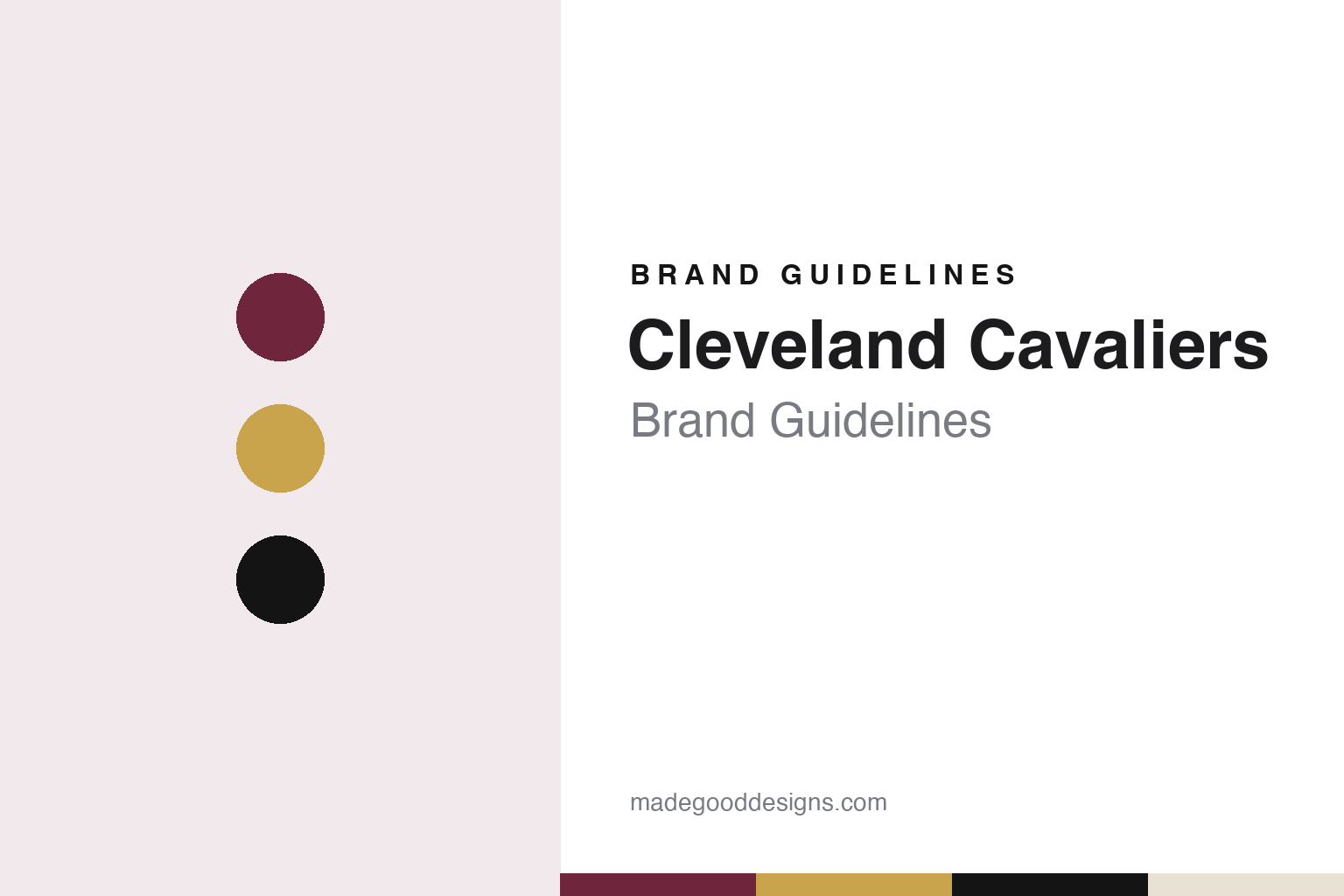
Cleveland Cavaliers Brand Guidelines
A swashbuckler’s name, a wine and gold palette and a sword that came and went.
Aa
Two constants: a cavalier wine, metallic gold and statement black palette and a crested capital serif register. Abstract homage — not a Cleveland Cavaliers mark; no logo, jersey or wordmark is reproduced.
All for one
A reader’s entry, a swashbuckler and a wine and gold uniform.
The Cleveland Cavaliers entered the National Basketball Association in 1970 as one of three expansion clubs, alongside the Buffalo Braves and the Portland Trail Blazers. The Encyclopedia of Cleveland History, published by Case Western Reserve University, says the team was organised by the Cleveland sports owner Nick Mileti, and English Wikipedia lists him as the original owner. The Cavaliers played their first home games at the old Cleveland Arena, moved in 1974 to the Richfield Coliseum, which the encyclopedia says Mileti built in Richfield, and returned downtown in 1994 to the arena now called Rocket Arena.
The name came from the public. According to Wikipedia’s history of the franchise, a competition sponsored by the Cleveland newspaper The Plain Dealer produced the winning entry, “Cavaliers,” submitted by a reader named Jerry Tomko. Wikipedia says supporters preferred it to the other finalists, “Jays,” “Foresters” and “Presidents.” The word set the tone for everything that followed: a cavalier is a swordsman, and swords, shields and a swashbuckling spirit have run through the club’s marks ever since.
The first identity leaned into that image. Wikipedia describes the original logo as a swashbuckling cavalier facing right with a sword pointing out, surrounded by the team name and a basketball. The colours were wine and gold, and the first jerseys carried a feathered treatment of the letter “C” in “Cavaliers.” In 1974 the club changed to block lettering with a checkerboard pattern, and in 1980 the gold shifted from a yellowish shade to a metallic one. Wikipedia says that 1980 set placed stripes above the word “Cleveland” and below the number, with the city name on both home and road jerseys.
Ownership moved quickly in the early 1980s. Wikipedia says the Nationwide Advertising owner Ted Stepien bought the team on 12 April 1980. During his tenure, according to Wikipedia, he floated renaming the club the “Ohio Cavaliers” to play games around the state, introduced a polka-flavoured fight song and a dance team called “The Teddy Bears,” and later threatened to move the franchise to Toronto as the “Toronto Towers,” going as far as having a logo drawn. The brothers George and Gordon Gund bought the Cavaliers in 1983 and kept them in Cleveland.
The Gunds changed the look almost at once. Wikipedia says they replaced wine and gold with burnt orange, blue and white and officially adopted “Cavs” as a short name for marketing, a word fans and headline writers had used since the start. The new logo spelled “Cavaliers” with the “V” drawn as a hoop and a circle above it as a ball.
Colour
Orange and blue, a splash of black, then wine and gold again.
The orange and blue period lasted two decades in several forms. Wikipedia says the first uniforms of the 1983–84 season carried the hoop-and-ball Cavaliers logo in an arch, with orange as the main colour on both home and road sets. From 1987–88 orange became a secondary colour and blue took over as the primary, and in 1989–90 the city name appeared on the blue road uniforms.
The move to the new downtown arena in 1994–95 brought another change. Wikipedia says the club added black to blue, orange and white, and the uniforms carried a blue “splash” graphic across the front, with “CAVS” on the home jersey and “CLEVELAND” on the road set. In 1999–2000 the splash was removed for a cleaner design with an orange and blue line on the shorts, and the logo became a basketball dropping through a net inside a black square, with “CAVS” beneath it.
The 2003–04 season marked a return to the start. Wikipedia’s history of the franchise says the name on the jerseys went from “Cavs” back to “Cavaliers” and the colours from orange, black and blue back to wine and gold, with navy blue added. The new primary logo showed a gold sword piercing the words “Cleveland Cavaliers,” with a wine basketball behind it, and a navy alternate jersey with checkerboard trim paid tribute to the 1970s uniforms.
In 2010–11 the club went back further. Wikipedia says new uniforms returned to the original shades of wine and gold used from 1970 to 1983: a white home jersey with “CAVALIERS” in wine block letters, a wine road jersey with “Cleveland” in gold and, from 2012–13, a gold alternate reading “CAVS.” Every set carried the motto “All for one. One for all.” inside the collar and a “Sword C” on the shorts.
The 2017 update made the sword theme explicit. Writing for NBC Sports on 31 May 2017, Dan Feldman reported that the Cavaliers were adding new logos and wordmarks, and quoted the team’s descriptions at length. The team said the C-Sword, introduced in 2003, kept its form but lost a white accent in the hilt and gained a consistent gold outline; that a stand-alone “C,” already used at centre court, joined the logo set; and that a new shield logo stood for the club’s commitment to “Defend the Land.” The team also said the sharp edges of the new “Cleveland Cavaliers” and “CAVS” wordmarks were inspired by a defender and the motion of a sword. Wikipedia adds that black was included in the 2017–18 logos.
The mascots follow the same mix of local history and swordplay. Wikipedia says Moondog, who first appeared on 5 November 2003, was inspired by the Cleveland radio DJ Alan Freed, who called himself “Moondog,” and that Sir C.C., a swashbuckler character, made his debut on 27 November 2010. An earlier polar bear mascot, Whammer, was introduced in 1995.
Typography
Design and documentation.
A team name is often the first piece of a basketball identity to be settled, and some clubs hand that choice to the public. A name-the-team contest or regional vote gives residents a sense of ownership before a game is played, and the shortlist usually leans on local wildlife, weather, landscape or industry so the name can be drawn as well as spoken. Once chosen, the name sets the direction for everything that follows: the animal or symbol in the primary logo, the colours and the tone of the wordmark.
Rebrands tend to arrive in cycles. A club may simplify an older, more illustrated mark into a flatter emblem that reproduces cleanly on screens, shorts and court paint, then add alternate logos, monograms and secondary badges that can stand in where space is tight. Arena names add another layer, because naming rights change hands over the years and the building’s signage, centre-court graphics and ticketing all have to follow. Colours and typefaces often stay steadier than either, carrying the identity from one logo and one arena name to the next.
Aa
A crested capital serif — the register of a fencing-club sign and a swordsman’s motto. (Specimen set in Cinzel, a capital serif STAND-IN; NOT the Cleveland Cavaliers logo or wordmark.)
Cleveland Cavaliers
Refine: metallic gold, no navy and a V that is also a hoop.
The businessman Dan Gilbert has owned the Cavaliers since March 2005. Wikipedia says the sale was announced on 3 January 2005 and completed on 1 March that year. Under his ownership the club moved through the 2010 return to wine and gold and the 2017 sword and shield set, and in 2017, when Nike became the league’s uniform supplier, Wikipedia says the Cavaliers wore a wine “Icon” jersey with “Cleveland” across the front and a white “Association” jersey reading “Cavs,” along with a small Goodyear “Wingfoot” patch under a sponsorship deal.
The current identity arrived for the 2022–23 season. According to Wikipedia, the club removed navy blue, went back to the metallic gold first used from 1980 to 1983 and again from 2003 to 2010, retired the C-sword alternate logo, and introduced an updated “V-net” logo that merges the styles of the 1983–1994 and 1994–2003 marks with the current typeface. That leaves wine, metallic gold and black as the working palette. Kurt Helin, writing for NBC Sports on 19 July 2022, reported that the Cavaliers’ creative director, the artist Daniel Arsham, oversaw the design of the new Nike collection: a white Association uniform, a wine Icon uniform and a black Statement uniform. Wikipedia says the white set carries the V-net logo across the chest, the wine set reads “Cleveland” in gold, and the black set shows the “Cavs C” in wine outlined in gold.
The City Edition uniforms have turned Cleveland itself into a design brief. Wikipedia lists a grey 2017–18 set reading “The Land,” a city nickname; an orange and blue 2018–19 design with a zigzag pattern; a 2020–21 black set made with the Rock and Roll Hall of Fame in which each letter of “CLEVELAND” was drawn in a different typeface, with letters standing for inducted acts such as David Bowie and The Beatles; a 2022–23 set in tan and light blue for the Cleveland Metroparks; a 2023–24 wine set with theatre-marquee lettering for Playhouse Square; a light blue 2024–25 design with sketches drawn from the Cleveland Museum of Art; and, for 2025–26, an orange version of the Metroparks set inspired by Cleveland sunsets and autumn leaves.
For a design guide, the Cleveland Cavaliers show how a name can keep returning a club to the same small kit of ideas, a sword, a shield, a C and the motto “All for one. One for all.,” while the colours swing between wine and gold and orange and blue. Compare the Cleveland Browns, the city’s football team, and the NBA, the league the Cavaliers joined in 1970. For this guide we use cavalier wine, metallic gold and statement black with a serif, an unofficial interpretation; no product or logo is reproduced.
Explore & save
Keep Cleveland Cavaliers’s identity on hand — save it to a board in the Made Good inspiration library.
Cleveland Cavaliers identity set
Pin the Cleveland Cavaliers wine, metallic gold and black palette and the crested capital serif register to your own board.

