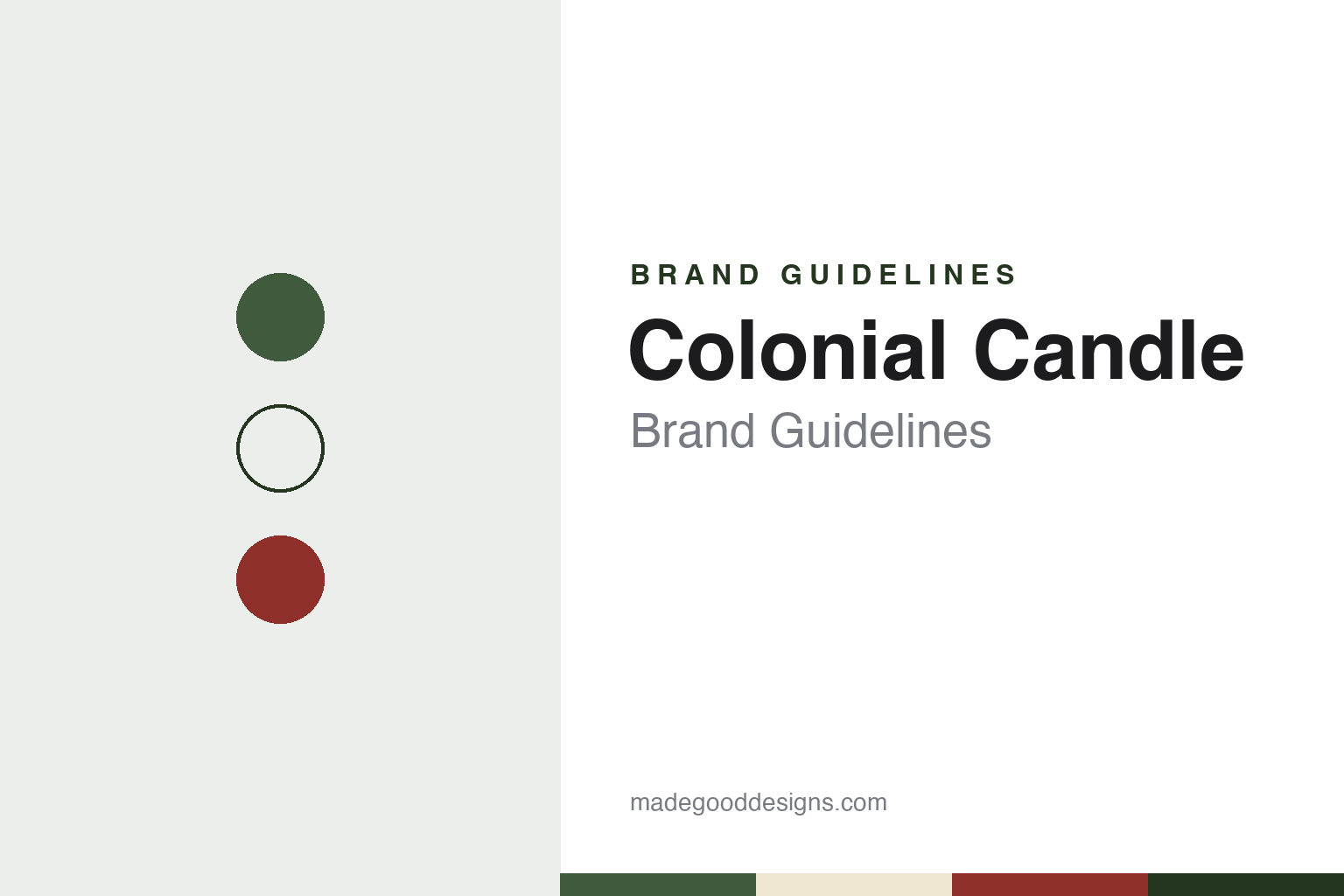
Colonial Candle Brand Guidelines
Mabel Baker’s bayberry tapers, from Cape Cod to Blyth and MVP.
Aa
Two constants: a bayberry green, taper cream and brick red palette and a heritage serif register. Abstract homage — not a Colonial Candle product or mark; no candle, jar or logo is reproduced.
Bayberries on Cape Cod
A teacher, a coastal shrub and a kitchen in Hyannis.
Colonial Candle traces its history to Hyannis, on Cape Cod in Massachusetts, and to a schoolteacher named Mabel Kimball Baker. In the company’s account, Baker taught home economics at the Hyannis Massachusetts Training School and had grown up hearing stories of the Pilgrims making candles from native bayberries. Around 1905 she began gathering berries from the bushes along the coast on her walk home and, with practice, making hand-dipped tapers in her small kitchen, which she gave to family and friends at Christmas.
The company dates its founding, as the Colonial Candle Company of Cape Cod, to 1909, when the gifts had turned into a business. It says that in 1910 a large Boston store bought an entire year’s supply of tapers, taking the candles to the city, and that Baker went on to sell through shops on Cape Cod and then across the country. The name, the company says, was inspired by Hyannis and its colonial past. These early details come from the company’s own history pages.
The bayberry taper is still the brand’s founding product. Colonial Candle calls it “the candle that started it all” and says it is still available more than a century later, and the company has built its present-day story around Baker: its website says the brand “honors Mabel Baker for her remarkable achievements,” and its ranges include M. Baker Candles, an M. Baker Apothecary line and a 1909 Collection.
Colour
The Blyth years.
For two decades Colonial was part of a much larger candle group. In 1990 Blyth Industries of Greenwich, Connecticut, bought “former rival” Colonial Candle of Cape Cod from General Housewares Corp., according to the International Directory of Company Histories (1997). The directory says Colonial gave Blyth a deeper reach into department stores, and that the purchase included Colonial’s direct-selling unit, PartyLite Gifts.
Under Blyth, the directory reported, candle and home-fragrance sales were grouped under a subsidiary called Candle Corporation of America, whose brand names included Colonial Candle of Cape Cod and Mrs. Baker’s Original Recipe. PartyLite’s independent representatives hosted “PartyLite Shows” to sell Colonial Candle of Cape Cod candles and accessories in people’s homes. Blyth described its spread of brands as “good, better, best,” the directory said, with Colonial at the high end, the Carolina brand in the middle and Old Harbor at the lower end. In 1996 Blyth agreed a marketing and distribution partnership with Hallmark Cards under which it would buy Hallmark’s candle-making facilities and replace Hallmark’s Canterbury candles with its Colonial and Mrs. Baker brands in Hallmark Gold Crown stores. Blyth’s chief executive Robert Goergen, who had taken over a small candle maker in 1977 and built the group by acquisition, summed up the appeal of the business to Forbes in 1996: “We are in the razor business, except our razor blades burn.”
Colonial later sat within Blyth’s Midwest-CBK gift and home-decor business. English Wikipedia records that Midwest-CBK was sold to MVP Group International in 2011, citing the trade paper Home Furnishings News. PartyLite stayed with Blyth; in 2015, Wikipedia says, Blyth sold its Silver Star Brands subsidiary, leaving it with PartyLite.
Typography
Candles and home fragrance.
The seven brands in this group are all candle and home-fragrance names: Capri Blue, Colonial Candle, Village Candle, Maison Berger Paris, Root Candles, Thymes and Bridgewater Candle Company. Candle and home-fragrance brands sit at many different points in the trade, from family workshops that still carry a founder’s name to labels that now belong to much larger consumer-goods groups, and a single brand can be sold everywhere from a small gift shop to a department store or its own website.
A candle brand’s identity is usually carried less by a single product than by a fragrance name, a jar, a label and the place it promises, because the company behind the name may have changed hands, moved its production or grown far beyond the town where it started. That makes the questions behind each name worth asking plainly: who started it, who owns it now, and where its candles and fragrances are actually made.
Each guide separates what independent sources record from what the company says about itself — its founding story, its owners over time, where its products are made and how its labels and packaging have changed — and marks plainly what rests only on the company’s own word.
Aa
A heritage serif for a brand that tells a 1909 founding story. (Specimen set in Cormorant Garamond, a serif STAND-IN; NOT the Colonial Candle logo.)
Colonial Candle
An oval jar, two wicks and a Charleston shop.
The new owner moved the brand south. In April 2014 the magazine Charleston Style & Design described MVP Group as a private-label candle maker that had been based in Charleston, South Carolina, for more than ten years, and said it bought Colonial in mid-2011, “making Charleston the new home for the brand.” The magazine reported that a Colonial Candle shop at Market and Meeting Streets had opened in October 2012, that it was the company’s only retail store, and that it doubled as a testing facility, with fragrance-testing rooms where new scents were tried on customers. A Charleston Collection there included scents named Yellow Jasmine and Rainbow Row, alongside a Paris collection; the magazine counted 45 core fragrances and 28 seasonal scents, and said a new fragrance, Tea Olive Bloom, inspired by a tea olive tree in the product manager’s mother’s front yard, was due that spring.
The same article pointed to the brand’s signature shape: Colonial candles, it said, are “easy to spot by their trademarked and patented oval-shaped jar and two wicks.” Colonial’s product manager, Amanda Lowe, told the magazine that the shape and wick placement help the candle burn evenly, and that the empty jars can be reused.
Today MVP Group International’s website lists Colonial Candle among its brands alongside Manly Indulgence, describing “more than 60 fragrances in our signature oval jars” and candles “proudly made in the USA.” Colonial’s own site says its bayberry Hand-dipt tapers are produced at its facility in Elkin, North Carolina. Its terms of use name Candle Corporation of America as the holder of the Colonial Candle and Colonial Candle of Cape Cod marks, and MVP Group International, Inc. as the holder of rights in the site’s content.
For a design guide, Colonial Candle shows how a founder’s story and a distinctive jar shape can carry a brand through several owners and a move from Massachusetts to the Carolinas. Compare Yankee Candle, another candle brand born in Massachusetts, and Village Candle. For this guide we use bayberry green, taper cream and brick red with a serif, an unofficial interpretation; no product or logo is reproduced.
Explore & save
Keep Colonial Candle’s identity on hand — save it to a board in the Made Good inspiration library.
Colonial Candle identity set
Pin the Colonial Candle bayberry green, taper cream and brick red palette and the heritage serif register to your own board.


